



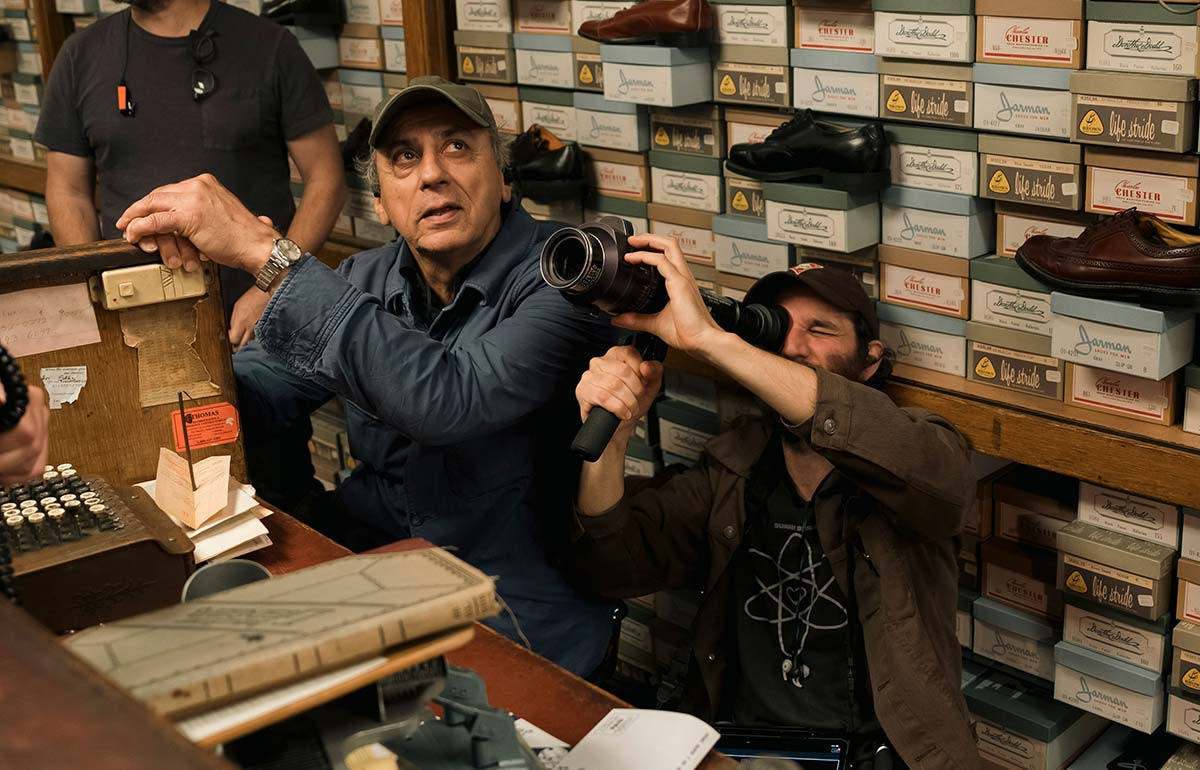
Few cinematographers working today have a resumé as varied, influential, and quietly adventurous as Darius Khondji. From the moody, rain-soaked, bleach-bypassed nihilism of “Se7en” to the operatic stylization of “Delicatessen,” from the tactile, nerve-wracking intimacy of “Uncut Gems” to the genre-bending worlds of “Mickey 17” and “Eddington,” Khondji has built a career defined less by signature than by expanding curiosity.
That spirit of discovery is front and center in “Marty Supreme,” his latest collaboration with Josh Safdie, which finds the veteran cinematographer revisiting the nervous, high-voltage energy of “Uncut Gems” while transporting it to a meticulously reconstructed New York City in 1952. The result is a film that feels simultaneously period-authentic and aggressively modern, a sports movie, a character study, and a kinetic, globetrotting urban odyssey all at once.
In the conversation below, Khondji discusses reuniting with Josh Safdie without Benny Safdie in the mix, the importance of creative “family,” using long lenses and classical framing to rethink sports cinematography, why the paintings of George Bellows were a key visual touchstone, and how Timothée Chalamet’s physical, electric performance shaped the way the film was lit and photographed. He also reflects on moving between radically different filmmakers in the same year and briefly revisits his formative collaboration with David Fincher on “Se7en.”
“Marty Supreme” expands to theaters nationwide on Christmas Day via A24.
This interview has been edited for length and clarity.
READ MORE: The 25 Best Films of 2025
Darius, not only am I a big fan of your work, but “Marty Supreme” is my number one film of the year. It’s truly remarkable. Congratulations on that, on “Eddington,” and on “Mickey 17.” What a wildly, wonderfully varied year you’ve had.
Yeah. Crazy, right? I realize this. I’m very lucky.
You’ve worked with Josh Safdie before on “Uncut Gems” and described that experience as career-changing, almost like a rewiring. What specifically about Josh and Benny’s way of working rewired you?
We did a small music video together [Jay-Z’s ‘Marcy Me], and we had the extreme pleasure of meeting and beginning to work together. I was very lucky that they offered me a movie after that. It was so chaotic. They were very funny because they promised me the film would never be like the music video, never that level of craziness in how we had to do it. Of course, it wasn’t exactly the same, but at the same time, the strong energy was there. The excitement, the joy of making a film. It was the same feeling, multiplied by ten on “Uncut Gems.”
And working with Josh and Benny on “Uncut Gems” was incredible. It was a very different energy. It was like children realizing a dream together, suddenly understanding that you can build a plane, or a boat, or a film together.
What is a film? It’s an incredible machine. You can fly in the air, you can travel through time or space. It felt like a new discovery for me. Even though I had worked with many amazing filmmakers before, I had never worked in this way. I didn’t know what to expect. Suddenly, I felt like I was standing in front of a completely new world.
So what’s it like working without Benny Safdie in the mix?
I love Benny. We’re friends. I really love him. However, they were each working on their own films, and I had to accept that. We had such a fantastic relationship together on “Uncut Gems,” so it was just like, “Okay, Benny is doing something else.” But “Marty Supreme” was not so different from working on “Uncut Gems,” in a way. Of course, I missed Benny. It was a new chapter. But the rest of the team was there. Ronnie Bronstein was there, Eli Bush was there, Anthony Katagas was there, and the producers were there. It felt like the same family.
Josh became the main energy, the strong point of view, especially on the character and the storytelling. It became a new experience, and it was fantastic. It was like “Uncut Gems,” and again multiplied by ten. Maybe by four hundred. It was an incredible endeavor, an incredible experience.
There’s definitely some “Uncut Gems” DNA in “Marty Supreme.”
Yeah.
Josh has talked about revisiting that brash beauty, but discovering it in 1952. What kind of conversations were you having about the visuals? How do you make an image feel both mid-century analog and hyper-modern?
One of the main elements, on top of having this group and Josh, was Miyako Bellizzi with the costumes, and Jack Fisk with production design. Jack arrived with another world of imagery that was incredible. It was like meeting a new friend and making this film together with Josh.
The 1952 period was something Josh wanted to make very exact. He wanted it to feel emotionally real. He couldn’t accept anything that wasn’t accurate to the time, especially visually.
At first, New York did not look like New York in 1952. But with Jack’s help and with location scouting, he made things possible. He added, replaced, hid, and rebuilt things. He created spaces where we could suddenly follow Marty for a long stretch, in the middle of the street, outside the tenement, and into another building. Little by little, it began to look like the period.
That was very exciting for me visually. At the same time, the soundtrack Josh gave me to listen to, the playlist, was completely different. It was music from the ’70s, the ’80s, and today. That was very exciting because, emotionally, the music brought something modern to the film. So Jack and I could be very scrupulous and precise with the visuals, the light, everything, making it look like the 1950s, while the emotional energy underneath was contemporary.
And amidst all of that, you’re also making a sports movie. It’s chaotic in an exciting way. What kind of goals did you and Josh have when it came to filming the ping-pong scenes in particular?
We decided to stay far away from the gimmicks you often see in sports movies. We didn’t want it to feel like a commercial. We tried to shoot it in a very classic way, but also an unclassic way, because we used very long lenses, super telephoto lenses, and long zooms.
We shot with multiple cameras, very frontal or sideways, framed almost like paintings. Classic paintings. I was thinking a lot about George Bellows, the realist painter. He has been with me my whole life, and sometimes he comes out. This was the moment he came out for me, because of his boxing paintings. In those paintings, you see the boxers lit from above, surrounded by darkness. I had those images in my mind.
When we tested with the ping-pong players, with Timothée, it felt almost like a dance. Like a boxing match. And when we started shooting, I decided to stay mostly with one key light, the old tungsten lights above the table, and let everything else fall into darkness. The actors would catch a little bounce of light on their faces, but that was it. Everything stayed subdued, except the players under those old tungsten lights. I loved that. We never shot for sensationalism. We followed the action almost like a documentary. That made it thrilling and very exciting for me, visually.
How much were you actually letting Timothée play freely in those scenes?
We wanted Timothée and the other players to play freely. He moved in and out of the light. He knew where the light was. He knew the tables were lit, and that if he stepped outside that pool of light, he would fall into darkness or silhouette. We loved that. I love when an actor can play with the light themselves.
His performance is explosive, intensely physical. How was he to work with as both an actor and a producer?
From the beginning, I had met him a few times with Josh before. But when he arrived to become Marty, immediately, from the first day, he was already the character. He was very electric, very passionate. He had this temperament that was not submissive to anything. He wanted to push to make it better. He was already inside the character. When we filmed him, we had to stay low-key around him because he was already so present. He was impressive, with a charisma that was immediately there. There was no time for anything else but the character. After the first day, the second day, we became completely connected with him. It felt like we were one person together, following this character. It was very exciting to experience that.
“Marty Supreme,” “Mickey 17,” and “Eddington” all came out in the same cycle, but they’re on entirely different stylistic planets. Do those films inform one another, or does moving between them stretch different muscles?
That’s a very interesting question. I’m rarely asked this. They are incredibly different filmmakers. Bong Joon-ho, Ari Aster, and Josh Safdie are entirely different. But what they share is genius and passion. When you work with a filmmaker like that, you have to work the way they want to work. Little by little, I observe, and I become part of their cinema. You cannot borrow something from one filmmaker and apply it to another. It wouldn’t make sense. They are always in a new space, a new world. They think differently. They film differently. But they all have that element of cinema you love.
With Bong, there is a different poetry. With Ari, there is a sense of being in the presence of a master. And with Josh, there is this incredible intuitive intelligence that creates a new cinematic world. It’s very exciting. But “Mickey 17” was shot almost three years ago. It just came out this year. That’s why they appear together.
I have to touch on “Se7en,” because it’s an all-time favorite of mine.
Please. Ask what you want.
It was before Fincher was known for his extreme precision, his 50 takes. How clear was it then that he was a different kind of filmmaker, and do you feel like you unlocked something in each other with that film?
I loved working with David Fincher. He was extraordinary. Coming from France, from “Delicatessen” and “City of Lost Children,” we discovered this new world and this new master, not knowing what we were unlocking. But I don’t know the David Fincher of today. I just know the David Fincher of “Se7en.” And he was extraordinary.
When you make a film, you are pursuing cinema. You don’t know what it will become. On “Se7en,” I was simply following David. He knew exactly what he wanted, very deeply. We didn’t realize what the film would become. We were just making it. That’s the art of filmmaking. You don’t really know before you make it.
You’ve knocked it out of the park many times.
I’m just very lucky with these films.
“Marty Supreme” has opened in limited release and expands to theaters nationwide on Christmas Day.
Mike DeAngelo is a film writer, podcaster, and entertainment journalist whose work has appeared in Variety, The Hollywood Reporter, IndieWire, and beyond. He is the host of The Playlist's podcasts The Discourse and Bingeworthy.

