




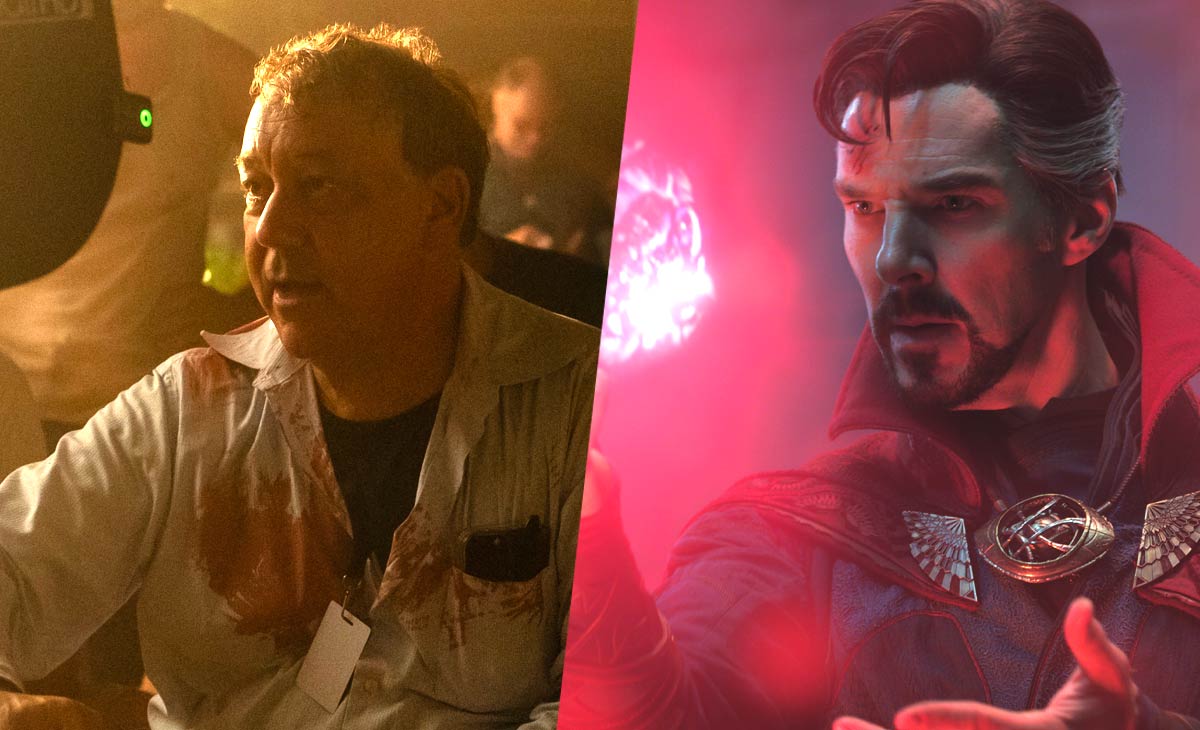
The multiverse is supposed to be infinite, but blockbuster filmmaking, particularly the Marvel Cinematic Universe, has its own version of reshaping infinity. Sometimes it’s through test screenings, Kevin Feige’s instincts, and other option-generating that erases ideas so completely they only survive in the way a director talks about an actor’s work.
Take Sam Raimi’s “Doctor Strange In The Multiverse Of Madness.” The finished film’s reality-hopping is largely anchored in three primary stops: the MCU’s Earth-616; Earth-838, home of the Illuminati; and the incursion-battered universe where Strange confronts a Darkhold-corrupted variant commonly referred to as “Sinister Strange.”
But there apparently was a fourth…
That revelation surfaced during a Sam Raimi interview with The Playlist for his latest comedy horror, “Send Help,” (read our review, it’s terrific), where the filmmaker’s admiration for his lead, Rachel McAdams, and her precision, led him to tell an unprompted story about the missing levels of ‘Multiverse Of Madness.’
I asked Raimi, presumably working with McAdams on ‘Madness’ and three different subtle variations of the one character she plays, to cast her as the lead of “Send Help,” and he enthusiastically concurred.
READ MORE: ‘Send Help’ Review: Sam Raimi’s Bonkers Survival Horror Comedy Is Deliriously Demented
“That’s exactly what happened,” he explained. “I learned who she was and what she was capable of. Rachel had created the character from the first ‘Doctor Strange’ movie, and she did a great job. She knew who she was, and in ‘Doctor Strange 2,’ which I got a chance to direct, the story by Michael Waldron, introduces the multiverse.”
For Raimi, the multiverse didn’t just create new plot routes; it created an actor’s challenge: play variations that register as fundamental shifts in history and psychology, not cosplay. “In the multiverse, she not only played the character she created in ‘Doctor Strange,’ but she also played three versions in the multiverse that had a slightly different background,” he explained. “And I saw her manifest the same character with subliminal tweaks, and that would be the result of those background changes. And I thought, she’s fascinating. It’s like a musical instrument—watching it play.”
Then Raimi described what sounds like an additional universe built during the Marvel reshoot process, requiring yet another calibration—work that didn’t survive the final assembly. “And then reshoote-shoot that we do for Marvel sometimes, Michael Walton created [another] universe,” he continued. “So now she had a different backstory. I saw her take those notes from the script and recreate the character yet another time with a proper re-tunement based on that background and how it would be reflected in the modern moment. And then I thought, ‘Holy smokes, nobody knows what she’s doing, but me,’ and it’s incredibly layered and complex,”
Raimi even framed his awareness of her layering as something the audience may never fully clock precisely because one version disappeared. “Maybe I’m only aware of it because one of her performances, one of the worlds, got cut out,” he revealed in the telling of his long anecdote about ‘Multiverse of Madness’ and how good McAdams was in it.
Raimi even detailed a fight scene in one of those sections of the film that was left on the cutting room floor, and why McAdams’ professionalism impressed him so much.
“In the reshoot, I added a little bit of cheesy fights, which I like to do,” he laughed. “So, I had to say to her on set, ‘This is where the demons from the netherworld have come out. And they punch you in the jaw.’ And I’m thinking, she’s thinking, ‘That sounds lame.’ I say, ‘And then I see you fall back into this chaise lounge. And then a demon jumps upon you. And you catch it with your legs like a flying trapeze for a moment. And you launch it off!’
What impressed Raimi wasn’t that she could “do comedy” or “do drama” on cue. It was that she didn’t condescend to any of it, even when he openly described his own direction as “lame.”
“And I’m waiting for her to say [something eyerolling],” he continued. “This nuanced actor just played this beautiful violin concert for me. And in three different keys, she played it in C in one range. And then she jumped an octave and played the perfect C in the next octave. And then she somehow got to that third C in a perfect reverberating harmony. But then she took this lame direction, and she looked at me for a moment and said, ‘What angle do you want me to approach the couch and at what speed after the ghost hits me?’”
Raimi said her ability to treat this “heightened” silliness so seriously and so professionally was a delight.
“It’s like, ‘Oh man, she’s so willing not to think ‘That’s silly,’ but instead, ‘How can I make this great?’ She’s a pro. She took the material and made it sing. And I thought, ‘She’s not saying it’s lame. She’s going to make it great.’”
“And it is a little lame,” he continued. “But her attitude was ‘Make it real and great.’ She made an exciting little action scene out of it that was really as believable as you can when you’re fighting ghosts and demons, which is my hobby, by the way [laughs]. When I saw her do that, I thought, ‘I need to work with this actress again.’ She brings so much to creating character, driving the story and the plot, so aware of the audience’s intelligence and playing up to it.”
If Raimi’s comments suggest anything beyond a tantalizing hint of a lost universe, it’s this: the most impressive work in franchise filmmaking often happens in the margins—micro-decisions, tiny shifts in intention and physicality—sometimes for sequences and even realities that will never be seen. And in Raimi’s telling, McAdams was doing that work anyway, re-tuning the character each time the film changed keys, whether the audience would ever know it or not.
What that universe is precisely, and what purpose it served in the movie, is unclear—we were here to briefly talk about “Send Help,” and this long tangent was protracted enough. But whatever the case may be, ‘Multiverse Of Madness’ led to the deliciously entertaining “Send Help,” and hopefully just the second of more Raimi and McAdams collaborations to come.