


The Venues that came and went
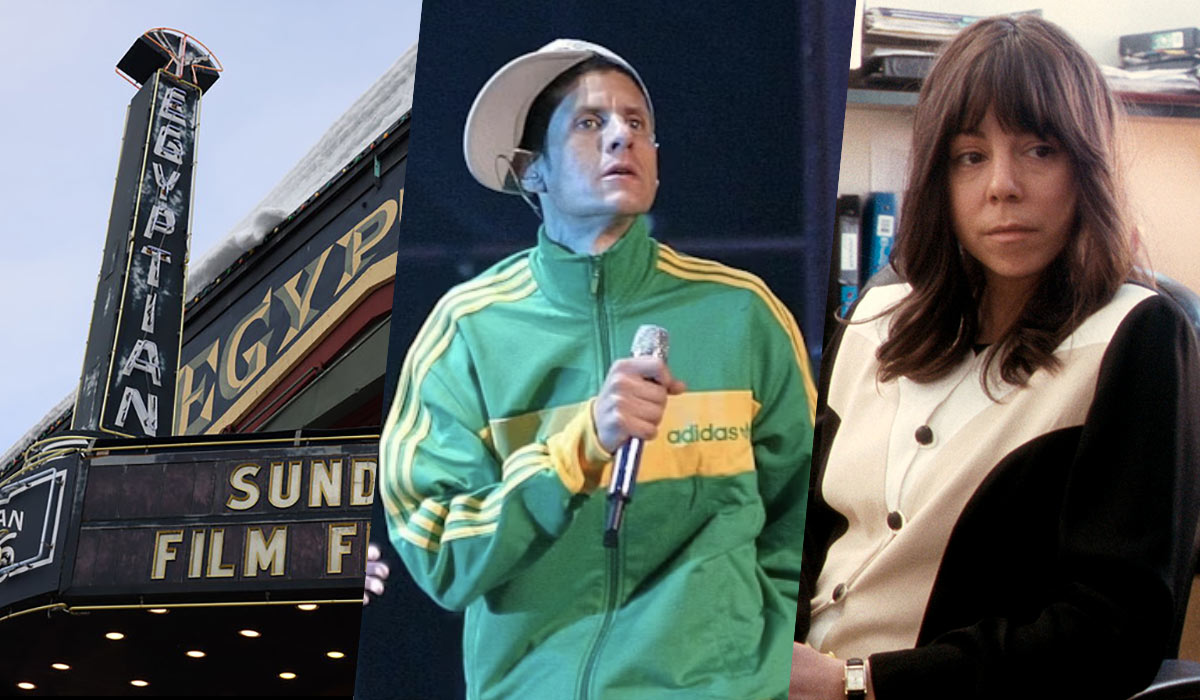
The Yarrow Theater was a mainstay that only recently returned to the fold. Prospector Square and the beautiful Temple Theater were documentary hubs (the latter should have found a way to survive; it was superb). The Raquet Club was always an annoying bus ride with the coldest wait of them all, but so many great films premiered there. It wasn’t a great sign if a movie was debuting at the Egyptian Theater, but it was a classy, old-school venue. Sorta sad it won’t be screening anything in the festival’s final go-around.
Roger Ebert on the town bus
The festival tried to get him to take a private car for years, but Roger Ebert insisted on using Park City’s local transportation. He was a mainstay even after he initially battled cancer and lost his lower jaw. With “stars” and promotional partners increasingly being transported by black SUVs and private cars, it was a reminder of how Sundance was still the “people’s” festival and not about all that bling (except when it was).
The hardest guest list ever – Harry O’s
During Sundance, you would have thought Harry O’s was the North American equivalent of Berghain. You could be on the guest list and still not get in. It was so difficult and annoying that we stopped trying, no matter what publicists told us. Flying in some of the biggest rock and Hip-Hop stars at the time just to play during the festival caused a frenzy. Especially with those crashing the fest. But, we do have a memory of going into Harry O’s basement in 2006? 2007? And a house music DJ was killing it. The space was crazy small, but on a table potentially used to prep meals, we turned to realize the one and only Paul Oakenfold was literally an arm’s length spinning away. And we partied to an intimate set from, at the time, one of the biggest DJs in the world.
The “Precious” moment
Here’s the thing. No one wanted to see Lee Daniels’ “Precious,” then known as “Push.” There were three, maybe four critics at the world premiere. I was one of them. Everyone else went to see Antoine Fuqua’s “Brooklyn’s Finest,” a hot acquisition title with a ton of stars, or had a conflict with the Gael Garcia Bernal and Diego Luna reunion flick “Rudo y Cursi.” Everyone thought “Push” was a misfire, a Mariah Carey vanity project. And there were rarely, if ever, great world premieres slotted at The Raquet Club. The festival saved those for the Library and Eccles. Our instinct told us it was worth checking out. Not only did “Precious” end up as one of the best pictures of the year, with a legendary performance from Mo’Nique, but it also turned out to be one of the best pictures of the decade. And, for those of us in the room, an emotional and powerful premiere that had many bawling.
The “Little Miss Sunshine” moment
We’ve had euphoric moments at a lot of film festivals. The roar and standing ovation for “Little Miss Sunshine” was something else.
The overrated Library Theater
Sales agents and distributors mostly loved the theater on the top floor of the Park City library. It was relatively small, with a low ceiling, so, in theory, comedies would play well there. It also had terrible heating and air conditioning, so it was either stifling hot or freezing (there was a vent that would be opened to cool the room down at the worst times). It also always featured filmmakers, their supporters, and their sales agents on stage left side of the auditorium. Critics, the public, and some acquisitions reps would always be on stage right. Do you know how many times I saw a “comedy” at the Library where the laughs only came from one half of the room? There was also the time in 2019 where publicity reps were holding seats for me and, oh yeah, the President of Focus Features for an acquisition title, and security wouldn’t let us upstairs. 10 min before the screening was to begin. That was fun.
The “Birth of a Nation” moment
The bizarre reaction of everyone reacting to the now long-forgotten “The Birth of a Nation,” as though it was a masterpiece, and wondering, “Wait, what? This was not that great. Why is this standing ovation going on? Like what’s going on?”
Seeing actors’ careers completely change inreal time
By 2005, Terrence Howard had worked in Hollywood for over a decade. He’d even had a pivotal role in “Crash,” which had debuted at TIFF the previous September. But it was still a little over four months until that drama hit theaters, let alone took Best Picture a year later. Howard was still relatively unknown. But when he sat down to speak to the press, including myself, hours after “Hustle & Flow” rocked the festival with a $9 million acquisition price, you could see a look of wonder on his face. And this was a year before he’d earn an Oscar nomination for his performance. Those sorts of moments happen much less frequently now, but when you went to Sundance? And your indie movie hit? And it was snatched up within days? You’ve never seen a bunch of happier people.
The Women’s March in 2017
It was one of the biggest blizzards I ever remembered at the festival, but people showed up. The anger was palpable. Eight years later? The festival felt like it was still in shock over the election two months prior (there also was the aftermath of the LA Fires that hung over the festival).
The Real Housewives of Salt Lake City era, before “Real Housewives of Salt Lake City” existed
Before it began to effectively “end” on Tuesdays following the pandemic, the festival would debut new films for a good full week. On Tuesdays, Wednesdays, and Thursdays, there would almost always be a world premiere that would be somewhat more “commercial.” A movie that would appeal to what we would, at the time, refer to as the Real Housewives of Salt Lake City. Yes, beforeAndy Cohen could even dream of launching a “Real Housewives” franchise In Utah, beforenMeredith Marks‘ name became part of the public consciousness, or she or any of the Housewives even bought homes in Park City, these women (and some of their husbands) would would be thrilled to pack the Eccles Theatre to see such stars as William H. Macy, Richard Gere, and “The Hangover’s” Bradley Cooper, just to name a few, in whatever new “not-so great but it sells tickets” indie movie that they had to promote. It was always a jarring moment when you realized that most of the industry had left, and this audience full of movie lovers, or perhaps more celebrity watchers, had driven up to Park City just to see their favorite stars in person.
The Queens of Sundance
Once upon a time, every year or every couple of years or so, a new Queen of Sundance would be crowned. The first queen was arguably Parker Posey, who ruled in the 90s during several different fests. Maggie Gyllenhaal had a moment in 2006 when “Sherrybaby” had everyone on the ground thinking Oscar nomination (whoops). A couple of years later, Kristen Stewart had “The Runaways” and “Welcome to the Rileys.” She was the quintessential Sundance “it” girl for a few years running. There hasn’t really been a queen of the Sundance since. Perhaps Charli XCX will take the crown this year with three films at XCXDance. Then there was that time we interviewed Posey, who returned to the festival in 2012 to host the now-defunct closing ceremony, which used to take place on the last Saturday of the festival. She insisted I interview her on the bed in the rented apartment the festival secured for her (it was recorded on camera). Somehow, she got “sick” and did not host the event three days later (a decade later and still waiting for the complete tea on what happened there).
Justin Timberlake and Anton Yelchin, and let’s pretend it was an “exclusive”
Sometimes you get lucky. In January 2006, Justin Timberlake was attempting to start a movie career before he dropped his “FutureSex/LoveSounds” album, arguably his peak as a pop artist. He starred in a still underrated movie from director Nick Cassavetes, “Alpha Dog.” The film’s big “stars” were Bruce Willis and Sharon Stone, but outside of the stunt casting of Timberlake, it was also the first breakout role for a still 17-year-old Anton Yelchin. Back then, most press stayed until at least the first Wednesday of the festival. “Alpha Dog” was closing the festival on Friday night (perhaps one of the best closing nights they ever had). When we were offered Timberlake, we changed our flight and found a place to crash one more night. You couldn’t turn that down. It turned out we were one of just a handful of outlets that got to interview the pair and perhaps the only “print” outlet. Timberlake had a fine debut, but Yelchin was the one who popped. A few years later, he’d land “Star Trek,” a few years after that, he’d star in the U.S.Dramatic Jury Prize winner “Like Crazy,” which effectively introduced Hollywood to Felicity Jones. But that 20 min convo in an almost deserted gifting lounge? With those two? Remember it as clear as day.
Just writing this feature has spawned a ton of other memories, but maybe we should save those for a book…
Follow along for all of our coverage from the 2026 Sundance Film Festival here.
Follow Gregory Ellwood on Bluesky
Follow Gregory Ellwood on Threads
Follow Gregory Ellwood on Instagram
Sign Up For The Breakdown Newsletter

Editor-at-Large Gregory Ellwood is one of the entertainment industry's most respected journalists and critics. Based in Los Angeles, he's the only current awards expert who previously worked on Oscar campaigns at a major movie studio. Over the years, he has written for the LA Times, Variety, The Hollywood Reporter, and Vox, among others. He also co-founded the entertainment news site HitFix, which spawned a legion of influential Emmy and WGA Award-winning alumni.


