


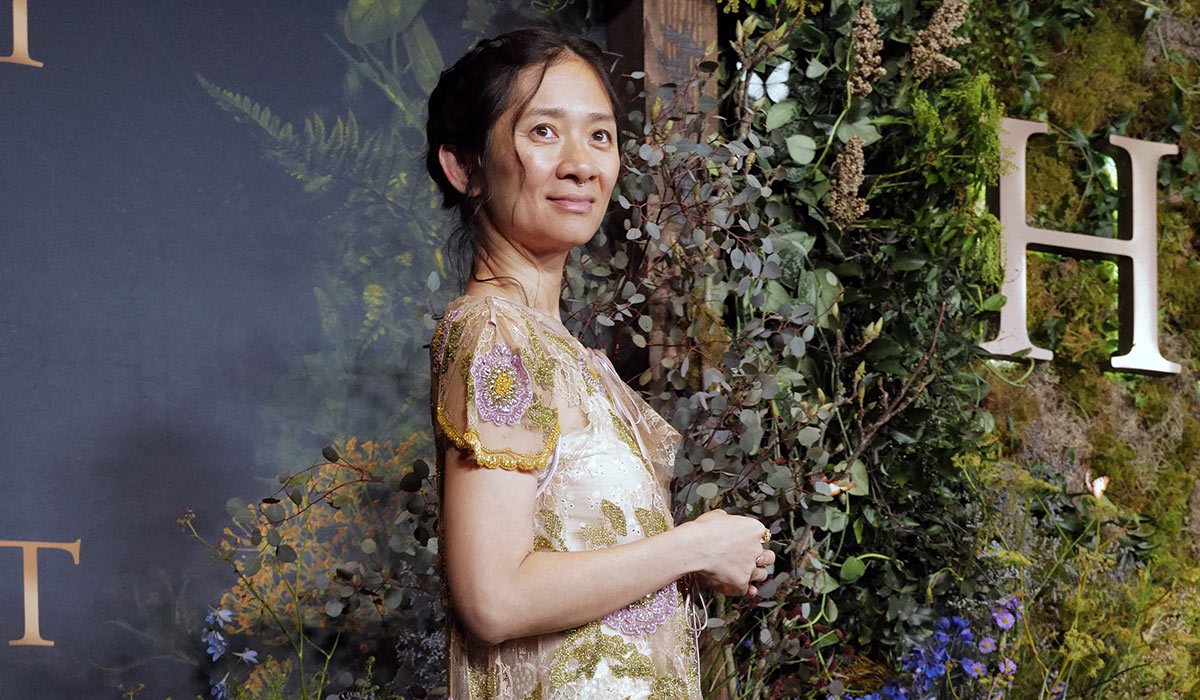
There is a break in the rain in Los Angeles. The sun is trying to peak through the windows of Chloe Zhao‘s home as the Oscar winner sits down for a Zoom interview to discuss her acclaimed new film “Hamnet.” And, on this day, Zhao is in a deeply philosophical mind space. We’re not mad at it.
Adapted from Maggie O’Farrell’s 2020 novel, “Hamnet” imagines the lives of William and Agnes Shakespeare and their three children in the English countryside. Agnes (Jessie Buckley) was seemingly never a part of the pomp and circumstance her celebrated husband (Paul Mescal) experienced in London, and this narrative examines that choice. Also lost to history and most English literature classes is the fact that the name Hamnet is also interchangeable with Hamlet. And it doesn’t take much detective work to realize the fate of the couple’s son may have influenced one of Shakespeare’s theatrical masterworks.
Whether with “The Rider,” “Nomadland,” or even “Eternals,” Zhao has been an auteur who finds ways to spark audience emotions while still keeping the proceedings as grounded as possible. For many, “Hamnet” is one of the biggest tearjerkers in years. But Zhao will tell you that was not her intention. How the audience reacts is on them.
“It’s not my job to tell people how they should feel,” Zhao says. “My job is to hold a mirror. That’s it. I am not here to preach anything at all. I’m here. That’s why I want to capture presence. I don’t want to capture anything that is a message or something I want to force you to feel. Something bigger than me is speaking. So I capture it, and I try my best to hold it up as a mirror and then allow the audience to project or reject whatever they’re working through onto the art. That’s what art is supposed to be.”
Over the course of our discussion, Zhao dives deep into her philosophical connection to the material, whether there are other art forms she’d like to express herself with, how she’d say yes to being offered a commercial project like “The Blair Witch Project,” and much more.
This interview has been edited for length and clarity.
_____
The Playlist: What about this novel made you want to adapt it into a movie? What about it spoke to you?
Chloe Zhao: The novel is just such an incredible container for big life human things you can explore, love, death, metamorphosis, mother wound, nature, just a connection with nature, the purpose of storytelling. It’s just everywhere. And it happens to be topics that I have been working through in my own life. And I think I am somebody who wasn’t a born cinephile in the sense that it is about a medium that makes me want to do it. It just happens with the medium that fits my skills, but I need the storytelling part to work through the things I need to deal with in life. And so this happened to be exactly what I was looking for.
Can you be specific about which themes spoke to you the most? Was it about the family relationships? Was it about dealing with trauma from death?
There were two threads that I followed. One is the idea of Agnes’ character as a feminine consciousness, which doesn’t exist in any of the films that I’ve made in the past. I would say Sersei in “Eternals” was my attempt for, but it’s a very kind of maiden energy. It hasn’t gone to Mother Crown yet. And because that is quite a big wound in me. And I think in our entire species, we have quite a devastating mother wound, right? It’s the connection to the feminine consciousness. So, I wasn’t sure I could even handle the story. I know I will have to look at my own, but I also know I made life. If you don’t, it’s going to catch up with you later. It’ll get you. And I would rather deal with it now than later. So, that was a commitment I made. And I know that I’m going to really push for creating onions as the kind of part of myself that I’ve suppressed and allowing that to come out. And Jesse was on the same journey. So, that was a great synchronicity. The other one is more my Shakespeare side. I’m much more comfortable being in these shoes. I understand what it’s like to escape into imagination and not be in the body because it’s not safe here, and connect from that place. But then I have been questioning if I were to bring my inner onus forward and heal some of this trauma, then would I still want to be in the imaginary world? Is my inner world going to die out? And so I also wanted to examine the purpose of why I’m doing this. And so, as you can see how the film ends, they look at each other to understand that there are two sides to me. There’s the wound that needs to be healed and, to a certain extent, might never be, but it needs to be loved and taken care of. So there is a coming to terms with your own trauma that made you who you are today as a storyteller, and come to be at peace with it. But at the same time, don’t keep the wound completely untended and trust that both paradoxes can coexist. So, that was all in the book for me, and more synchronously, Paul coming in. My own life was also hanging along with it. And it is making this specific thing much, much more present, which is why there’s a bit more, well, Shakespeare in the film than in the book. To create that inner civil war that we all experience in two archetypal outer characters. So, when they see each other in the end, there’s a much bigger harmony that is happening.
When you were introducing the film at Telluride, there was this big family hug with yourself, Jesse and Paul. How much do you feel like they contributed to the film? Is it a group collaboration as opposed to just empowering vision?
I really don’t feel I have a vision, and it doesn’t mean that I don’t have ideas, since they’ll come to me, but they’re not generated from my mind. I was in Pompeii recently, and I asked a woman who had worked there for 20 years what makes a good archaeologist. And she said, A good archaeologist comes to a site with the intention, a vision of what happened here. And then they start excavating, and then one little fragment will show up. And that’s a very important moment. If they’re present, they let go of what they think happened here, and they let the story come through. And then they come to work every day, facing the unknown and seeing this fragment on one hand hold some kind of pattern for it that can come together in the end, and surrendering to not knowing. To let the fragments speak through. So everybody on my set, Paul and Jessie, is too big. They are not just fragments, but massive chunks of what was excavated. And I ask them to work that way. I ask my department leads to work that way. Everyone holds that tension between knowing and not knowing. And I have to hold that tension too, to be or not to be. So yeah, I have visions, ideas on a daily basis, but they usually come out of being purely present with what is coming through in the moment, reacting to that as opposed to having a big blueprint.
Do you feel like your films come together then on set, or do you feel like it comes together in the editing room?
I think because it’s cinema, I would say a much larger amount of that comes together in the edit. And you’ve got to trust that there’s a whole chunk of magic that is not anywhere near what we can even imagine could happen once we put it in the can. Of course, a majority of it happens on set, but never discount the power of what happens later with sound and music, and editing. So, I think both.
You mentioned that you see this as a medium that you use as an art form to express yourself. Are there other art forms that you have thought about exploring? Do you feel like you are hindered by just being a film director?
Thank you for asking that question. No one ever asked me that question.
It seems so obvious.
I’ve been working for four years with my body to feel safe, to be seen. So, before “Hamnet,” I was working on “Our Town.” I would be part of the play as well and be the stage manager, and somehow a little bit similar to how I was interacting with the audience at Telluride, right? Somehow be a bridge between what’s on stage and off stage, and we’re just playing with how present we can involve the audience. So, that’s something I’m excited about but also afraid of. But I’m exploring that with a lot of support from teachers who have done this kind of work. But then also I would love talking, working with Maggie. I would love to write a novel. I think if I could write a book, I’d probably not make as many films because filmmaking is stressful.
It is stressful. I was about to say, unless it’s a one-off thing. If you’re doing “Our Town” somewhere five nights a week, that’s also super stressful.
But it’s present. It just feels so nice that your job is just chopping wood because at the end of the night, knowing that your work is done is so good for your psyche. You’ll be writing a screenplay, and you just have no idea what’s going to happen. Even when you capture something on set, you don’t know what’s going to happen in the edit. So, I think the balance is really good.
So many people, including myself, have a visceral, emotional reaction to the end of the film. Is that what you were hoping to evoke in the edit? Is the emotion at the end of the film what you were thinking about while you were working on it or making it?
On one hand, I’m only interested in what happens in the present moment when I’m on set. If it’s present, it is true. Sometimes I will say there’s 20% of the time that I know intellectually this doesn’t work. But physically, when it’s present, I feel the presence of this moment that comes through my actors or the weather, where something happened. A cow got loose or whatever. If it’s present, it’s the truth. That’s it. And my job is to bottle it up and see how to use it in the edit and guard that presence, no matter what the test screening says. But then, on the other hand, we’re in the business to help people feel and to create a space where they can feel when they might not feel comfortable feeling in other places. So, there’s a commitment to that and understanding that grief is just the tip of the iceberg. But really, there are so many colors to that. There’s shame, there’s regret, there is tenderness, there is rage. There are so many little micro emotions underneath, within grief. So, the audience, someone may have seen this film and is very angry and doesn’t like it and feels like this is terrible, terrible, terrible. It just makes them angry. That is dropped down for me as well.

So just eliciting emotion is satisfying. No matter what that might be.
For me, it’s not my job to deliver a message to the world. It’s not my job to tell people how they should feel. My job is to hold a mirror. That’s it. I am not here to preach anything at all. I’m here. That’s why I want to capture presence. I don’t want to capture anything that is a message or something I want to force you to feel. Something bigger than me is speaking. So I capture it, and I try my best to hold it up as a mirror and then allow the audience to project or reject whatever they’re working through onto the art. That’s what art is supposed to be. It was never supposed to deliver the artist’s message. At least for me. Maybe that works too. But I think there’s space for both kinds of art. I think being an artist is not supposed to be a comfortable path.
If someone comes to you with a potential project down the road and it seems too easy, does that make you want to say no?
What projects are easy?
Well, there we go. O.K. If they come to you with a comedy…
I’ll be like, “That is the hardest thing ever.” I’ll try. I’ll try. I don’t think any is. You mean emotionally less taxing?
Someone comes to you and says, Hey, I’ve got a commercial thriller. We’d love your aesthetic on it. The script is done. Would that be too easy for you to just show up? Would you do that?
If someone came to me with “The Blair Witch Project,” I’d be like, “Hell yeah, I’ll do it.” Or a great script of a horror movie. I can do it, but I’ll tell you, don’t hire me because I’ll be bad at it
That I do not believe.
To answer your question from earlier, I think every one of us came into the world and was put in certain situations as we were being brought up, some on the surface, much better off than others. And I used to feel like there’s so much unfairness, and it’s stressful for me to think about this, but once I surrender to that, you realize from that setup it creates a very unique human being. And that unique human being fits into this grand scheme of things to provide something that they’re good at because they went through what they went through. And so, because of what I went through, I’m good at standing on the edge of the abyss and being very close to darkness and handling a lot of really difficult emotions. My nervous system can’t handle it because it’s been doing that since she was a little girl. That is just my purpose. It’s what I’m made for. I want to do hard things.
“Hamnet” is now playing in limited release.
Follow Gregory Ellwood on Bluesky
Follow Gregory Ellwood on Threads
Follow Gregory Ellwood on Instagram
Sign Up For The Breakdown Newsletter

Editor-at-Large Gregory Ellwood is one of the entertainment industry's most respected journalists and critics. Based in Los Angeles, he's the only current awards expert who previously worked on Oscar campaigns at a major movie studio. Over the years, he has written for the LA Times, Variety, The Hollywood Reporter, and Vox, among others. He also co-founded the entertainment news site HitFix, which spawned a legion of influential Emmy and WGA Award-winning alumni.


