




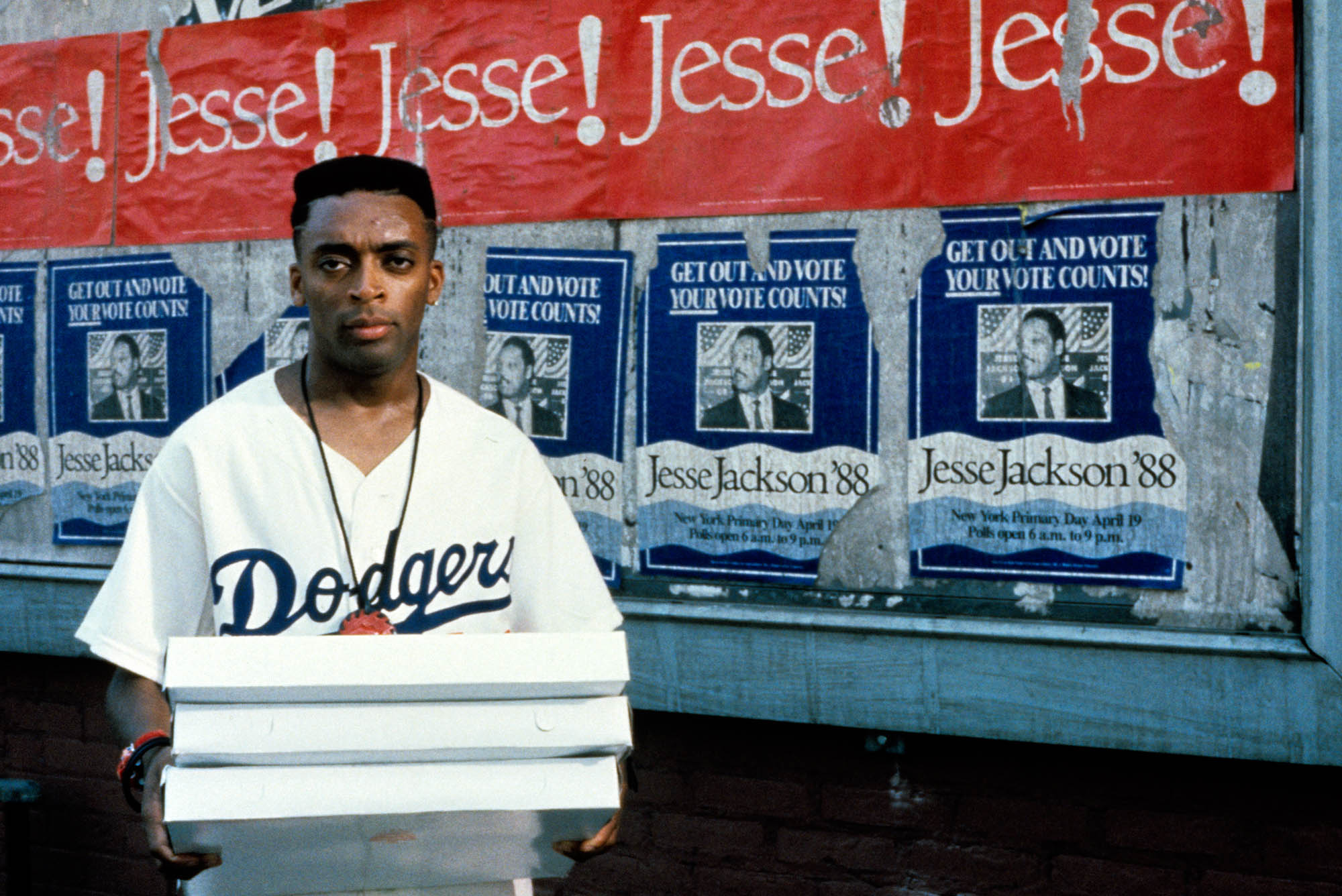
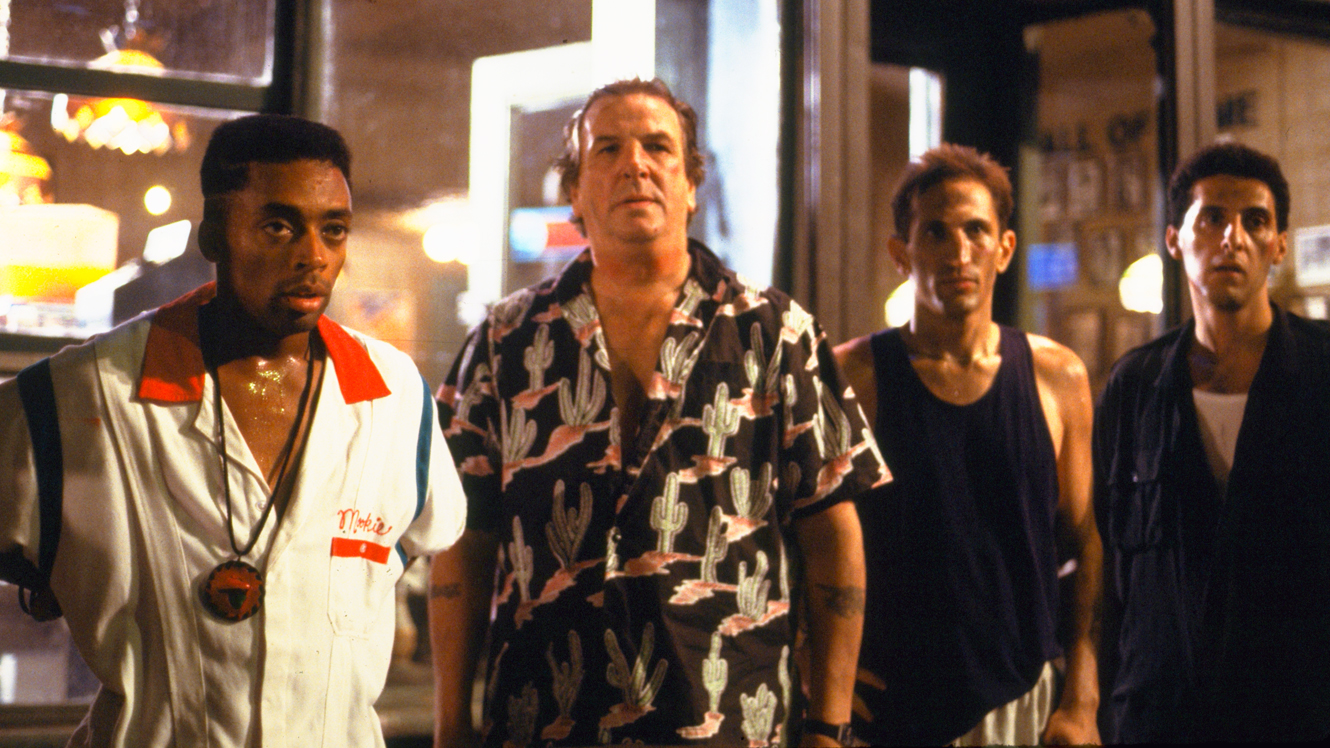
 This aspect of ‘DTRT’ is the maybe less attention-grabbing, and certainly at the time inspired far fewer impassioned/alarmist op-eds, but with the passage of years it has emerged as one of the film’s most enduring undersung legacies. The Brooklyn Lee depicts is not just the tinder pot of ethnicities and cultures rubbing up in constant friction against one another (the film’s famous “racist rant” montage sequence is a particularly concise, and very funny, illustration of that), it is also a portrait of a diverse, divided, difficult but undeniably close community. Contrast its portrait of the borough with the hellish, crack-addled, gang-run hoods that provide the settings for so many of the subsequent films from the black urban filmmakers for whom Lee opened the gate, and you can see how much of his reputation as a scaremongerer and a shit-stirrer, at least on the basis of this, his most controversial film, is overstated. If he really was such an agent provocateur, shouldn’t the scales be tipped more in favor of once side than the other? And should there be such affection for the way life is lived on that block?
Who told you to buy a brownstone on my block, in my neighborhood, on my side of the street?…Man, motherfuck gentrification. — Buggin’ Out (Giancarlo Esposito)
As much as there is anger and horror at the way trivial arguments can escalate to fatal conclusions, almost as though they have a life of their own and the people involved are helplessly swept along in the stream, there is also a throughline of great compassion, even love for the other side of that coin: the neighborhood’s vibrancy (which Ernest Dickerson’s photography brings busting to life), the color and noise and music and social interaction, of which the majority is conducted with the good humor of benign familiarity. Lee may be angry about racism and the economic and social oppression of America’s black population (as should we all be), but there is also a ferocious pride in his identity even if that identity has been forged in injustice, marginalization and deprivation. Life, as shown in “DTRT” is teemingly complex, and its complexities breed bigotry and ambiguity and mess, but perhaps all that mess, that comes from different people of different backgrounds living on top of one another, is preferable to gentrified homogeneity or atomization; it is certainly more vital.
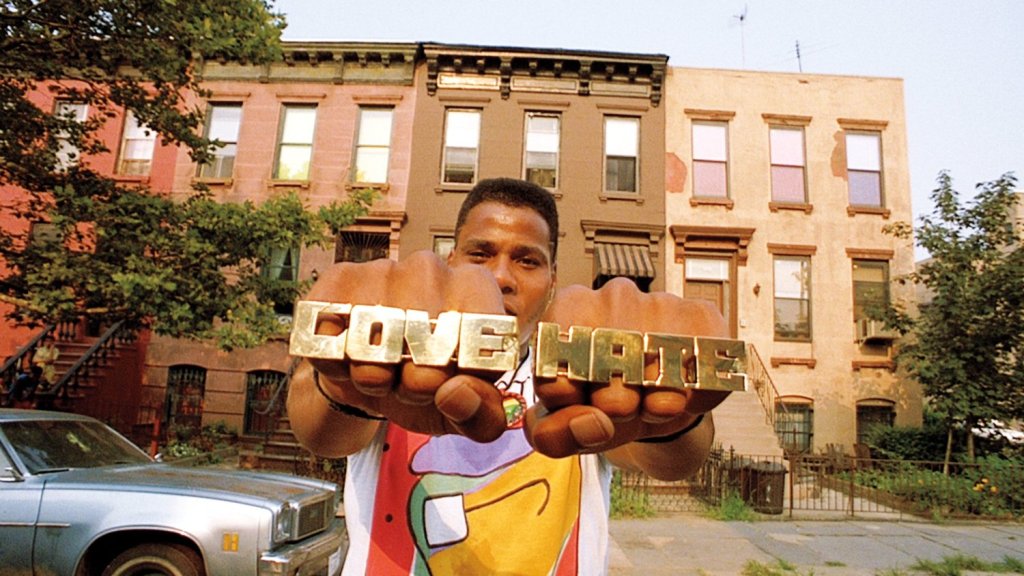 I wanna get paid. — Mookie (Spike Lee)
Lee famously lost out to Steven Soderbergh at Cannes that year (we have anin-depth account of the history and impact of “sex, lies and videotape” here), an award that to film historian Peter Biskind “ratified the turn away from the angry, topical strain of the indie movement that had its roots in the 1960s and 1970s and toward the milder aesthetic of the slacker era.” Which may be true but it also may simply be a matter of timing. Not that we’re suggesting “Do the Right Thing” was ahead of its time so much as it was precisely on time while the film establishment was lagging behind. Consider also that it was nominated for two Oscars (Screenplay and Supporting Actor for Aiello) but won neither, in a year that Hollywood to gave its highest prize to the complex, vibrant, fearless, authentic and deeply incisive portrait of racial tension that was ”Driving Miss Motherfucking Daisy.”
My people, my people, what can I say; say what I can. I saw it but didn’t believe it; I didn’t believe what I saw. Are we gonna live together? Together are we gonna live? — Mister Senor Love Daddy (Sam Jackson)
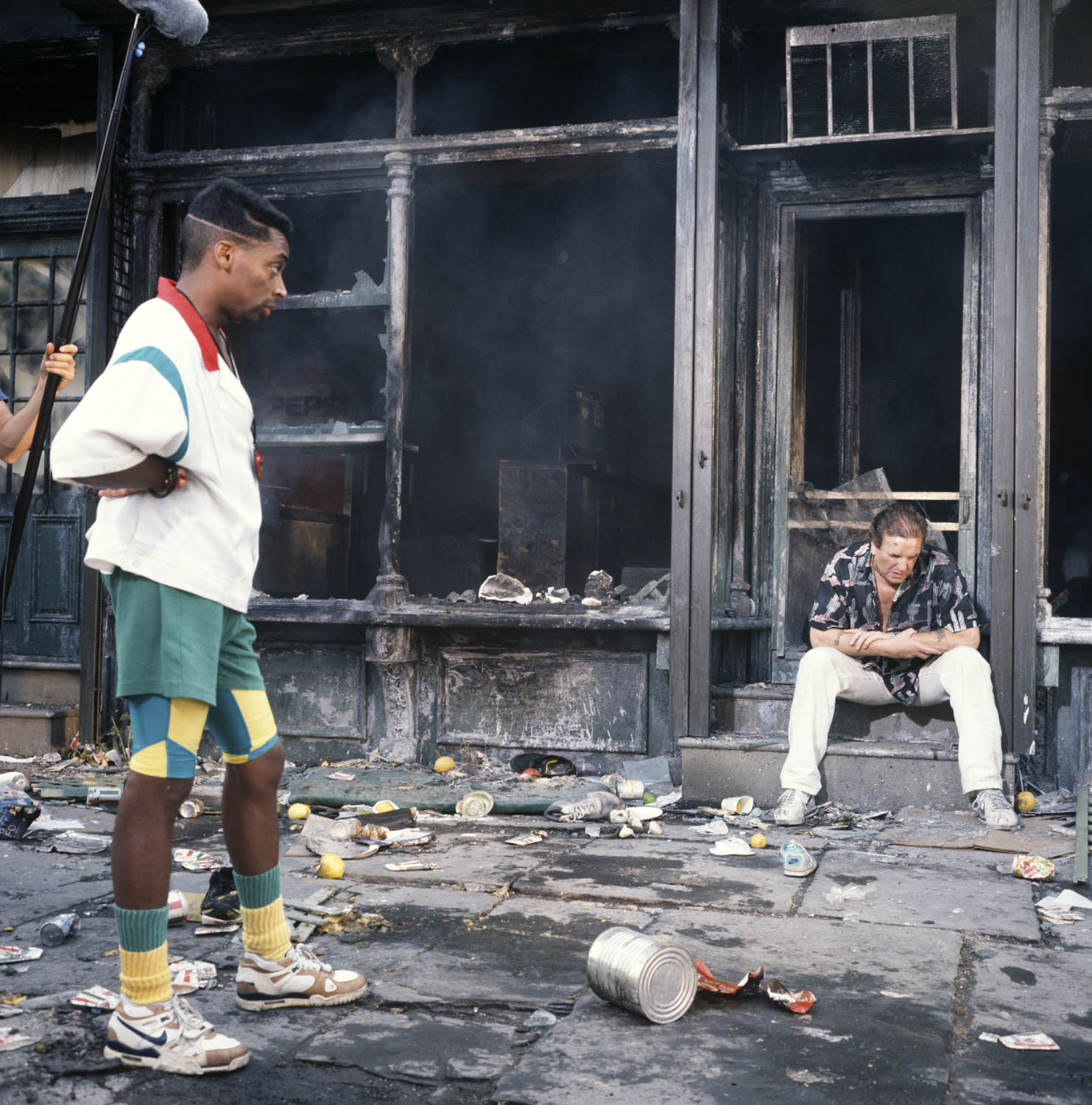
“Do The Right Thing” is eternally, rightly memorialized as a galvanizing, challenging landmark in film history, but, especially with the benefit of hindsight we can see also as a celebration of a neighborhood way of life that is on the cusp of disappearance, if not already entirely gone. So yes, within the tight confines of the story, the arc is so ambivalent as to perhaps lend itself to a pessimistic, laissez faire reading, but like all great movies, “Do The Right Thing” lives beyond its limits, spilling outside the frame and beyond the span of that one hot day in summer. And out there in the wider world of the film, there is a sense of a diverse, vibrant, lively community that is worth fighting for, if it could just stop fighting itself. And that conclusion is anything but futile, or depressing or incendiary, it simply feels to us like a deeply held truth.
Or maybe even a triple truth, Ruth.
Here’s Lee talking briefly about the film prior to a 20th Anniversary screening:

- Jessica Kiang
- Jessica Kiang
- Jessica Kiang
- Jessica Kiang
- Jessica Kiang
- Jessica Kiang
- Jessica Kiang
- Jessica Kiang
- Jessica Kiang
- Jessica Kiang
- Jessica Kiang
- Jessica Kiang
- Jessica Kiang
- Jessica Kiang
- Jessica Kiang
- Jessica Kiang
- Jessica Kiang
- Jessica Kiang
- Jessica Kiang
- Jessica Kiang
- Jessica Kiang
- Jessica Kiang
- Jessica Kiang
- Jessica Kiang
- Jessica Kiang
- Jessica Kiang
- Jessica Kiang
- Jessica Kiang
- Jessica Kiang
- Jessica Kiang
- Jessica Kiang
- Jessica Kiang
- Jessica Kiang
- Jessica Kiang
- Jessica Kiang
- Jessica Kiang
- Jessica Kiang
- Jessica Kiang
- Jessica Kiang
- Jessica Kiang
- Jessica Kiang
- Jessica Kiang
- Jessica Kiang
- Jessica Kiang
- Jessica Kiang
- Jessica Kiang
- Jessica Kiang
- Jessica Kiang
- Jessica Kiang
- Jessica Kiang
- Jessica Kiang
- Jessica Kiang
- Jessica Kiang
- Jessica Kiang
- Jessica Kiang
- Jessica Kiang
- Jessica Kiang
- Jessica Kiang
- Jessica Kiang
- Jessica Kiang
- Jessica Kiang
- Jessica Kiang
- Jessica Kiang
- Jessica Kiang
- Jessica Kiang
- Jessica Kiang
- Jessica Kiang
- Jessica Kiang
- Jessica Kiang
- Jessica Kiang
- Jessica Kiang
- Jessica Kiang
- Jessica Kiang
- Jessica Kiang
- Jessica Kiang
- Jessica Kiang
- Jessica Kiang
- Jessica Kiang
- Jessica Kiang
- Jessica Kiang
- Jessica Kiang
- Jessica Kiang
- Jessica Kiang
- Jessica Kiang
- Jessica Kiang
- Jessica Kiang
- Jessica Kiang
- Jessica Kiang
- Jessica Kiang


