


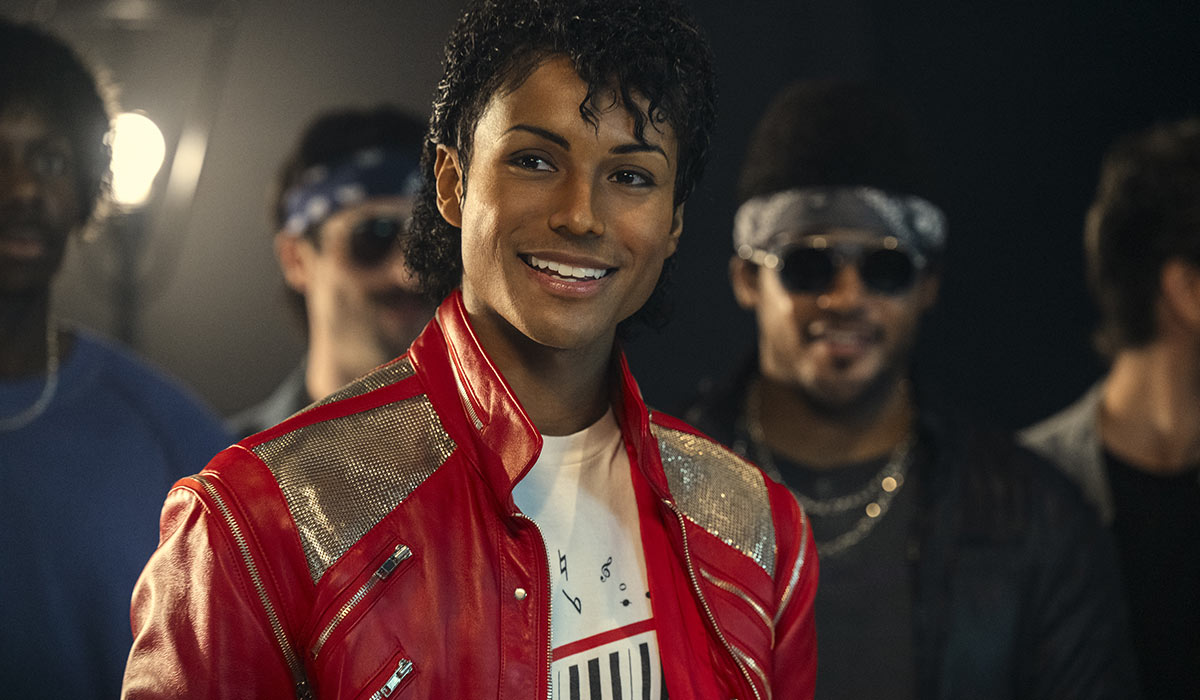
Some of history’s greatest playwrights would salivate over the narrative storylines that spawned from the Jacksons, a family full of fledgling musicians originally from Gary, Indiana. There is enough drama and intrigue over the past six decades to craft a multi-season series worthy of “The Crown.” As it stands, Antoine Fuqua’s “Michael” is aiming to tell a slightly more compact story centered on one of the biggest stars in music history, the second youngest offspring of Joe and Katherine Jackson, and the “Michael” in question, Michael Jackson. And despite an unexpected legal detour, it comes close to pulling it off thanks to some incredible performances, from Jaafar Jackson, in particular, stellar set pieces, and, of course, a music library that has stood the test of time.
READ MORE: “The Odyssey”: Christopher Nolan Gloriously Reimagines The Fable Of The Trojan Horse [CinemaCon]
Granted, there is reason to ponder the movie that Fuqua, screenwriter John Logan, and producer Graham King intended to make, but that incarnation will never be seen. Essentially, the original third act was completely reworked, and the film’s release date was delayed by a year because the Jackson estate misread the fine print on a legal agreement with an accuser of the one-time King of Pop. So, a film that initially had a more expansive view of Jackson’s career instead becomes a story about a son, Michael Jackson (Jafar Jackson), attempting to break free from the controlling bonds of his father, Joe Jackson (Colman Domingo). In theory, that could equate to a more compelling story if it weren’t such a Hollywood cliché.
Our story begins in 1965, as steelworker Joe Jackson, a wannabe music manager and taskmaster, believes his five sons, dubbed The Jackson 5, have the makings of a successful music group. The youngest and most talented is Michael (portrayed by a fantastic Juliano Krue Valdi), but Joe treats him harshly, whipping him with his belt if he talks back or disobeys his instructions. His older brothers are so fearful of their father that they never intervene, nor does a sympathetic matriarch, Katherine (Nia Long).
A good portion of the film flows like an extended montage of short scenes that pop over convenient time jumps. The Jackson 5 are discovered by future Motown executive Suzanne de Passe (Laura Harrier) at a live performance in Chicago. Before you know it, they are in Los Angeles, where Motown founder Berry Gordy (Larenz Tate) signs them to a deal. He beams over Michael’s vocal talent as he records “I Want You Back” and gives the youngster a glimmer of attention he desperately needs. And just like that, the kids from Gary are on TV, becoming household names with Michael as their shining star.
When the movie jumps ahead a decade, Michael is now played by a stellar Jaafar Jackson, his real-life nephew, and is working on his own projects. But Michael is still too fearful to inform his father that he’s about to start working with Quincy Jones (Kendrick Sampson). No, he tells his business managers to relay the message instead. Joe’s response? Michael can do whatever he wants after work hours, but from 9 to 5? “He’s mine.”
Over the next six years, Michael crafts his breakout solo release, “Off the Wall,” and the seminal album, “Thriller.” Along the way, he chooses the Beach Boys and Fleetwood Mac manager and lawyer John Branca (Miles Teller) to represent him and take his career to another level. He fights to become the first black artist to air regularly on MTV, thanks to some smartly timed pressure put on CBS Records president Walter Yetnikoff (a fun Mike Myers cameo), and delivers a legendary televised performance on the Motown 25 special. Fans hound him, but still, Joe is waiting in the wings, scheming and guilting his son into committing time with The Jacksons, a group he’s outgrown. Joe can partially pull off this subtle and emotional manipulation because, despite being the biggest star on the planet, his adult son still lives at the family mansion in Encino.
Sometimes, history is wild.
When “Michael” grabs you, it’s because of Jafar’s inherent on-screen charisma and some of Fuqua’s inspired directorial choices (the filmmaker uses close-ups wonderfully throughout). At one point, hoping to quell gang unrest in Los Angeles, Michael brings members of the competing Crips and Bloods to a dance rehearsal for his music video “Beat It.” It becomes a small window into his creative process that is genuinely fascinating. Jafar is utterly captivating in moments like this, or when he’s shooting the “Thriller” video, singing live in a recording booth, or performing on stage. But he’s not the only actor going the extra mile.
Domingo and Long notably deliver layered performances that work hard to overcome the conventions of this familiar industry tale. But it’s increasingly difficult when the Michael Jackson in this movie is such an unconventional personality. The movie depicts him as a childlike, asexual being that no one around him seems to question. No one. Sure, his family shakes their heads when he brings Bubbles the chimp home or has a giant cobra in his bedroom, but it’s all played as a desperate need for love. And, as some might expect, the film often fixates on Michael’s love for Peter Pan and reaching the magical world of Neverland.
In truth, Michael is portrayed as such a loner that you’d never know he had any friends, let alone celebrity friends in his life, whatsoever (Elizabeth Taylor and Diana Ross simply do not exist in this timeline). His closest confidante and sympathetic ear, until the end of the movie, appears to be his head of security, Bill Bray (KeiLyn Durrel Jones). And even casual Michael Jackson fans will wonder why there is no mention of his sister Janet Jackson, who was living with him under the same rooftop during this period of his life. Again, she was living in the same house where Michael and all his other family members have been residing for years on end. The choices are so quizzical that you often wonder if a documentary about the making of this movie would be equally as compelling as what’s on screen.
Then again, as we noted earlier, you could spend hours on end chronicling Michael’s history up to where the film ends. Even so, the film skips over a ton of relevant moments that could give more context to his songwriting and artistic vision (let alone his collaborations with Jones, who is almost depicted as an afterthought). There are always difficult choices to be made, but the further you find yourself from cinematographer Dion Beebe’s glowy visuals and the production teams’ spot-on recreations, the more it begins to wear on you.
And no, the allegations that have haunted Jackson and been depicted in numerous documentaries and news reports are not even casually hinted at. Jackson is just a pop star whose childhood was stolen from him and who lends a kind smile to kids at hospitals. That other stuff was supposed to be explored in this movie, until it wasn’t. But if you want to relieve some of the MJ magic, Jafar, Fuqua, and those timeless bangers will quench a nostalgic thirst that will make you want to forget all that “negative stuff.” For a few moments anyway. [B-/C+]
“Michael” opens nationwide on Friday
Follow Gregory Ellwood on Bluesky
Follow Gregory Ellwood on Threads
Follow Gregory Ellwood on Instagram
Follow Gregory Ellwood on TikTok
Sign Up For The Breakdown Newsletter


