


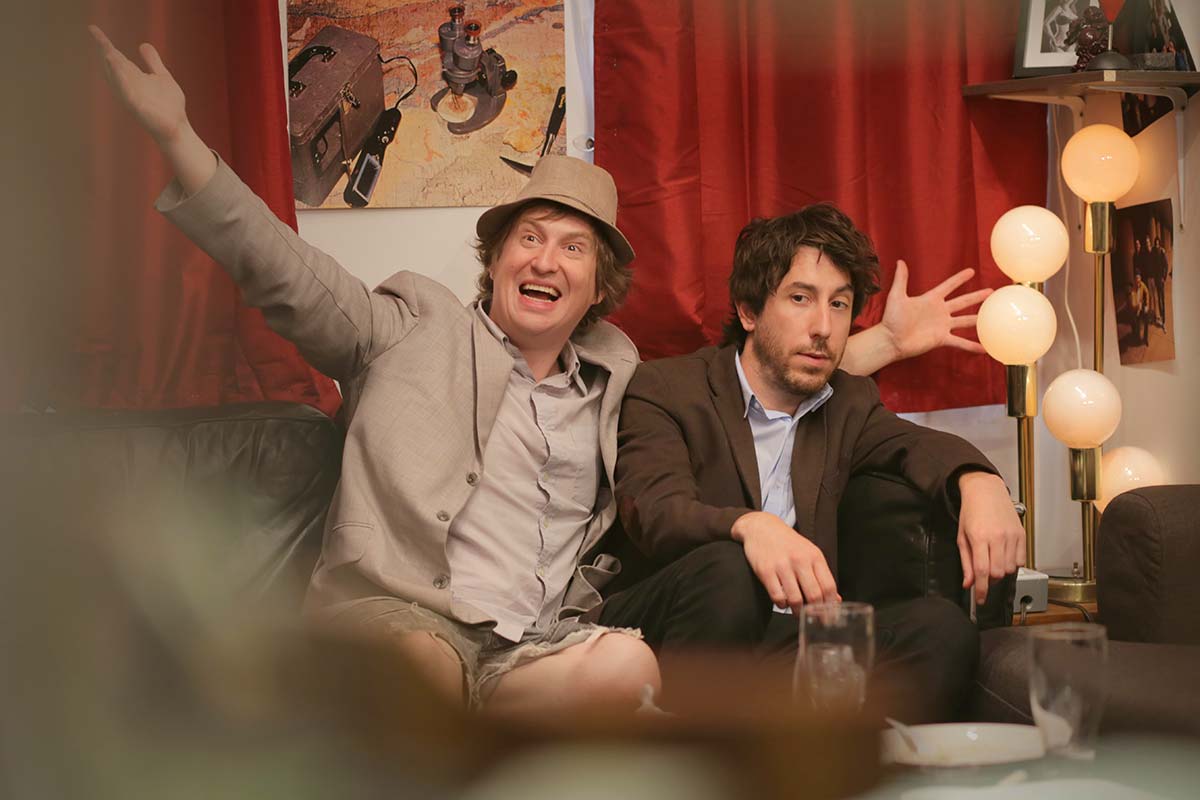
Some movies are about finally arriving somewhere. ‘Nirvanna The Band The Show The Movie’ is about two people refusing to stop walking the same thankless path together. Built from decades‑old footage, rewritten realities, real stunts, and a running gag that has never paid off, the film disguises something deeply human inside its most absurd impulses. Beneath the time travel, the public stunts, and the escalating chaos sits a simple question the movie never stops asking: what does it mean to keep choosing the same collaborator, the same friend, long after logic says it would be easier to move on?
That tension animates both the film and this conversation with Matt Johnson and Jay McCarrol, who have been in and building some version of Nirvanna The Band together for nearly twenty years. While the finished movie feels precise and inevitable, Johnson was clear that its existence was anything but. There was no groundswell of industry interest, no clean path from cult series to feature film. The only reason it exists is because of a blank check they received after the success of their movie, “Blackberry.”
“No, it was the exact opposite,” Johnson said. “Had we not been Canadian citizens, there’s just no way that this movie ever would have been made. The only way that this was getting made is if we literally made it ourselves with the assistance of the Canadian government. This is literally nationally funded art in our country [due to ‘Blackberry’].”
READ MORE: 14 Must-See February Films: ‘Wuthering Heights,’ ‘Pillion,’ ‘Crime 101’ & More
That freedom came with instability. Over two years, the project was shot, rewritten, and effectively restarted multiple times. Johnson traced one early version back to the aftermath of the “BlackBerry” festival run.
“As soon as BlackBerry was done and we premiered it in Berlin, I met with Telefilm, and they said, ‘Yeah, we will fund anything up to a certain budget level,’” he said. “Originally, I thought, ‘Oh, we need to make a Nirvana The Band movie in Europe because I was traveling to all these different film festivals. This would be amazing, seeing these characters in this other world.’ And we didn’t shoot any of that. Thank God.”
When that idea collapsed, another took its place, even more elaborate and unwieldy.
“When we came home, I had this completely ridiculous idea that we should do a parody of ‘A Confederacy of Dunces’,” Johnson said. “Set it in New Orleans. Do a combination Confederacy of Dunces slash ‘The Talented Mr. Ripley’ parody where these guys take the RV you see in the movie, turn it into Doc Brown’s time machine, and drive it from Toronto all the way down to New Orleans.”
That version was real. It was shot. It was edited. And it quietly revealed itself as unsustainable.
“We were writing it as we went, which is usually the way we do things,” McCarrol said. “But it was very complicated. We were chasing ourselves, planning to return to cities for reshoots. We did return to some of those cities for reshoots.”
What finally unlocked the film was not a new location or a more innovative concept, but a decision they had spent years avoiding. For nearly two decades, Johnson and McCarrol had been sitting on footage of themselves shot when they were young, treating it as something too valuable, too sacred, ever to touch.
“We always said, even with this movie, ‘We can’t use that footage. We’ve got to save it for something one day,’” Johnson said. “And when we got back from this road trip, it was like, wait a minute. What are we saving this footage for? Isn’t this it? We’re making the movie. Let’s use the fucking footage.”
Once that door opened, the movie’s central mechanism revealed itself almost instantly.
“As soon as we made the decision to use the footage, time travel auto‑completed itself,” Johnson said. “It was like, well, how do we use the footage? They get the time machine. And then it just started writing itself.”
McCarrol described how embracing that level of complication paradoxically simplified everything.
“When we indulged ourselves and just got carried away on this time‑travel plot, within a day or two we had the entire movie complete, with a big ending that we loved,” he said. “That one‑page synopsis, the five‑act structure, didn’t change. That was a miracle for us.”
Seen this way, the time travel isn’t a gimmick but a structural expression of the friendship at the film’s center. Past and present versions of Matt and Jay argue, interrupt, and course‑correct one another, mirroring the real‑world dynamic that allowed the project to survive so many false starts.
That same philosophy extends to how the film was physically made. Many of its most audacious moments unfold in public spaces, sequences that feel too precarious or too absurd to have been approved through traditional channels. Johnson doesn’t frame that approach as rebellion, but as necessity.
“Permits are a funny thing,” he said. “A lot of young filmmakers mistakenly think that location releases are a must‑have. But what’s amazing is that your ownership of the footage you shoot can often supersede trespassing.”
He pointed back to “Operation Avalanche” as the moment that clarified that boundary.
“One of the big questions was, can we shoot in NASA and make this entire movie about the moon landing being faked without them having total knowledge?” Johnson said. “The fact that it was our footage that we’d shot and then left with made it legally viable.”
For Johnson, the guiding principle is intent. “If you’re trying to do something that is hard to explain, and you really don’t mean any harm, and you aren’t going to mess with somebody, permits will sometimes stymie independent filmmakers to the point of not allowing you to actually do something,” he said. “Sometimes you have to ask forgiveness as opposed to permission.”
That trust in instinct, and in each other, remains the connective tissue of the project. Even the Rivoli, the Toronto venue they still haven’t played, is treated less as a physical destination than a boundary they refuse to cross.
“The Rivoli is very much the top of the Sisyphus Mountain,” McCarrol said. “It’s a spiritual destination. We’re very careful not to mess with that too much in a tangible way because it feels really great when it’s always kept at arm’s reach.”
Johnson framed that restraint as essential. “There’s a naive barrier that we can’t cross,” he said. “If certain things were acknowledged, it would be like taking a bite of the apple in the Garden of Eden. You can’t really go back.”
While Nirvanna The Band continues to expand, Johnson is already deep into what comes next. Asked about the long‑gestating Anthony Bourdain biopic, he confirmed it’s no longer theoretical.
“It’s not only next,” Johnson said. “It’s almost done. We’re in the midst of it. It’s wonderful.”
The future of Nirvanna itself also appears brighter than ever, with plans for a comprehensive physical release of the series and the possibility of finally completing a long‑delayed third season. According to Johnson, the scope of that material will be “huge,” folding together everything they’ve shot, scrapped, and saved along the way.
But regardless of how large it grows, the film’s emotional center never shifts. ‘Nirvanna The Band The Show The Movie’ is not about success or closure. It’s about two people who keep recommitting to the same shared delusion, decade after decade, and finding meaning not in whether the dream ever comes true, but in the fact that they’re still chasing it side by side.
What is already a likely contender for comedy of the year, ‘Nirvanna The Band The Show The Movie’ opens in theaters February 13 via NEON. Listen to the whole conversation with Matt Johnson and Jay McCarrol below.
The Discourse is part of The Playlist Podcast Network, which includes Deep Focus, Bingeworthy, and more. We can be heard on Apple Podcasts, Spotify, Soundcloud, and most places where podcasts are found. You can stream the podcast via the embed within the article. Be sure to subscribe and drop us a comment or a rating, as we greatly appreciate it. Thank you for listening.


