


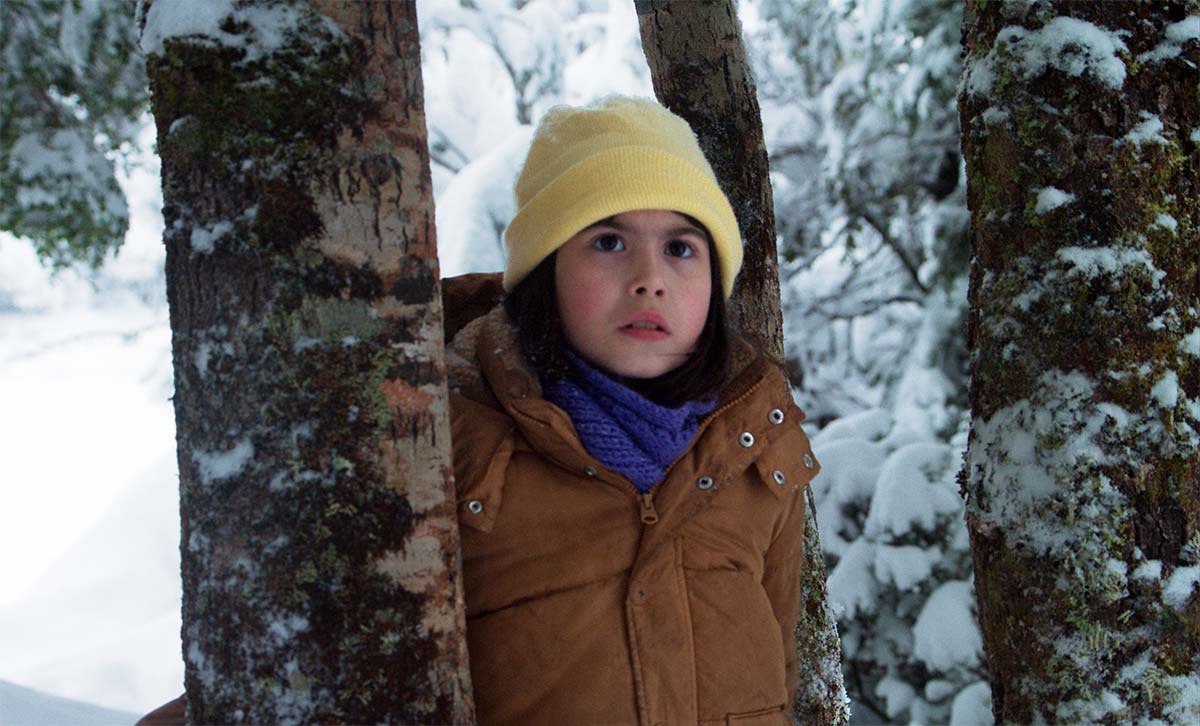
At her young age, Inés (Maya O’Rourke) is the keeper of numerous secrets. Some she wishes she could divulge; others she treasures as proof of the trust she inspires in others. Growing up in a Chilean mountain hotel with a constant influx of international tourists practicing winter sports, the nine-year-old girl speaks fluent English, serving as the bilingual bridge between visiting outsiders and the inner workings of her family’s hospitality business.
READ MORE: 27 Most Anticipated Films From The 2026 Cannes Film Festival
Manuela Martelli’s “The Meltdown” opens with a series of images, premonitions perhaps, that introduce an air of uneasiness amid snow-covered landscapes. The feeling that something menacing lies beneath remains throughout, and even takes on a more literal form when German teenager Hanna (Maia Domagala), whose life as a professional skier in training revolves around chasing snow around the world, vanishes without a trace. There’s a comforting peacefulness to the powdery white, but that deceiving tranquility also serves as a metaphor for what Inés’ family is willing to conceal in order to preserve its operation. After all, it’s the façade that others see, not the history that sits behind it.
As with her excellent 2021 feature debut, “Chile ’76,” a thriller about a wealthy woman with secret left-wing beliefs during the Pinochet regime, Martelli addresses larger societal concerns through situations that one might not immediately read as political. While the film avoids feeling schematic, the longer one thinks about even the most innocuous details, the more “The Meltdown” reveals itself as a carefully calibrated exploration of national identity, not just a tale of the friendship that develops between Inés and Hanna.
Inés’ parents, for example, are away at an expo in Seville, Spain, trying to convince European investors that Chile is a stable country for business in the aftermath of the dictatorship. Their exhibit includes a piece of an iceberg flown from Chile, which inevitably melted a bit in transit. When Inés shares this with Hanna, she asks her not to tell anyone, likely aware that if word spreads internationally, it could cause national humiliation.
Back at the snow-covered hotel, a pair of Spaniards is looking to work with Inés’ grandparents to build state-of-the-art properties to boost tourism in the area. These exchanges illustrate the perceived need of Latin America, and the Global South at large, to constantly prove themselves worthy to Europe and the West. It’s as if validation and “benevolence” from more powerful countries were the only path forward for “developing” nations to prosper. Sovereignty becomes just another illusion in a geopolitical game.
And that mentality applies just as much inside Chile as it does in many other countries in the region. Those in the upper crust, usually white, maintain control of resources while exploiting the population for their financial gain. Early on, the hotel’s bartender explains to Inés and Hanna that long ago, the land they are standing on belonged to his family; now he is just another employee. His demeanor is not one of resentment. Part of the trick of control is convincing the oppressed that they must be thankful for what they are “given.” Yet, that brief interaction speaks to a never-ending colonialist mentality that has endured for centuries.
When Lina (Saskia Rosendahl), Hanna’s mother, arrives in Chile, she expects the locals to prioritize her search for her daughter. A group of girls who don’t take her plight as seriously as Lina believes they should refer to her as a “gringa,” not because she’s specifically American—they have no idea where she’s from—but as a generic name for any white outsider who behaves as everyone around them should bend to their will.
That’s not to say that Martelli exhibits no empathy for Lina, a woman raised in East Germany whose country has just disappeared after the fall of the Berlin Wall, but the power dynamics between now-unified Germany and a country like Chile will always benefit her. At one point, the German embassy puts pressure on the hotel and search teams to intensify their efforts to find Hanna. The local authorities, on the other hand, function with a chip on their shoulders, offended that the Europeans think of them as inept and corrupt, as they try to save face. Meanwhile, Inés’ grandmother, Techa, played by Paulina Urrutia, one of the subjects of the Oscar-nominated documentary “The Eternal Memory,” has actively withheld information from the police and hopes it all blows over without having to admit any blame.
It’s never overt, but Martelli’s deft writing inserts piercing observations inside casual moments and employs Inés as a perceptive witness to it all. The girl knows more than she can share with Lina. The relative freedom her parents’ absence allows and the time she spends with the workers give her a unique point of view in this ecosystem. Though she might not entirely grasp the consequences, Inés understands that raising suspicions about what happened puts her family at risk. Is her loyalty with those who’ve raised her, or with her missing foreign friend and her mother? One could easily make parallels between this vow of silence and the tacit complicity and eventual attempts at historical denial that permeated the dictatorship and the years after.
Aside from acting in two languages, young O’Rourke’s striking gaze, at times inquisitive and at others penetrating, propels a remarkable performance that conveys maturity and an inner world. Amid the contained chaos around her, Inés searches for a role model—an older sister or a mother in the absence of her own. The young protagonist’s desire to endear herself to the Europeans doubles as a manifestation of Chile’s eagerness to be accepted abroad as a promising, worthwhile country. Ultimately, it’s in the warm bed of one of the low-level hotel employees where Inés feels safest and most at home.
Just as the snow melts in the area, Inés’ previously held notions about the world and her family fade away as well. She doesn’t have to verbalize it, but a shocking discovery and her expressionless face betray a rude awakening. As enigmatically as “The Meltdown” unfurls, it leaves enough clues above ground for one to patiently decipher the intricate ideas Martelli is working through in her quietly commanding, narratively rich sophomore film. [A-]


