


When a detective first shows up to question Josephine (Mason Reeves), an 8-year-old girl who witnessed a brutal sexual assault in San Francisco’s Golden Gate Park, the camera ditches stillness and begins to spin around the table where the adults sit with worried faces as they speak to the kid. But there’s another guest, only the young heroine can see: the perpetrator (played by Philip Ettinger). His presence operates as that of an unwanted imaginary friend or a ghostly apparition haunting the child who can’t make sense of the ways people hurt each other—the ways men hurt women. Like in this intensely disorienting scene, the work of cinematographer Greta Zozula adds a vivid kinetic quality throughout, matched in its uneasiness by Miles Ross’ piercingly atmospheric score.
Rather than disembodying the wrongdoing and having it only as an inciting incident, director Beth de Araújo gives it a human personification. The man who committed the abhorrent crime remains part of the story in otherworldly form. He doesn’t speak to Josephine whenever he appears in her room, but sits there as a manifestation of what she is feeling. That’s one of the most provocative choices that De Araújo makes in her sophomore effort, “Josephine,” an audacious, potently unflinching, and profoundly humanistic gut-punch of a film. By having Ettinger play this entity representing the lingering mark of the attack, the story places the focus on the person who must be held accountable instead of exploiting the trauma of the victim.
READ MORE: Sundance 2026 Preview: 30 Films We Can’t Wait To See
That said, the initial encounter between Josephine and the survivor is necessarily devastating, setting the stage for what will unravel within the child protagonist. As a trigger warning, it should be noted that the assault occurs on-screen. Its narrative purpose, one can infer, is to ensure the audience is crystal clear about what Josephine observed as the sole eyewitness. What follows is Josephine’s personal struggle to understand how and why something like that could happen to someone. Explaining it forces her parents, Damien (Channing Tatum) and Claire (Gemma Chan), to confront moral conundrums no one is prepared to deal with. In superb, charged performances, Tatum and Chen convey the inadequacy and distress most parents, and people in general, would feel if faced with such a situation. How do you explain to a child who has been taught there’s a clear order to the world that those who commit terrible offenses often get away with them?
Tatum’s Damien exhibits some predictable, though not unrealistic, traits, particularly in how he chooses to tackle the issue at hand: physical activity to quiet the mind rather than battling unsavory emotions. One unspoken instance that illustrates how the ordeal changes some of his convictions shows him pointing a gun after stating he would never buy one. But is his fear unfounded? Probably not. De Araújo is invested in these contradictions born of reality, not in hypothetical moral purity. The more the family becomes involved in the legal proceedings to help the victim get a semblance of justice, the more the marriage suffers. The conflict between Chan’s Claire, a dancer, and Damien stems from their disparate mindsets about how much to reveal to Josephine and how. Should the girl go to a psychologist or to self-defense lessons? Is telling her about consent going too far, or is it unfortunately needed? Or maybe Josephine is even more resilient than they give her credit for. The dramatic triangle at play sizzles with believability, a testament to the actors’ talent.
Araújo pushes the idea of experiencing the world through a character’s eyes beyond using the camera to mimic Josephine’s point of view. There are segments, like the film’s opening right before the crime occurs, where, in fact, the camera becomes the character. But what’s most daring and effective is that the narrative embraces the psychology of a child grappling with the fear and confusion she feels about what she saw. The logic by which the events unfold makes sense to Josephine, even if it baffles the adults. There’s an impulsive, erratic energy to Josephine’s behavior, with emotions swinging from rage to unabashed silliness, all while her parents struggle to agree on how to make her aware of the gravity of the situation. As tension mounts, when Josephine and her parents must decide if she will testify in court, the drama is permeated with a sense of dread, as if an imminent tragedy could happen at any moment.
The movie, of course, hinges on Reeves’ performance. She observes more than she talks. Her face communicates a constant quest for answers, and a bit of distrust towards grown-ups, especially after learning that bad things happen to people for no justifiable reason. Josephine has an outburst of violence and begins to challenge her parents’ authority after they are unable to ensure she will never become a victim. Whether they are there or not, she perceives men around her staring at her, and in the aftermath of the event, she moves through the world with caution. For De Araújo to direct Reeves into these intricate mental states feels miraculous. “Josephine” is a tale of an untimely coming-of-age for an 8-year-old, and Reeves expresses the inner turmoil of shattered innocence.
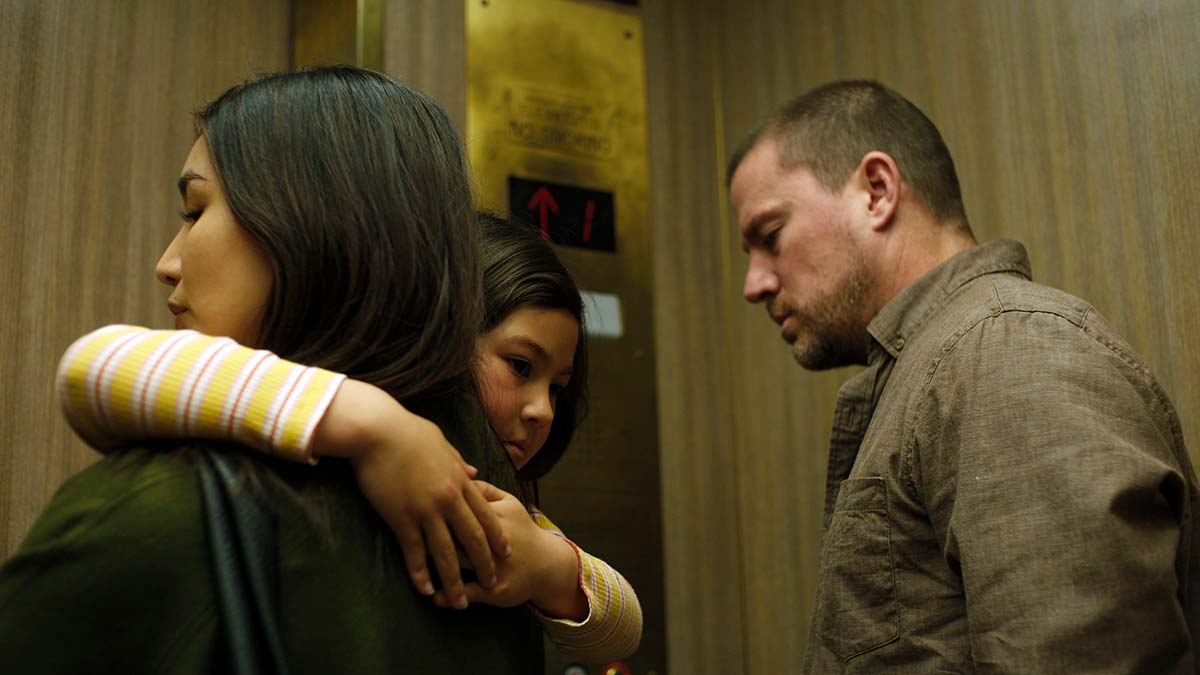
Later, after a decisive day during the trial, the camera follows the small family as they leave the courtroom. It’s a moment of emotional suspension, where the parents are concentrating on the physical motions to reach the elevator, because otherwise they’d break down. Both parents show distress on their faces, struggling to keep it together to spare Josephine from seeing their fragility at a moment when she needs them to show strength. Those seemingly small details in scenes that other filmmakers could have chosen not to show exhibit De Araújo’s keen interest in human behavior under duress, when the things we thought we knew about the world are tested not theoretically, but with real-life stakes.
Near the end, Josephine ponders if the man that she can’t stop seeing is and always was purely evil, and, with even more concern, she worries that she could become like him? De Araújo doesn’t absolve him, but she does force the viewer to engage with the difficult reality that even those “monsters” who deserve consequences for their actions are human—and they children once. Facile explanations are absent from “Josephine,” as they should be, but what lingers is a sense that every gesture of empathy and bravery, no matter how small or imperfect, tips the scales towards good, even if trying feels like a losing fight. [A]
Follow along for all of our coverage from the 2026 Sundance Film Festival here.


