


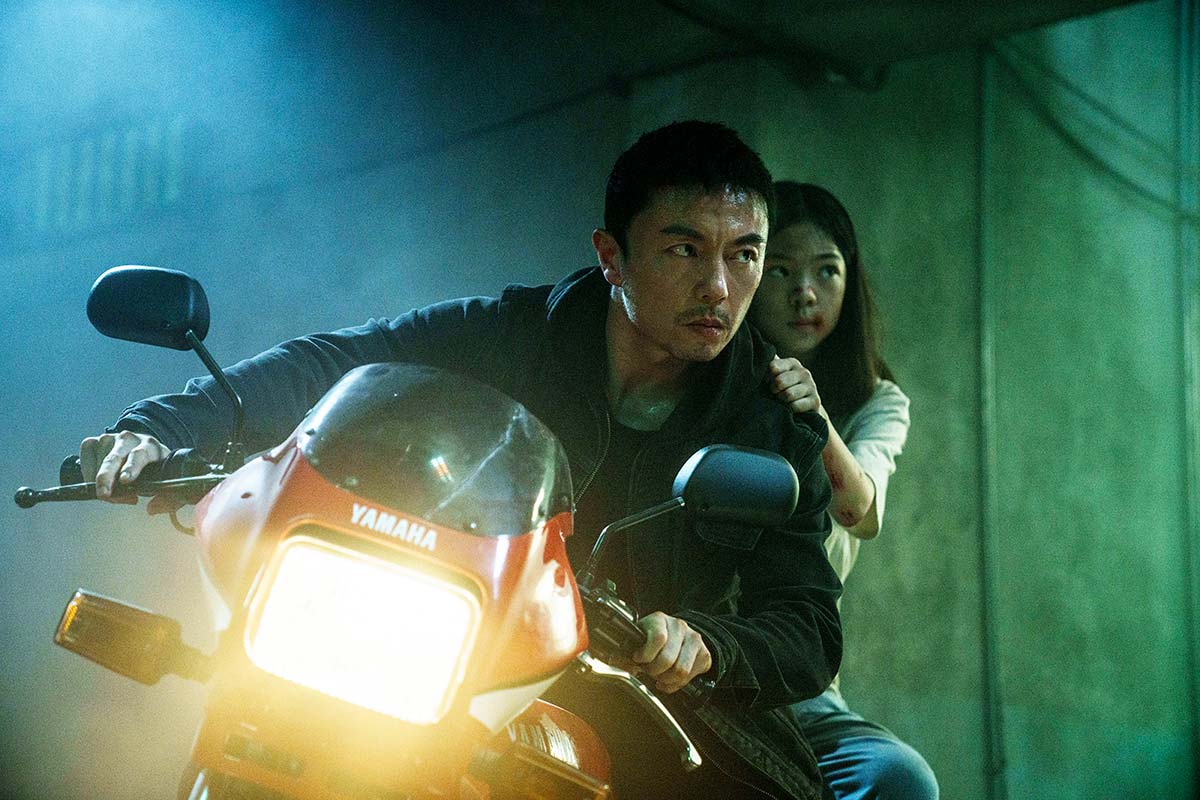
There’s a difference, too, between pain as danger and pain as part of the texture of the performance, right?
Taslim: It’s impossible to achieve something great without sacrificing that. Of course, safety is the priority. But you’ve got to deliver that. You’ve got to surrender to it. And you’re working with people who understand and love you, and people you trust. I got hit so many times, and we laughed about it. They’d say, “Are you OK?” AOK’d say, “Let’s go.”
Sometimes there would be a kick to the body, and I’d say, “You’ve got to do it harder than that.” They’d say, “Are you sure?” And I’d say, “Yeah, give me another 20% because I need to react. If you don’t give it to me, I cannot react.” So when we’re talking about actors doing their own fights, I believe that’s essential.
You can cheat it with a double and still deliver something fun, but to deliver something on the level of “The Raid,” “The Night Comes for Us,” or “The Furious,” pain is the price that you have to pay.
I promised my son one “Mortal Kombat” question after taking him to “Mortal Kombat 2,” which he loved. If there’s another film, what would make you want to return as Sub-Zero, and what would you like to explore with him next?
Taslim: There have been conversations about the future of Sub-Zero. Honestly, I always pitch the idea to the studio and the producers. I really want to do the spinoff. I really want to tell the Sub-Zero story with Scorpion. That’s it. Not talking about the tournament and not talking about “Mortal Kombat” in general. Just talking about these two characters and why they’re trying to kill each other so badly.
So, not just another appearance, but something that actually gets into the mythology between those two characters?
Taslim: What happened before? And then, the relationship with his younger brother, the Sub-Zero. I think that’s beautiful. The siblings, two ice ninjas, and the relationship between them. And why did Bi-Han need to kill Hanzo’s family? That was never really explained. It’s always like, “Because he was assigned to do it.” But I believe there is more to it, because we’re talking about the Shirai Ryu and Lin Kuei rivalry that’s been going on for hundreds of years. So, for me, that’s my dream.
In the press notes, Bill Kong tells you, “Let’s make the ultimate martial arts film,” which sounds great until you actually have to execute it. What made the film come into focus for you?
Tanigaki: I’ve made a lot of different kinds of action films because I’m the action guy, but I had the chance to be the director this time. So why not use actors who can really move? That’s the bottom line because I don’t have to cheat or put in any “MSG,” right? Sometimes we need “MSG” to make an action film. But this time, I’m using “unplugged music.” It’s back to basics. Stay wider. The shots are wider, cleaner, and longer.
When you say “unplugged music,” you mean stripping the action back to the performer and the shot itself?
Tanigaki: I was so lucky to have our talented actors and crew. My focus was to use classic film techniques. I like Buster Keaton and Gene Kelly. They keep the wider shot. Why do they become classics? Because they rely on the actor’s skill, not the camera angle, not the VFX, not the editing. So that’s my focus. I hope the first reaction from people is to applaud the actor.
You can feel that in the movie. A lot of action today is built in the edit, but “The Furious” is designed to be witnessed. Did you shoot much coverage, or was the plan always to stay wide and let the performers do it?
Tanigaki: Actually, I had a lot of coverage because we can make a lot of different versions. But at the end of the day, we used the wider one because we didn’t need the close-up. The wide is cleaner. And yes, you make a strong point because nowadays, many action movies are built in the edit.
But some good action movies, like “John Wick,” directed by Chad Stahelski, my good friend, have that very “John Wick” style. Chad’s style is to stay longer, stay wider, and stay on the actor. He loves the actor struggling. So that’s a good point.
And that style obviously has its own modern language now, too. Did showing the film to Chad give you a sense that you were on the right track?
Tanigaki: Actually, I showed this film to Chad first. I flew to London, and he was very busy prepping “Highlander,” but he made time for me. I showed it to him and said, “Hey, this is my film. Do you like it?” He liked it. That gave me confidence.
I don’t see how he couldn’t. And didn’t you work on “John Wick 4,” specifically?
Tanigaki: No, no. My “John Wick 4” credit is because I was working on another film at the time. So I lent him my Japanese stunt team.
This is such an international film: different fighting styles, actors from different countries, multiple languages, and more English than I expected. Was the goal to make it feel as universal as possible?
Tanigaki: Yes, of course, because an action movie is not just for one area of the world, right? I hope every audience worldwide can enjoy this film. Actually, it’s easier to get a wider audience with English. Why not? Maybe we can use English, even though I don’t speak good English. It’s OK. We’re OK with a wider audience.
Now people are watching anime. People are getting used to reading subtitles. But if we use English, it’s easy to watch and easy to get into. You don’t have to follow the subtitles. It’s easier to get into the character and the story. So that’s our way in.
“The Raid” is clearly part of the modern action DNA here, from some of the cast to the silat influence. How did you push beyond that and make sure “The Furious” had its own language?
Tanigaki: Now I realize “The Raid” is a great film because many people have compared us with “The Raid.” But I try not to follow their way because it must be ours. What is our strong point? We must be unique, right? Different from other IPs.
So it’s less about copying one specific action language and more about folding all your influences into something that feels like yours?
Tanigaki: I’m a big fan of Sergio Leone films, so the five split screens obviously come from the Western genre. And some Korean, Japanese, and anime. I’m a fanboy, so I just combined my favorites. I try not to follow other films. I don’t want to be the follower.
So, does that mean only original movies, no “The Furious 2”? I know there was an announcement of you doing a “Man From Nowhere” film with Joe Taslim. I don’t know what’s next…
Tanigaki: Of course, I want to do a lot of different movies, but “The Furious” is my baby. So I want to shoot a sequel, but the bottom line is that the first one must be successful. So I really need the support. We made this movie, but now it already belongs to the audience. So I hope it will grow from here.
“The Furious” hits theaters in the U.S. and Canada on June 12.
This interview has been edited and condensed for clarity.


