




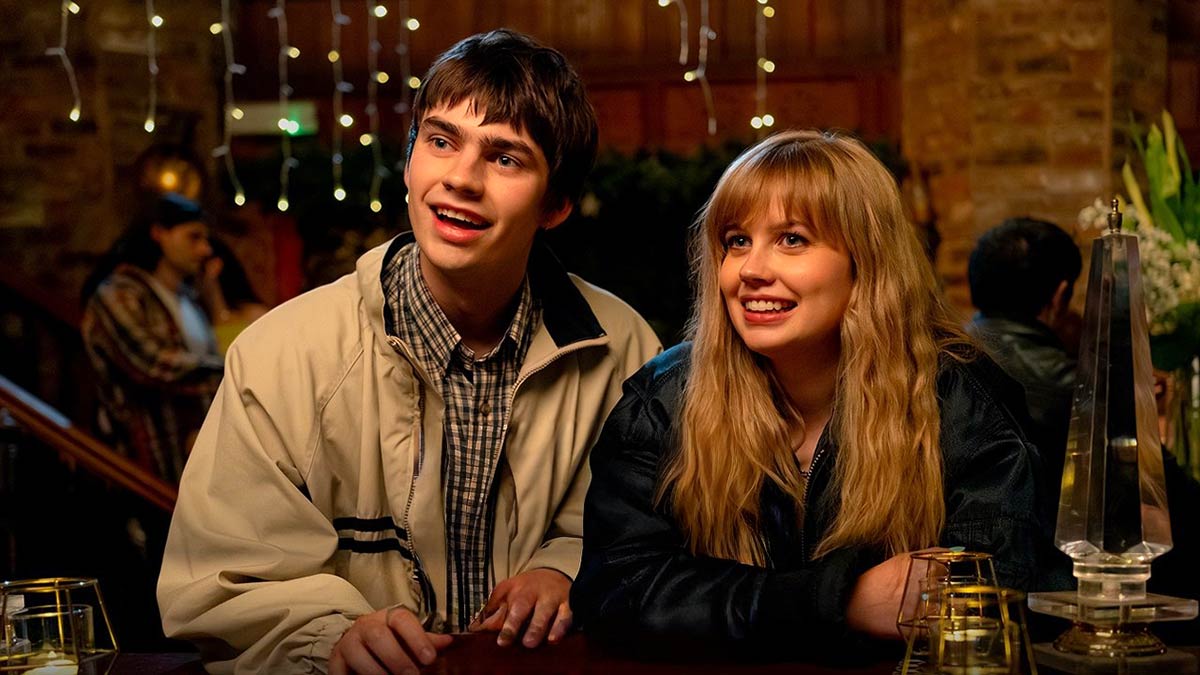
It’s time to start remembering the name Angourie Rice. (It’s pronounced “ang-GOW-ree,” if that helps.) The 25-year-old Australian actress has enjoyed a decade-long run that ought to be the envy of her peers. Rice’s early teenage roles allowed her to learn from some of her profession’s top talents: Ryan Gosling in “The Nice Guys,” Nicole Kidman in “The Beguiled,” and Kate Winslet on television’s “Mare of Easttown.” All the while, she made an impression in familiar franchise fare, whether as a scene-stealing supporting character like Betty Brant in the first three MCU “Spider-Man” films or as the lead of the “Mean Girls” movie musical.
But as the co-lead of “Finding Emily,” Rice takes another step toward defining herself as an adult star in her own right, not merely a student or daughter. As Emily—though not the Emily of the title—Rice gets her meatiest role to date as a soon-to-be psychology graduate preparing for life after university. There’s just one pesky problem for this procrastinator: her thesis paper, which needs to prove Sigmund Freud’s assertion that love is a state of temporary psychosis.
Enter Spike Fearn’s Owen, a lovelorn 23-year-old sound engineer in Manchester who shares a fateful connection with another girl named Emily at a bar. But the phone number she gives him at the end of the night is missing a digit, sending Owen on a mad quest. He settles on a Hail Mary to locate his beloved Emily among the hundreds enrolled at a local university: emailing everyone with that name in the directory. Along the way, his quest intersects with Rice’s Emily, who spots the perfect subject for her study. Writer/director Alicia MacDonald takes Emily on quite the journey from foil to friend — and perhaps more —revealing the mechanics of the romantic comedy along the way and holding certain elements up to overdue scrutiny in the contemporary age.
Rice sat down with The Playlist for a conversation ahead of “Finding Emily” opening stateside on August 28. She discussed what she took away from her formative early projects, how she came to understand her hyper-intelligent character, and where she might want to go next in her career.
I have to say, I don’t think I can say the word “stuff” anymore without thinking of your exchange with Ryan Gosling in “The Nice Guys”: “Don’t say ‘and stuff.’ Just say, ‘Dad, there are whores here.’”
Yep, a classic!
Have you been surprised by how that film has endured a decade later?
It’s surprising to me that I’m still recognized for it because I was 13 when I filmed it, and I’m 25 now. A couple of weeks ago, I went to the Met Museum here in New York, and the guy I bought my ticket from was like, “Oh my God, I love ‘The Nice Guys!’” I was like, “How can you tell, over 10 years later and when I’m in my glasses?” It’s amazing to be part of something so beloved.
I could spend our entire time listing some of the amazing collaborators from your first projects. Is there anything in particular you learned from working with such giants that you’re still utilizing today?
I remember being so spoiled. Everybody was so nice to me, and I had whatever snacks I wanted. I just had the best time, and I think what really stuck with me was that everybody seemed committed to making it a good time for me. Of course, everybody’s there to make the film, but [they also ensured] that I had a good experience. That’s something that now, when I work with younger actors, I want to do, too. I want to be that person for them who’s there saying, “We are here to make a movie, yes, but it’s also important that you have fun.”
I’ve heard movie sets compared to summer camps, where you spend a lot of time together in close quarters and then go your separate ways before reuniting at the premiere. Does that ring true to your experience?
It’s something that I still struggle with. I wrapped a film two days ago, came back from the wrap party last night, and called my mum. I was like, “I’m feeling sad,” and she was like, “Yeah, this happens every time, doesn’t it? Every time you call home sounding so sad!” So, yeah.
It hit me in the second half of the movie that the title “Finding Emily” could just as easily apply to your character’s journey, not only Owen’s. How did you find your way into who Emily was at her core and make that arc feel so natural?
For me, a lot of it was music-based because music is such a big part of this film. Obviously, for Owen, he’s a musician. But I built a playlist before I started listening to it on my way to work, and it mimicked how I thought Emily might have felt upon first arriving in Manchester as someone who’d come from a town in Iowa. It also mirrored the journey of the film, those classic plot beats of the meet-cute, rising action, falling action, all of that. So music was a big part of it, and spending time with Spike, who plays Owen. I mean, he’s just an absolute gem, and I think that relationship is the key to the movie. And I just wanted to hang out with him and hear what he had to say.
Beyond giving her a built-in difference from most of the film’s other characters, what did Emily being an American in Manchester mean to the character?
I think it really made me relate to her in so many ways, being an outsider and trying to figure things out. I also think it says a lot about someone who leaves their town to go to university in another country, where there might be cultural differences and variations in slang and accents. It really spoke to me that she is up for adventure. She is strong. She is independent. She is resilient. She’s just gonna do something, even if she’s afraid of it.
Like Emily, who is putting together a big dissertation in the film, you’re no stranger to writing yourself as a twice-published novelist. Do those artistic practices of writing and acting inform each other, and was that a way into this character?
I think so. Hopefully, writing has helped me see the bigger picture in certain ways, such as understanding who your character is, what their world is, and how they fit into the film’s world. Being able to zoom out, I think, is helpful.
Emily is so well-versed in the archetypes of the romantic comedy and the science of love. When figuring out how to slot into the genre yourself, did you find intellectualizing those dynamics more of a help or a hindrance?
It was helpful because that’s how the character thinks about it. There’s this really interesting push and pull throughout the whole film of, like, head over heart. You intellectualize things, but then, how do you actually feel and express them? Alicia and I went to a lecture together before we started filming about all the theories Emily talks about in the film, and it was really interesting. I read books about it, and I found them helpful. I’m sure lots of people talk about this in their process: You learn everything about the character and the world, then, as soon as you get on set, you throw it all away on day one. I think that’s what Emily does in this film. She learns everything about love, and then, when it comes down to actually being bold and brave and saying how you feel, she has to throw it all out the window.
“Finding Emily” opens an interesting dialogue with classic rom-coms by asking whether tropes like the grand romantic gesture can be both creepy and charming. Did making this film give you a new perspective on the genre or make you rethink some of your favorites?
That’s what I love about “Finding Emily” and what Alicia MacDonald did. Every Emily responds to Owen’s email in a completely different way. We see the whole range. We see girls who say, “I would want someone to do that for me.” We see girls who say, “It’s a bit creepy.” We see girls who say, “He’s terrible and should never be spoken to. What’s he doing?” You see this whole range of responses, whereas previously in rom-coms, we’ve been taught that one response is better than the other. I like how, in this film, we see how everybody feels about it. At the end of the day, the thing that actually matters is how the person you are making this big romantic gesture for is going to feel about it, regardless of everybody else. I think Emily and Owen find each other in that way, and that’s who they are. They love with their whole hearts.
This has been called the summer of Gen Z, with breakout movies like “Backrooms” and “Obsession” spotlighted as reflective of an emerging generation’s values and interests. Obviously, this is a very different kind of film, but do you think “Finding Emily” speaks to something specific about Gen Z’s attitude toward romance and relationships?
I do think “Finding Emily” is a rom-com for the modern era. I think it perfectly balances how we understand what we’ve learned about love from rom-coms and then how we slot that into the crazy world of online dating, things going viral with heightened exposure and being twisted into a quippy little remark, or people being labeled in a certain way. I do think that the film perfectly balances that, and that’s what I love about it. I really think the script captures that.
In the same way that Emily is headed toward graduation and adulthood, your career is moving away from playing teenagers. What’s next, and where do you want to head?
It’s a funny thing, and I think it always changes. It changes for the right story. But I would hope that there are more roles in my future where I get to play someone in their twenties.
“Finding Emily” opens theatrically in the U.S. on Friday, August 28.

Marshall Shaffer is a freelance film critic and journalist based in New York. In addition to The Playlist, his byline can be found at sites including Slant Magazine, Decider, Crooked Marquee, and Men's Health. He is a member of the Critics Choice Association and New York Film Critics Online.

