


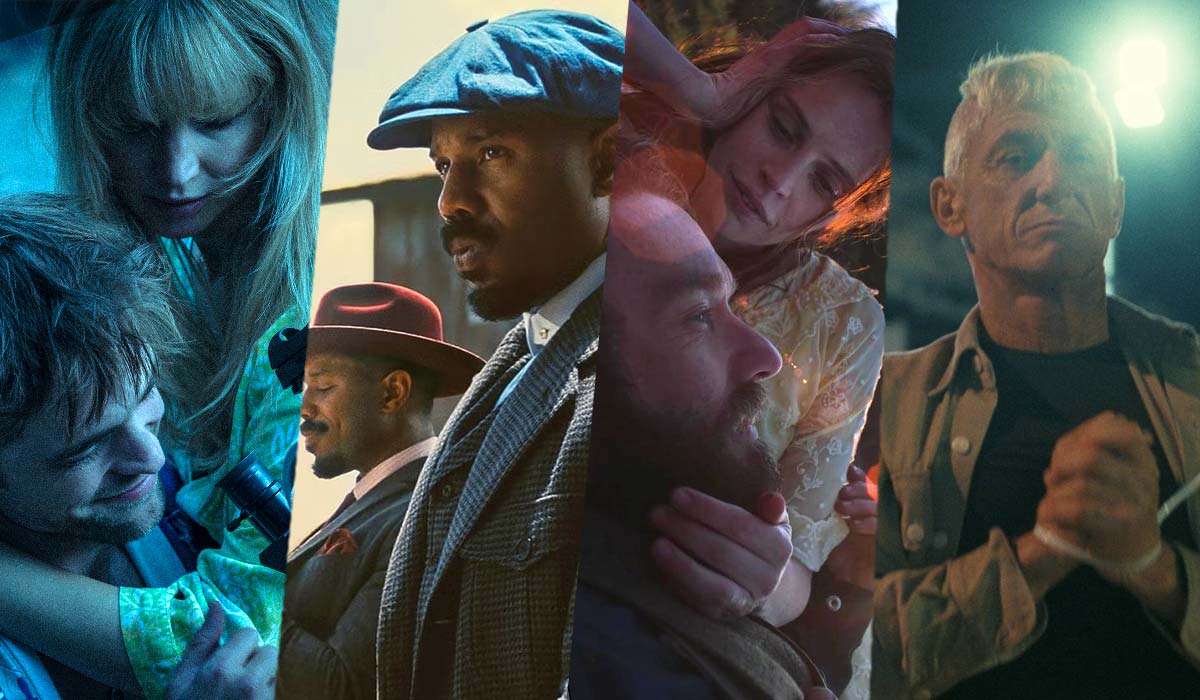
“Left-Handed Girl,” Ko-Chin Chen, Tzu-Hao Kao
Shih-Ching Tsou describes Taipei as a city out of a fairytale, where people do the unthinkable by treating strangers as family and welcoming foreigners into their homes; it is fitting, then, that her solo debut, two decades in the making, should be drawn with such soft edges. Chen and Kao give “Left-Handed Girl” dreamlike textures, and in that, optimism that no matter how bad things get, we can count on the relief of a better ending for Tsou’s characters; at the same time, they maintain realism’s grit, which feels like a tightrope walk in a film as small in scope and scale as this one. This is cinema made with the same DNA as the films of Sean Baker, a natural trait born out of Tsou’s longstanding relationship with him, but with pleasing tension between reality and fantasy–the product of Chen and Kao’s lensing.
“Frankenstein,” Dan Laustsen
“Guillermo del Toro made a pretty movie” became a given a long, long time ago, and as a matter of course, singling out his post-2010s cinema for its aesthetic merits feels an awful lot like declaring that climate change is real. Then again, those merits are pretty high! “Frankenstein” is the most that del Toro has ever del Toro’d, explained by Laustsen’s contributions, who has been the visual author of his movies since 2015’s “Crimson Peak.” Gothic richness is the soul of that film, and this one. (You can cut the “Gothic” and keep the “richness” for “The Shape of Water” as well as “Nightmare Alley.”) Laustsen brings del Toro’s world to glossy life, though “life” in “Frankenstein” is pliable and often not all it’s cracked up to be. At least the settings and costumes are gorgeous, and gorgeously photographed, with all the patience needed to give the impression of a novel’s pages unfolding. – AC
“Sister Midnight,” Sverre Sørdal
A film on rails, in the manner of Jacques Tati and Wes Anderson. Karan Kandhari’s Mumbai-set vampire horror-comedy, where Uma (Radhika Apte), unhappily hitched to her childhood pal Gopal (Ashok Pathak) via an arranged marriage, grows ill and develops a thirst for blood, is constructed with tensile precision: the camera moves, rigid but fluid, through the slums where Uma dwells with Gopal, through streets where she encounters friendly hijras on her perambulations, over rooftops where she finds brief respite from the otherwise restricted world she is condemned to inhabit. The film emphasizes the point that Uma wishes for more and to be more than she is; Sørdal reflects that desire through his camerawork. – AC
“One Battle After Another,” Michael Bauman
A certain A24 film about an upjumped ping-pong champion aspirant gets all the credit for reeking of anxiety, but Paul Thomas Anderson’s latest knockout truly takes that cake. A paranoiac thriller spanning periods, “One Battle After Another” runs on nerves: the nerves of a father, frantically and, with sympathy, uselessly searching for his daughter; the nerves of his daughter, on the run from the United States military, led by an authoritarian weirdo who is deeply confused about his own identity and desires; the nerves of her mother, who dips early in the film, struggling (as many female leads in 2025 do) with the dichotomy of maternity and revolution. Bauman uses proximity to the actors and tightly controlled angles to hem each of these characters in, giving a sensation of confinement even in the California desert, where the film’s climactic car chase takes place, and all nerves are shredded in a single collision over a blind summit. – AC
“On Becoming a Guinea Fowl,” David Gallego
Much of contemporary African cinema treats its locations not so much as characters but as fonts of mystery; take last year’s “Omen” as a prime example of filmmaking where the supernatural and the natural bleed into one another, such that we feel as if we’re watching a story set in a whole other world than ours even though the Democratic Republic of Congo and Zambia are very much real. “On Becoming a Guinea Fowl,” which, for the record, has one of the best titles among all of 2025’s movies, mixes folktale mores with social reckoning and family drama; we appreciate the reality that Gallego captures while also wondering how much of what we’re seeing unfold on screen is real or imagined. – AC


