


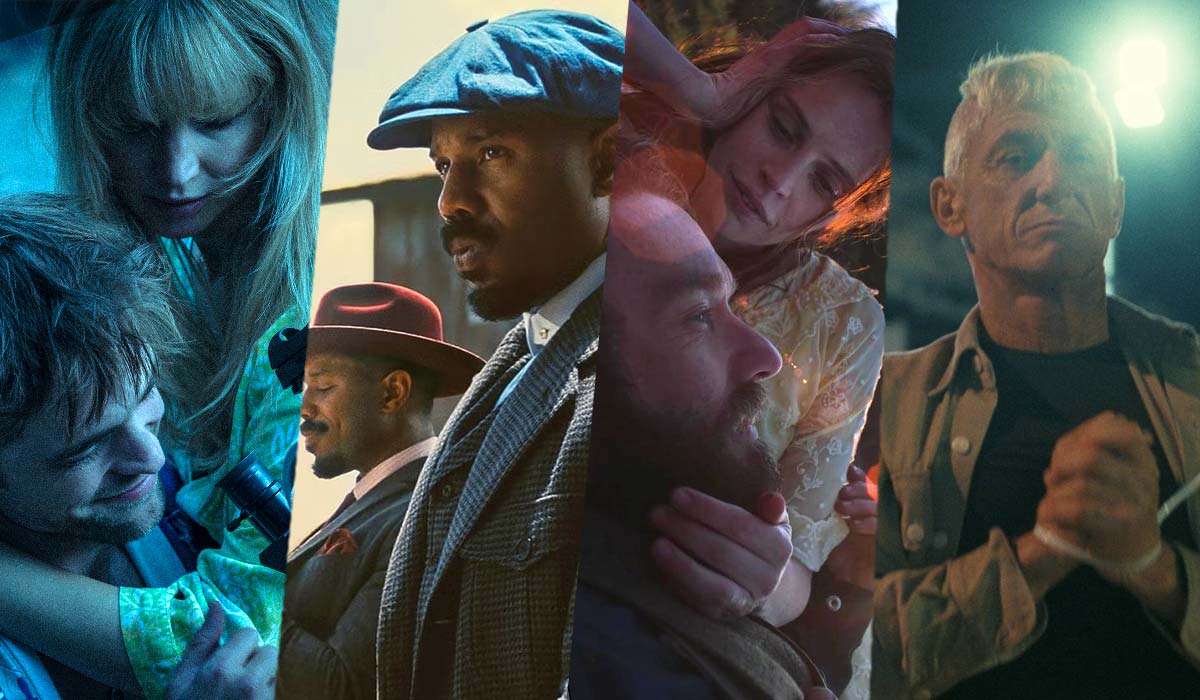
“Reflections in a Dead Diamond,” Manuel Dacosse
Hélène Cattet and Bruno Forzani speak in a visual language that comprises sequences of quick cuts. Consequently, their projects place a premium on meticulous editing over almost everything else; set design and costumes come in close behind. But the person shooting those projects has a harder brief, comparatively, because the images they photograph are so frequently fleeting in the final cut that production leaves them little to no room for waste. Dacosse wastes nothing in “Reflection in a Dead Diamond,” Cattet and Forzani’s riff on Eurotrash and spy cinema, splicing together the lineages of Georges Franju, Jesús Franco, and Mario Bava into a melancholic “James Bond” homage that, in its heart, is about masculinity’s futile attempts at comprehending femininity. Every frame of this film is just shy of sensory overload, but Dacosse brings fidelity to Cattet and Forzani’s script without either skimping on details or taxing our faculties. – AC
“No Other Choice,” Kim Woo-hyung
Park Chan-wook’s body of work is so strongly affiliated with the sumptuous visual style of Chung Chung-hoon, his cinematographer on all but four of his 10 features (six out of 12, if you include his little-seen debut and sophomore effort), that imagining him working with anyone else at this time in his career wracks the mind. But Kim Ji-yong shot 2022’s “Decision to Leave” for a reason, and that logic holds true for Kim Woo-hyung, whom Park worked with on his 2018 BBC One miniseries “The Little Drummer Girl,” and who likewise shoots “No Other Choice” with a handsome, realist chill. Park’s funeral dirge for our increasingly outmoded ideas about “work,” and its effect on society as a collective, maintains his fondness for unique, fastidious compositions, but without the lux touch that defines films like “Oldboy” and “The Handmaiden” and, frankly, 75% of the rest of his movies; it’s a story with grim rooting in the present tense, as hyper-mechanization and the parlor trick called “AI” by charlatan hacks seep into our daily lives no matter that most of us would rather they not. Kim is happy to indulge Park’s inventive side, a’la filming beer poured down Lee Byung-hun’s gullet from the perspective of the bottom of a stein glass, but he’s judicious enough to keep the narrative’s feet on the ground–and all for the better. – AC
“Vulcanizadora,” Adam J. Minnick
Michigan’s woodland is vast and open, and even in hot weather, it’s icy. Together, these qualities form the perfect atmosphere for Joel Potrykus’ grief-stricken tale of masculine nihilism, wherein two friends (played by Potrykus and Joshua Burge) trek through the forest for a camping weekend meant to culminate in something awful. (You’ll likely discern the “awful” before the film gets there, but getting there is part of the dreadful pleasure here.) Even though they’re together, the two leads feel like they’re miles apart; that’s how Potrykus and Burge play their knotted bond, and that’s how Minnick photographs their surroundings and contextualizes the pair within them. There’s no worse feeling than being alone, even when you’re with another person. With bleak determination, “Vulcanizadora” drives home that particular flavor of existential anguish. – AC
“Good Boy,” Wade Grebnoel & Ben Leonberg
Getting a dog to act is an impossible task; Hercules would dip without making even one attempt at it, and given a choice, Sisyphus would probably stick to his boulder. Leonberg and Grebnoel took a different approach to shooting Indy, immediately one of horror cinema’s greatest animal stars, in this eerie, jump-scaring tragedy about a dog and his haunted owner: wide lenses and patience, all the better to give Indy room to do as dogs do and inhabit space, while simultaneously obliterating a need for anything like “direction” as far as performance is concerned. “Good Boy” embodies one of horror cinema’s best ideals–making movies not just on the cheap, but on the fly, by problem-solving and innovating one’s way through setbacks. Grant that Leonberg expected difficulties on set with a dog as his star, but grant also that he and his crew found ways around canine distraction, and wove the convincing illusion of Indy’s thespian chops. – AC
“Black Bag,” “Peter Andrews”
If Steven Soderbergh shoots one of his films using his own name instead of a creative alias, did he really shoot the film? (Put simply: yes.) There’s an informative contrast between “Presence,” his other 2025 release, and “Black Bag,” in the sense of the latter feeling more “like” Soderbergh than the former, even though he shot them both. (Oh, sorry: Peter did.) One might argue that “Presence,” as a horror film, lies somewhere outside of his comfort zone, and that he failed to connect with his material as well as the genre the same way he does with “Black Bag”; one might counter that, more straightforwardly, he just shot “Black Bag” better, bringing to bear his casually titanic application of “cool” on this twisty-turny spy thriller-cum-BDSM romantic drama, where Michael Fassbender and Cate Blanchett sustain a married couple’s amor through the strict application of rules, boundaries, and barriers, and where everyone in the cast is apparently expected to have that drip at all times, as if in accordance with Soderbergh’s dictates from behind the lens: “Sit down. Stand there. Whatever, shut up, just look hot.” – AC


