


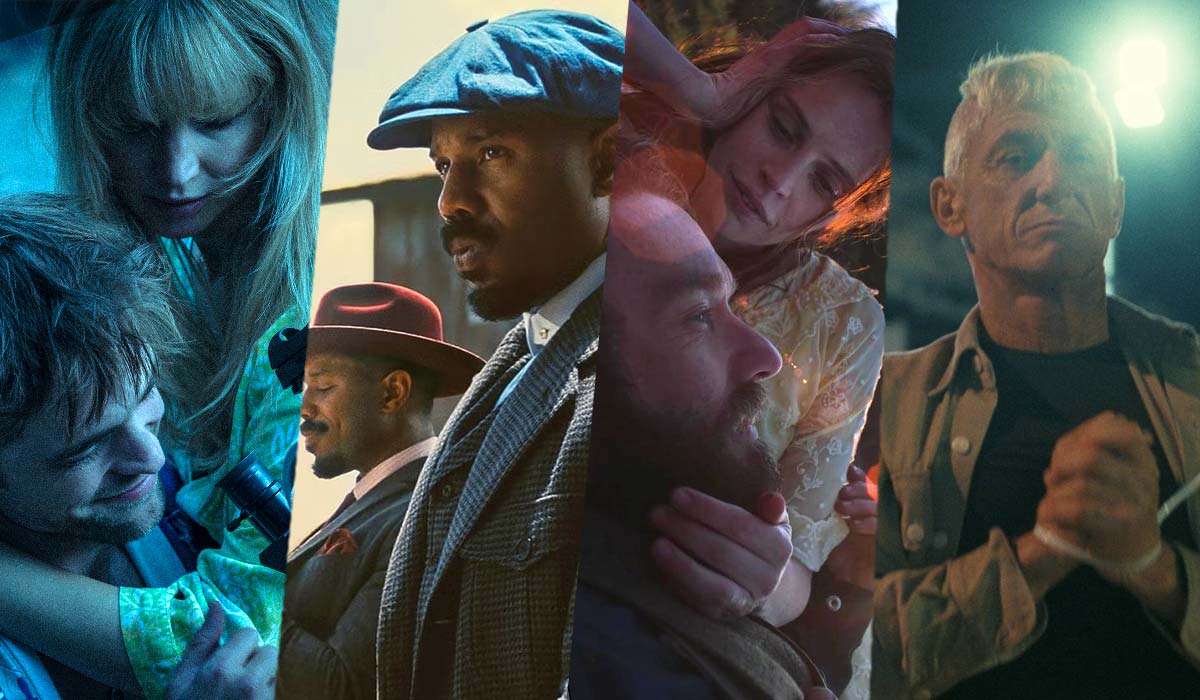
“Resurrection,” Dong Jingsong
Talking about Bi Gan’s latest dizzying arthouse genre whatsit necessitates talking about that oner, being the latest oner to define Gan’s career and shape conversations around his work; see “Kaili Blues,” and “Long Day’s Journey Into Night.” Talking about the oner in “Resurrection” also means talking about Dong’s reality-warping photography, without which Gan’s film can’t function. If film is a collaborative art form, then it stands to reason that every department matters on every shoot, regardless of the movie’s genre or budget. But “Resurrection” is a good example of how one department can matter more than the rest, and how every film is defined by the choices DPs make during shooting, especially for films with such ambitions as this one: Dong seamlessly vaults from silent-era grammar to large-scale spectacle, as if in respect to how they’re intrinsically connected despite being so vastly unalike. – AC
“28 Years Later,” Anthony Dod Mantle
From the grainy video touches of “28 Days Later” to the often majestic grandeur of “28 Years Later” is quite the leap, but, surprise of surprises, it works. In fact, it’s a good bet the film wouldn’t have the same effect had Danny Boyle and Dod Mantle listlessly opted to stick with the same aesthetic here as in the original movie, where said grainy quality enhances the claustrophobic action. In “28 Years Later,” a broader scope is required; the Rage virus has done its work, and Britain has moved forward, though not entirely. There is no need to dress up this story as a lost grindhouse movie from the 1970s as Dod Mantle did. Instead, there’s a greater impulse to connect the series with modern filmmaking sensibilities, and to open up the world by opening up the level at which Dod Mantle is permitted to shoot. – AC
“Eephus,” Greg Tango
It fits that a film named baseball’s lowest velocity pitch should be shot with an easygoing pace to match its namesake: unhurried, unbothered, not at all showy but calibrated to do exactly what the pitcher means it to do. Tango takes his time with Carson Lund’s feature debut; time, in fact, is the film’s chief characteristic, tied to both Massachusetts’ yesteryear, the 1990s, and to the final game to be played on a small town field before the field gets plowed over to make way for construction on a new school. It’s the sort of “times change” development no one can really be upset about, though a few characters are anyways. Rather, it’s melancholic and nostalgic, an elegy for a future to come in a world that’s already left the film’s cast behind. Tango understands well the need for deliberacy here. For what it’s worth, the viewer is left wishing they could spend a little more time with these Sunday league teams, too. – AC
“F1,” Claudio Miranda
Joseph Kosinski tends to treat cinema like an instrument meant to be played loud, clean, and at maximum velocity, and “F1” gives his sensibility the perfect runway: engineered momentum, big-swing emotion, and the kind of spectacle that needs to be felt in the chest. But the movie’s real torque comes from Claudio Miranda, whose camera makes speed legible without sanding off the danger—tracking the violence of the turns, the claustrophobia of the cockpit, the split-second decisions where control looks like instinct and instinct looks like survival. Even when the story stays familiar, the images don’t: the racing has an adrenal, white-knuckle immediacy that turns every lap into a pressure test, the film rocking like a stadium concert that keeps building toward rousing, sustained ecstasy.– Rodrigo Perez.
“The Mastermind,” Christopher Blauvelt
If you’ve never been to New England in the fall, you should, because the foliage and the apples really are worth the trip. But, should the inclination elude you, just throw on Kelly Reichardt’s latest film, and you’ll more or less get the idea of what that time of year is like up in the northeast: grey, dreary, void of the slightest pop of color when you aren’t visiting orchards or parks. That’s just the way that life looks in our colder seasons, or maybe the way it looks through the eyes of J.B. (Josh O’Connor), glum, unemployed and perennially dissatisfied in Vietnam War-era America. Blauvelt, working with Reichardt for the sixth time since “Meek’s Cutoff,” captures mood through his lens–the mood of the nation, the mood of the setting, and the mood of the protagonist, all at the same time, with no more than a desaturated color palette. It’s a perfect, and perfectly simple, method of reflecting theme and character and time, and the film sings in spite of and because of the overarching dourness. – AC


