


6. “Beneath the Planet of the Apes” (Ted Post, 1970)
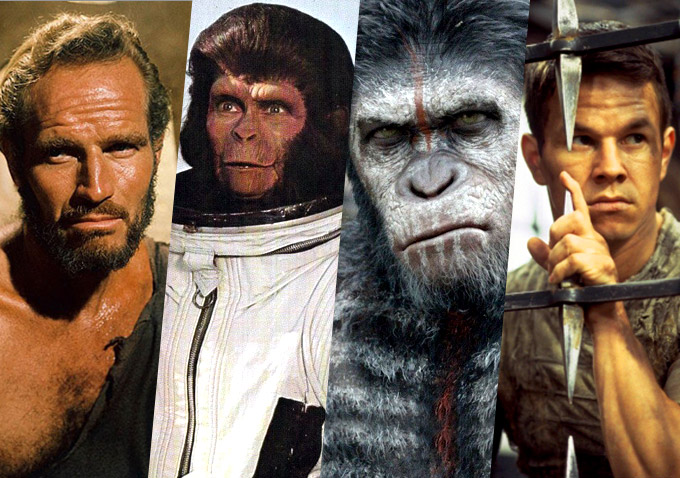
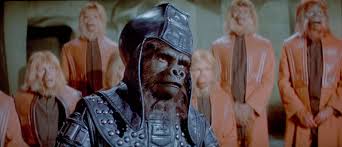
The original “Planet of the Apes” is a hard act to follow, and “Beneath the Planet of the Apes” isn’t really up to the challenge. The movie begins right after the big reveal that capped off the first movie, with Taylor (Charlton Heston, who supposedly donated his sizable check for what amounts to a “guest appearance” to a charity of his choosing) venturing further into the Forbidden Zone. After the earth starts to crack and flames shoot out of the ground, Taylor disappears, leaving the mute (but incredibly hot) Nova (Linda Harrison) to find help. It turns out she doesn’t have to look far, because Brent (James Franciscus), an astronaut who has traveled into the same portal looking for Taylor and his crewmates, shows up. This is problem #1 with “Beneath the Planet of the Apes:” James Franciscus is fucking awful. He looks sort of like Heston, something producer Richard Zanuck later said was a deliberate attempt to confuse the audience, but none of his gravitas or gruff charm. (His beard is pretty good though.) The movie is rather plodding, with Brent going through the same motions that Taylor did, although there are some delightful flourishes: James Gregory as warmongering gorilla commander General Ursus (who utters the immortal “The only good human is a dead human!” line); a long, unbroken tracking shot of the gorilla training camp; and more upfront political commentary, like when the apes, bound for battle, encounter a group of peace-loving chimpanzees with signs that read “Unity in Peace.” (The movie’s lively last 30 minutes, when Brent encounters an underground society of mutants that worships an atomic bomb, and runs into Taylor, is pretty trippy too, if completely nonsensical.) Still, in addition to Franciscus’ wooden performance, there are a number of things that make “Beneath the Planet of the Apes” one of the least engaging entries in the franchise: the large crowd scenes, where extras are clearly wearing Halloween-style plastic masks, the wonky pacing, the lack of Roddy McDowall (he was directing a project in England at the time) and the bleak ending which tries to top the shock of the first film (and doesn’t) and seems to have been designed almost exclusively so Heston wouldn’t have to show up for another sequel.
5. “Conquest of the Planet of the Apes” (J. Lee Thompson, 1972)
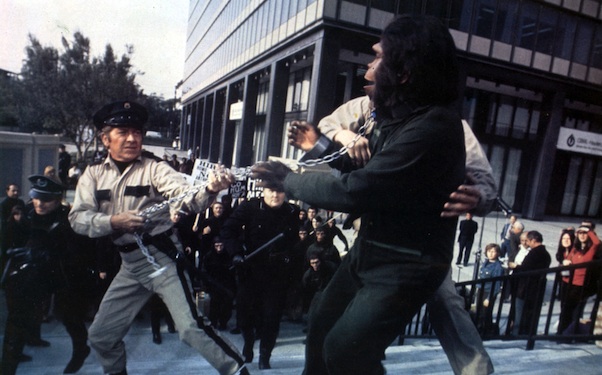
The “Planet of the Apes” films had always been political, but with “Conquest of the Planet of the Apes,” things got angry. And it was awesome. Continuing the tradition of the sequels having bigger canvases but smaller budgets, “Conquest of the Planet of the Apes” takes place in the nebulously phrased “North America – 1991” and was filmed in the newly opened, starkly modern Century City, an urban tangle built on land formerly owned by 20th Century Fox. In the years since “Escape from the Planet of the Apes,” a virus has killed off most of the domesticated pets on earth, leaving apes to supposedly fill that role (and so much more). These apes are basically slaves, and so it’s up to Armando (Ricardo Montalban, back again, this time sporting some wispy facial hair) to protect the super smart child of Cornelius and Zira, Caesar (Roddy McDowall, this time playing his own son, something he described later as “a unique acting challenge”). Of course, Caesar is found out and put through the process the rest of the apes face, a kind of training program/internment camp, which serves to militarize him, until he eventually leads a violent ape revolt against the human oppressors. McDowall is, once again, flawless, and one of the most touching moments in the entire franchise is when he discovers that the human government has murdered Armando. As tears roll down McDowall’s make-up-coated cheeks, there’s no doubt that this character is 100% real. Shortly before “Conquest of the Planet of the Apes” was released, the studio got skittish about the movie’s level of violence and its incendiary political subtext (which referenced everything from America’s history with slavery to more contemporary issues like the Watts riots), and softened the ending, which had Caesar leading an all-out execution of the human prisoners (“Ape management is in the hands of the apes”). That version has been beautifully restored for the Blu-ray release and is the essential incarnation of “Conquest of the Planet of the Apes,” which has its share of cheap drive-in moments but is also surprisingly cerebral and dark. It also set the stage to a truly explosive finale to the series, which unfortunately ended up not coming to pass (see ‘Battle‘ above).
 4. “Rise of the Planet of the Apes” (Rupert Wyatt, 2011)
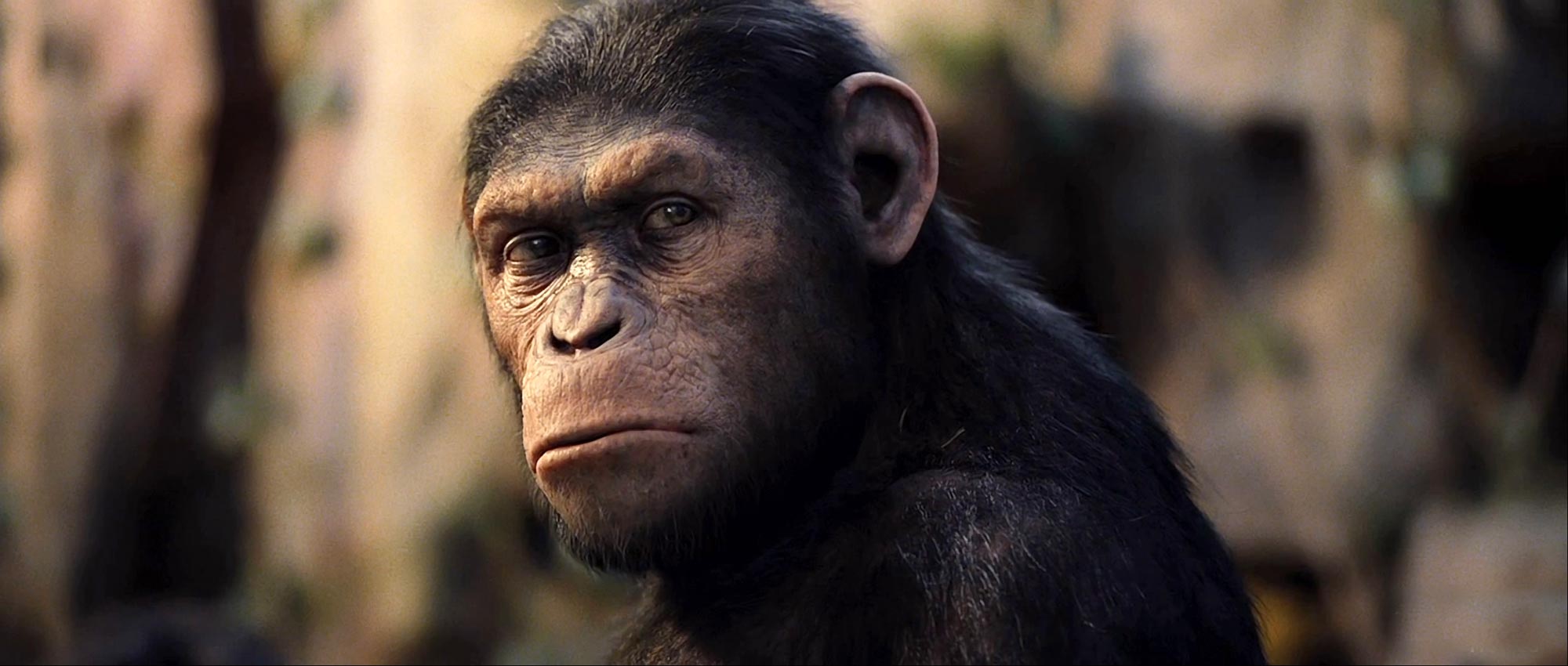
With ‘Dawn’ by all accounts eclipsing the first entry in the rebooted franchise, it would be easy to undervalue “Rise of the Planet of the Apes” by comparison, but that would do an injustice to just what a Herculean task Rupert Wyatt’s film achieved. Bursting out of the gates from the standing start of a moribund franchise whose last attempt at rejuvenation (Burton’s 2001 film) had become more or less a punchline, where it was remembered at all, ‘Rise’ had a seemingly insurmountable mountain to climb to claw back any relevance to the modern filmgoer. But two major factors allowed it to do just that: an industry in which the fields of motion-capture technology and computer generated imagery had made exponential strides forward in achieving photorealist creature effects, and a cracking script that makes the characters of the apes, particularly Caesar, as unforgettably performed by mo-cap superstar Andy Serkis, among the most complex and rounded of recent blockbuster protagonists. Again, perhaps the human characterization suffers a little by comparison—James Franco is not on quite the sleepy-eyed autopilot he is elsewhere but he’s not an especially interesting human foil, and we instantly forgot Freida Pinto was even in this—but perhaps that’s all the better for us to become invested in the apes, not just Caesar but the Maurice the orangutan who knows sign language, Buck the gorilla and the bitter bonobo Koba. For the majority of its run time, the film is a complex, absorbing piece of work, as we watch the watchful Caesar progress from observation to comprehension to the planning and organizing that indicate vastly superior intelligence, all through the minutest of performance details. Indeed the almost-silent-movie-style heist sequence in which Caesar leaves his “prison,” to steal the intelligence-enhancing gas is as fine an example of pure cinema as the tentpole has yielded recently, all culminating in that first, shocking spoken word–“No.” In fact, ‘Rise’ could even have outflanked 1971’s ‘Escape’ and even maybe the 1968 original on this list were it not for its final battle scenes which become suddenly a bit daft by comparison: as action scenes they’re well staged and exciting, but it’s hard to maintain the same level of intellectual engagement when you’re watching a gorilla make a twenty foot jump off the Golden Gate bridge and into a helicopter. Still, ‘Rise’ largely delivered the last thing any of us were really expecting—an intelligent, thrilling ‘Apes’ movie that must surely go down as one of the most successful and welcome franchise reboots ever.

