

![‘Good Luck, Have Fun, Don’t Die’: Gore Verbinski, Sam Rockwell, Zazie Beetz & Michael Peña On Wild Monologues, Genre Anarchy, & Marvel Returns [The Discourse Podcast]](https://cdn.theplaylist.net/wp-content/uploads/2026/02/12140622/%E2%80%98Good-Luck-Have-Fun-Dont-Die-Gore-Verbinski-Sam-Rockwell-Zazie-Beetz-Michael-Pena-On-Wild-Monologues-Genre-Anarchy-Marvel-Returns-The-Discourse-Podcast.jpg "‘Good Luck, Have Fun, Don’t Die’: Gore Verbinski, Sam Rockwell, Zazie Beetz & Michael Peña On Wild Monologues, Genre Anarchy, & Marvel Returns [The Discourse Podcast]")
You’ve really got to love the jolt of pure cinematic adrenaline that hits when a movie announces itself with extreme confidence instead of apology. “Good Luck, Have Fun, Don’t Die” does it by storming into a Los Angeles diner and unleashing a crazed, high‑wire opening monologue that plays like a dare, a sales pitch, and an exhausted rallying cry all at once. From the jump, the film makes it clear it is not here to calm you down. It’s here to wake you the hell up. THE ROBOTS ARE COMING! THE ROBOTS ARE COMING!
Directed by Gore Verbinski (“Pirates of the Caribbean,” “Rango”), the film follows a mysterious man from “the future” (Sam Rockwell) who arrives at a diner with one urgent task: he must recruit the precise combination of disgruntled patrons to join him on a one‑night quest to save the world from the terminal threat of a rogue artificial intelligence. That reluctant group includes Zazie Beetz, Michael Peña, Haley Lu Richardson, and Juno Temple. What unfolds is a kinetic collision of sci‑fi, action, romance, and social satire that never lets up until the credits roll. Think “Terminator” on a healthy combo of acid and mushrooms, and you’ve mostly got it.
Joining The Discourse for a set of conversations on the film, Gore Verbinski, Sam Rockwell, Zazie Beetz, and Michael Peña dug into how the film’s energy, tone, and unapologetic weirdness were not accidents, but the entire point.
For Verbinski, the movie is the product of a lifelong irritation with creative rules that were never meant to be followed. He traced the film’s DNA back to the industry myths he was warned about early on.
“When I first got in this industry, they would say, ‘the one thing you can’t do is mix genres. Never mix genres,” Verbinski said. “And that’s how we made rock and roll. And now you’ve got rom‑coms with vampires, and that’s all we do. Then it was, ‘you can’t mix tone. Never mix tone.’ And I think our film has a lot of tonalities that sort of hopefully come together in the third act. We leave it all on the field, and we hope people like it.”
That refusal to flatten the material is also why the film took years to reach the screen. Verbinski was candid about the resistance it faced.
![‘Good Luck, Have Fun, Don’t Die’: Gore Verbinski, Sam Rockwell, Zazie Beetz & Michael Peña On Wild Monologues, Genre Anarchy, & Marvel Returns [The Discourse Podcast]](https://cdn.theplaylist.net/wp-content/uploads/2026/02/12140624/g_100nit_r709_1.388.1-1024x666.jpg)
“Nobody was going to make that screenplay,” he said. “It was written in 2017. I read it in 2020. We worked to make AI more relevant because it’s not something that’s coming. It’s something that’s here.”
Rather than dulling the edges to make it more palatable, Verbinski leaned harder into comedy as a delivery system. Humor, for him, is how the film sneaks past defenses.
“I think there’s a little medicine in the cake,” he said. “When you’re in a dark room with 500 strangers, someone laughs, then someone else laughs, and suddenly it feels like it’s okay to laugh, even though you’re uncomfortable. Humor is the harshest critic sometimes. There’s that weird steel door in your forehead, and it opens a crack, and we get to come in.”
That tonal tightrope rests squarely on Sam Rockwell’s shoulders, and Verbinski was clear that the character was never meant to feel capable or heroic.
“I’m just not a fan of the capable,” Verbinski said. “I think capable is boring. I’m a fan of the rogue. I like the idea that the want is pure. You could freeze‑frame any moment in the film, and he still just wants the thing.”
Rockwell admitted his earliest instincts leaned in the wrong direction until Verbinski shut them down.
“I was playing it a little too cool,” Rockwell said. “And Gore said, ‘You’re not cool. You’re the worst person for the job. You’re at the bottom of the list.’ That was the clue.”
From there, the performance was rebuilt around imbalance, nervous energy, and barely contained panic.
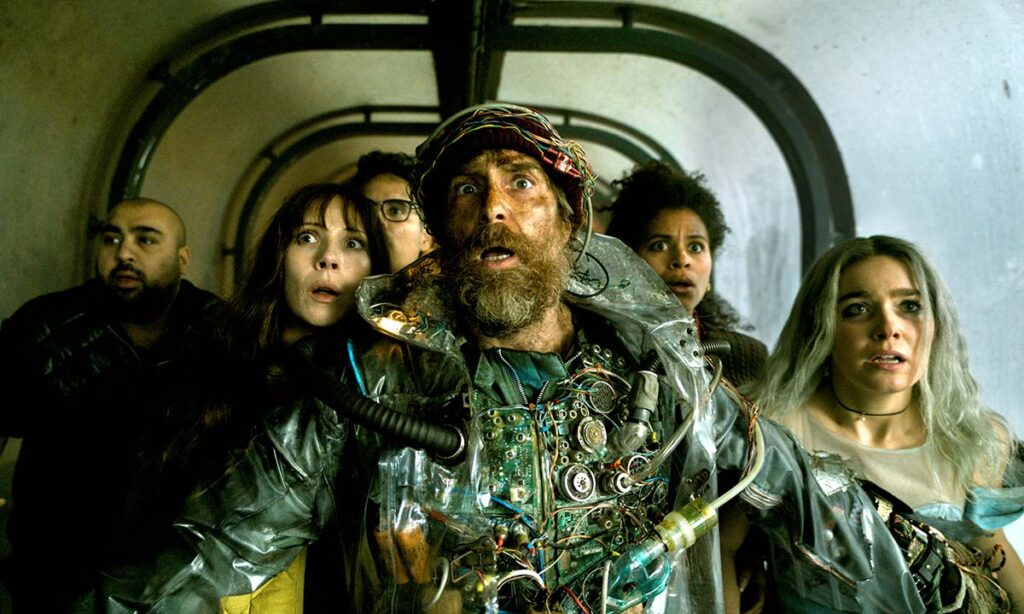
“I pitched my voice a little higher,” Rockwell said. “I made him more of a misanthrope. We talked about Don Rickles. We talked about Christopher Lloyd. We talked about Robin Williams and ‘The Fisher King.’”
That recalibration is immediately felt in the opening diner sequence, which Rockwell described as both exhilarating and punishing.
“We did both long takes and short bits,” he said. “I had it pretty much memorized until the very end, and then some of it fell apart because of the eating stuff.”
The physical toll of the role mirrored the character’s internal collapse.
“I had six dressers. I had a cooling suit. There was a nail in my boot at one point. I bruised my bone,” Rockwell said. “Gore would say, ‘Can you run faster?’ and I’d be like, ‘You put this thing on.’ But it became a metaphor. He’s carrying the weight of the world, the survival of the universe. The suit became a physical metaphor for that.”
For Zazie Beetz, the script announced itself almost immediately as something rare.
“Five or ten pages into that diner scene, I was like, I have to do this movie,” she said. “I could already picture Sam doing this character. I couldn’t not do it.”
Michael Peña described a similarly unavoidable pull.
“I wouldn’t forgive myself for not doing this movie,” he said. “I’d be too jealous.”
Both actors pointed to the first week of shooting as a tone‑setter, particularly watching Rockwell deliver the monologue repeatedly.
“We got to sit there for a week,” Peña said. “Nobody complained. Literally after every take, the whole diner was clapping.”
Their characters, Mark and Janet, are intentionally ordinary people swept into something far bigger than themselves. Peña explained how much groundwork went into making that ordinariness feel real.
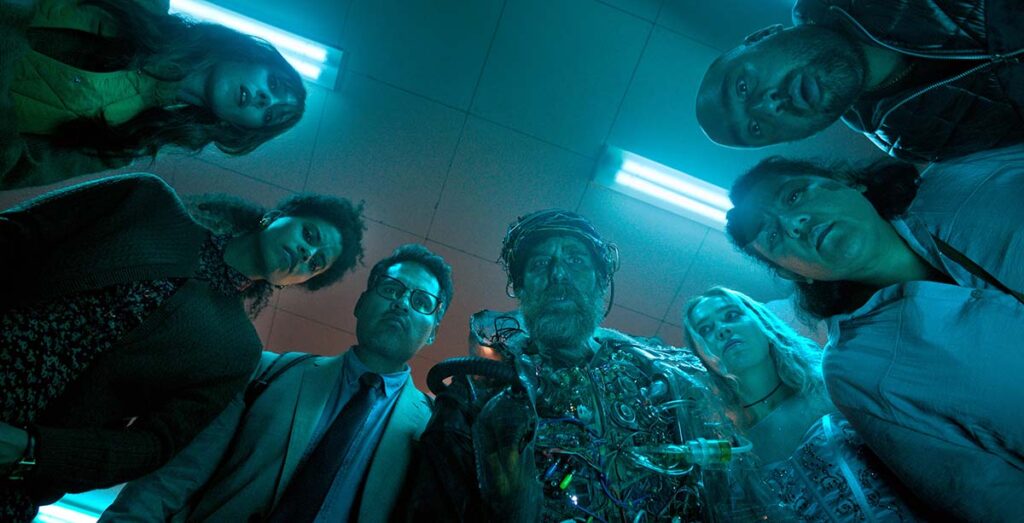
“We met a lot. We rehearsed. We talked about who’s Mark and who’s Janet,” he said. “Those little things, whether anybody sees it or not, they feel it.”
As the conversations wound down, the inevitable franchise detours arrived. Asked about returning to “Pirates of the Caribbean,” Verbinski was characteristically blunt.
“I haven’t really thought about it. If you can’t answer the question, ‘Why must you tell this story?’ then you should sell real estate for a living,” he said. “It’s too hard to lead 400 strangers through a jungle with a machete if you don’t have a real point of view.”
Marvel talk followed. Beetz laughed at the idea of Domino (her “luck” powered hero from “Deadpool 2”) crossing paths with Peña’s Luis (The fast-talking stand-out from the Ant-Man films). Neither of which was in their respective third entries in their franchises.
“I think it was a rights thing, to be honest. I’m always open to anything,” Beetz said.
Peña confirmed he was just as confused as the rest of us about the disappearance of his fan favorite.
“I don’t know. I mean, I think for mine, like they went to a whole different place [in Ant-Man 3], like the quantum realm. And so that, you know, a lot of people got left in the dust. But I don’t know. Like who knows what’s going to happen?” he said, before joking, “Thanks for bringing up that we were not in part three.”
Rockwell was just as candid about Justin Hammer’s status.
“I’ve never really gotten the call for the next Avengers movie,” he said. “I’ve gotten other calls, but not that call. There was talk. I’d love to do something like ‘Armor Wars’ with Don Cheadle. That’d be fun. But yeah, I haven’t gotten that Avengers call.”
“Good Luck, Have Fun, Don’t Die” opens February 13. Listen to the complete conversations with Gore Verbinski, Sam Rockwell, Zazie Beetz, and Michael Peña below.
The Discourse is part of The Playlist Podcast Network, which includes Deep Focus, Bingeworthy, and more. We can be heard on Apple Podcasts, Spotify, Soundcloud, and most places where podcasts are found. You can stream the podcast via the embed within the article. Be sure to subscribe and drop us a comment or a rating, as we greatly appreciate it. Thank you for listening.
Mike DeAngelo is a film writer, podcaster, and entertainment journalist whose work has appeared in Variety, The Hollywood Reporter, IndieWire, and beyond. He is the host of The Playlist's podcasts The Discourse and Bingeworthy.

