


Disaster movies are built to end things. Cities collapse, the planet cracks open, and whatever survives crawls out into the credits. Sequels are supremely rare because escalation usually feels beside the point. But “Greenland 2: Migration” exists because director Ric Roman Waugh never viewed the first film as a one-off thrill ride. For him, it was always the opening chapter of a single emotional story about family, survival, and legacy.
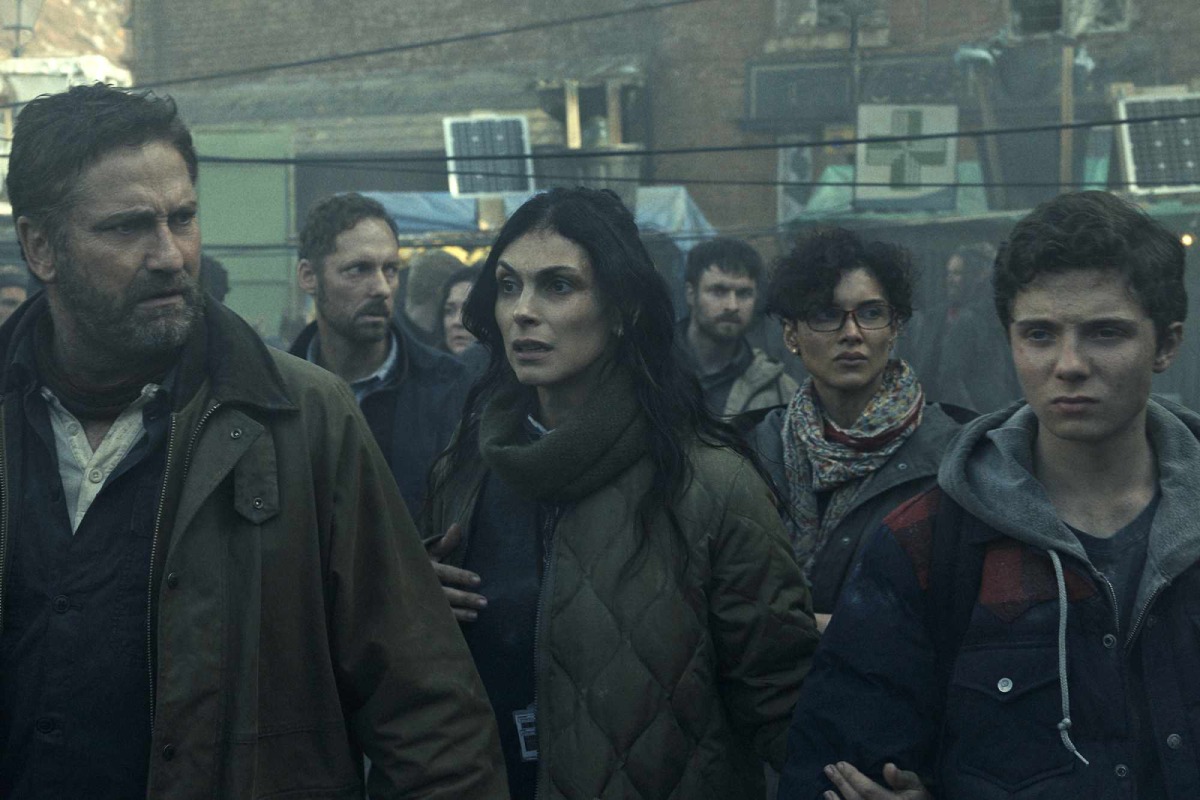
The sequel again follows the Garrity family as they must leave the safety of the Greenland bunker and embark on a perilous journey across the decimated, volatile wasteland of Europe in search of a new home. The film stars Gerard Butler, Morena Baccarin, Roman Griffin Davis, William Abadie, and more.
On this episode of The Discourse, host Mike DeAngelo is joined by director Ric Roman Waugh to discuss why “Migration” was never conceived as a traditional sequel, how emotion allows spectacle to breathe, reuniting with Gerard Butler for their fourth collaboration, and balancing franchise expectations with the fear of repetition.
READ MORE: ‘Dust Bunny’: Bryan Fuller On Monsters, Spielberg’s Notes, Hannibal’s Future, & Creative Differences On Shows [The Discourse Podcast]
What initially drew Waugh to the first “Greenland” film was its refusal to treat catastrophe as a geopolitical puzzle. Instead, it stayed locked inside one family’s experience. “What I loved about the story is they’re always from the inside out. They’re never from the outside in,” Waugh said. “Most disaster films, if not all of them, are always from the outside. You’re cutting to the president, the world stakes, all these multiple characters. What I loved about this was it was about a family. It could be my family. It could be me.”
Even with a premise built around a comet striking Earth, Waugh said the challenge was never plausibility but emotional truth. “It was the first time I was dealing with something that was considered fantastical,” he explained, “but how do you create reality within that? It always comes about emotion. It always becomes about what’s the thrust of that conflict.”
That focus took on unexpected weight when the first film landed during the pandemic. “Suddenly a pandemic hits and you’re like, ‘Who’s going to want to watch a disaster film in the middle of a disaster?’” Waugh said. “And yet it became this phenomenon because you got to live vicariously through something else. Will you be selfless when it’s life or death, or will you be selfish? And there’s all kinds of shades of that.”
When the opportunity to continue the story arose, Waugh said the guiding question wasn’t how to top the destruction but how to move forward honestly. “It was never a sequel for me. It was the next chapter,” he said. “If the first chapter took you up to the extinction event and we didn’t pull punches, the earth was going to get hit and it does. If you were so lucky to survive it, how would you rebuild?”
That question quickly expanded into something generational. “How would you rebuild when the earth is starting from scratch and you suddenly have your own internal conflict as a family?” Waugh asked. “What’s his legacy? What’s her legacy? What’s our responsibility to the next generations to come?”
Despite the film’s expanded scope, Waugh said his approach to scale hasn’t changed, a philosophy shaped early on by his mentor Tony Scott. “What I loved about him is you knew a Tony Scott movie,” Waugh said. “He lived or died by his own sword.” That mentality carries into Waugh’s own work. “If you’re doing emotion first and character first, you get to hide the monster and then show the monster when you need to. I don’t care if your budget’s $30 million, $300 million, or $2 million. You gotta make lemonade out of lemons somewhere.”
That character-first mindset is also what keeps Waugh and Butler returning to each other. “We’re brothers in a way,” Waugh said. “We love each other, we fight, we push each other’s buttons, but it’s always coming from a place that we’re trying to raise the bar. We’re both scared of repeating ourselves, of the mundane, of phoning it in.”
On “Migration,” Butler was especially invested in shifting the focus away from heroics and toward relationships. “He was really pushing on John Garrity the husband, John Garrity the father, John Garrity the human being,” Waugh said. “What would you bring? What would you leave for humanity? How would you pass the torch to your son and create that legacy through him?” That perspective, he added, shaped the entire film. “He’s not in a selfish mode. He’s in the selfless mode of knowing that the Garritys are the sum of all parts.”
The production itself echoed the film’s themes, particularly during the Iceland shoot. “We heard that a new huge fissure opened up outside of Reykjavik,” Waugh said. “And it was hard because you’re hearing the real devastation of it. That lava flow is taking out towns. There’s now a town that does not exist anymore. It’s under lava.” Rather than recreate that destruction digitally, he pushed for authenticity. “That lava flow John Garrity comes across? That’s real lava. That’s not CG. When you go to Iceland, it’s where you see God created the earth. It’s constantly reinventing itself.”
The conversation also turned to whether Waugh and Butler might ever return to the “Has Fallen” franchise, which began their collaboration with “Angel Has Fallen.” Waugh said no sequel is in the works yet, because neither of them is interested in revisiting that world without a meaningful evolution. “How do you do another one where it doesn’t feel like just a sequel?” he said. “How does it become an evolution of who Mike Banning is and his family and who he would be at this point?” While the affection remains, he stressed, “I don’t think either one of us wants to jump back into that saddle unless we can really raise the bar emotionally along with the action.”
Beyond “Greenland,” Waugh also teased his other film dropping this month, “Shelter” a new action film arriving this month starring Jason Statham. “What I love about Jason is I don’t think I’ve ever met anybody so committed to the process,” Waugh said. “What I love about this movie is you’re going to see a different version of him.” He described the story as two lost souls trying to find family, citing touchstones like “Man on Fire” and “The Professional.” “Hopefully it’s another one that’s an emotional ride,” he said. “It was always about emotion first.”
As for whether “Migration” closes the book on the Garritys, Waugh remains cautious but open. “I think it’s always dangerous to go, ‘Let’s make six of these,’” he said. “How about we just make one unbelievably and put everything we have into that one?” Still, he admitted, “There’s a lot of meat on the bone. If it comes together and we’re not replicating ourselves, I’d be all over it.”
“Greenland 2: Migration” hits theaters January 9. Listen to the full interview below:
The Discourse is part of The Playlist Podcast Network, which includes Deep Focus, Bingeworthy, and more. We can be heard on Apple Podcasts, Spotify, Soundcloud, and most places where podcasts are found. You can stream the podcast via the embed within the article. Be sure to subscribe and drop us a comment or a rating, as we greatly appreciate it. Thank you for listening.


