


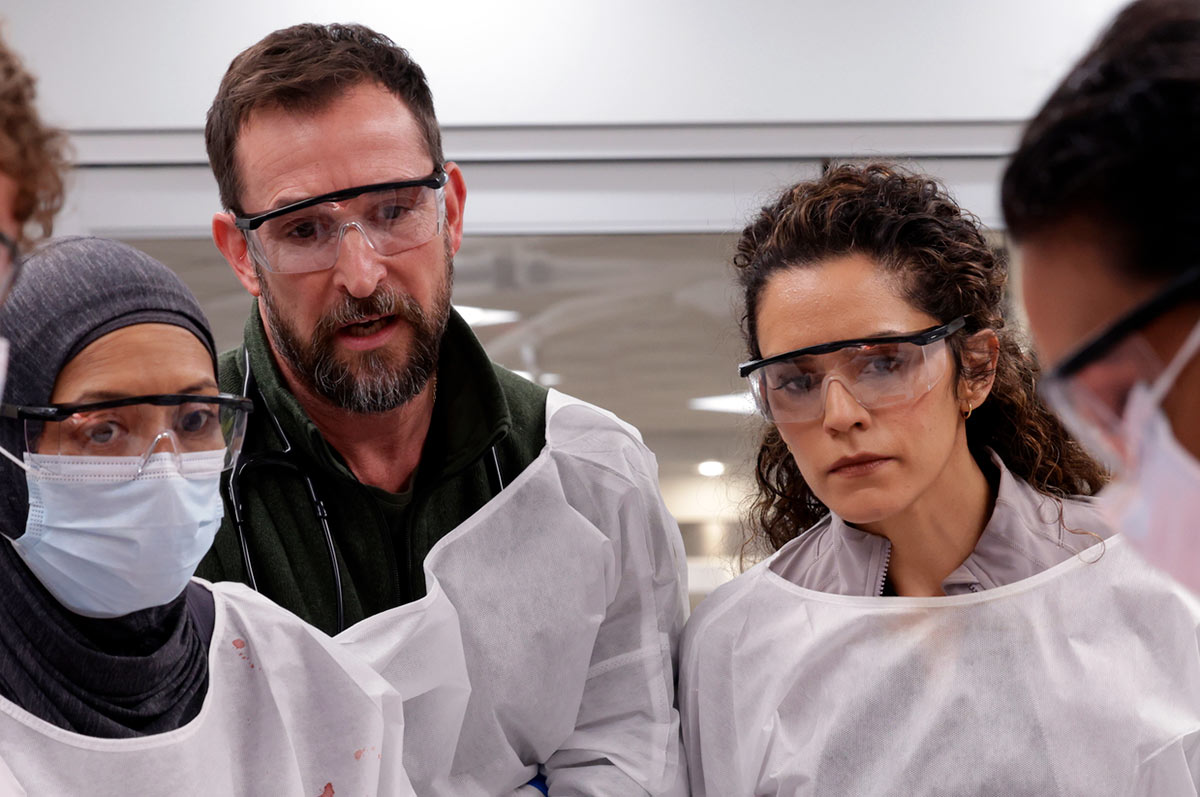
HBO Max’s thrilling medical drama “The Pitt” may be known for its emergency room gore, its urgent “someone’s on the verge of dying” intensity, its interpersonal rivalries, team-building camaraderie, and the taxing emotional labor involved in working at a chaotic hospital’s trauma center. But at its core, it’s a deeply human show about empathy, the responsibility of care and the dignity the best of us doctors afford their usually despondent patients.
Dying is scary, so is the feeling that you’re sinking into the abyss, so it’s really no wonder that first responders like firefighters and trauma doctors are often regarded as true heroes. However, amid the high-stakes pandemonium, grim casualties, last-second rescues from death’s edge, hemorrhages, full-frontal penis surgeries (no, really), exploding diarrhea (no, really), and other headline-getting emergencies this season, is the heart of the show. And it’s one that centers on compassion.
READ MORE: The 75 Most Anticipated TV Shows & Mini-Series Of 2026
Set during a hectic Independence Day Weekend, season two begins with the Pitt team on the verge of witnessing a miracle: Dr. Michael “Robby” Robinavitch (co-exec-producer and star Noah Wyle), about to go on a sabbatical, taking his heavyweight motorcycle up to Canada for some much-needed rest and relaxation. The show’s conceit is 15 episodes chronicling the real-time stress of a 15-hour emergency room shift, one hour per episode and the hour one begins with everyone taking unofficial bets on whether Dr. Robby will actually go on his odyssey and whether he’ll last three weeks, let alone the three months that his motorcycle journey across North America is scheduled for.
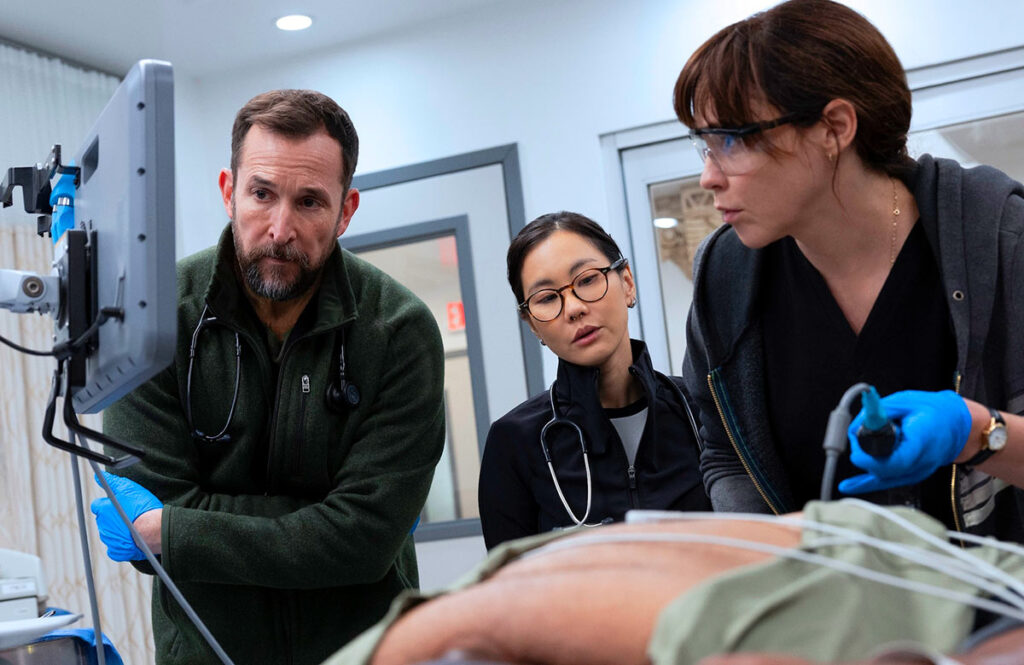
However, before Robby can even contemplate his trip, although one can already see the furrowed-brow anxiety brewing about whether he can relax, the Pitt emergencies start piling up. His most considerable agitation, however, might be Dr. Al-Hashimi (Sepideh Moafi), the new attending physician who is supposed to take over the ER while Dr. Robby is away. She’s progressive, but irritating, espousing the virtues of A.I. for note-taking efficiency (which leads to problems when doctors don’t catch their inherent errors), and wanting to instill many changes that Robby finds unnecessary and even overstepping her bounds. Shadowing him everywhere, she’s like flies on rice, and soon vexes the patience of the senior attendant.
Elsewhere, Dr. Langdon (Patrick Ball) is back from rehab—it was revealed he was addicted to Benzedrine last season while working on the job, a severe desecration of his Hippocratic oath and ethical breach. Usually Dr. Robby’s no. one lieutenant and right-hand man, the trust between them is broken, and while Langdon does everything he can to promise his colleague this dishonorable violation will never happen again, Robby’s not only unsure if he can ever find his way back to forgiveness, he’s unconvinced he wants Langdon working in his ER at all.
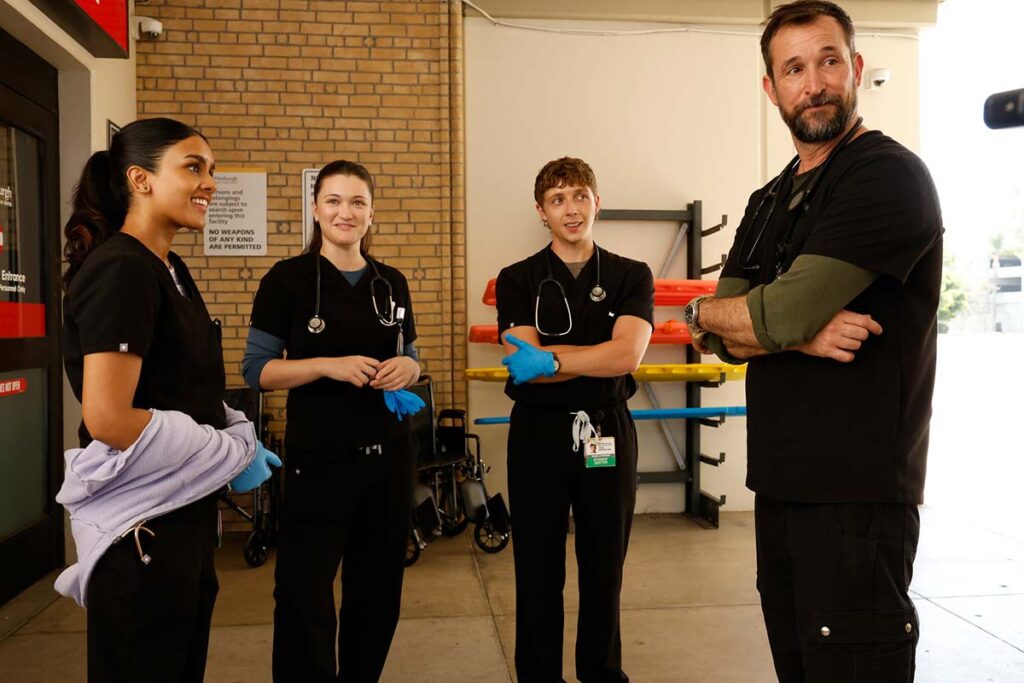
Katherine LaNasa as Dana Evans, the tough but caring and dedicated charge nurse in the ER, was already a breakout in season one. Still, she continues to soar in season two and is arguably not only the best character, embodying a deep sense of compassion that will move you to tears, but also the best actor on the show.
Nebraska-born Dr. Whitaker (Gerran Howell) also steps up his game (both character and actor), transitioning from overwhelmed medical student to reliable first-year resident who has not only grown in confidence, but also begins to mentor some of the other residents, including newcomer and recently graduated nursing student Emma Nolan (Laëtitia Hollard). Nolan’s part of an achingly bruising sexual assault that also includes the aforementioned Nurse Evans, but it is handled with such grace and care, you want to restore your faith in humanity and the broken system.
Meanwhile, Dr. Mohan (Supriya Ganesh), Dr. Santos (Isa Briones), Dr. McKay (Fiona Dourif), Javadi (Shabana Azeez) continue on their respective journeys, evolving and facing conflicts along the way; Mohan meticulous; Santos, too brash and still ambitious; Mckay, as resilient as ever, and Javadi, talented, but overconfident leading to near disaster.
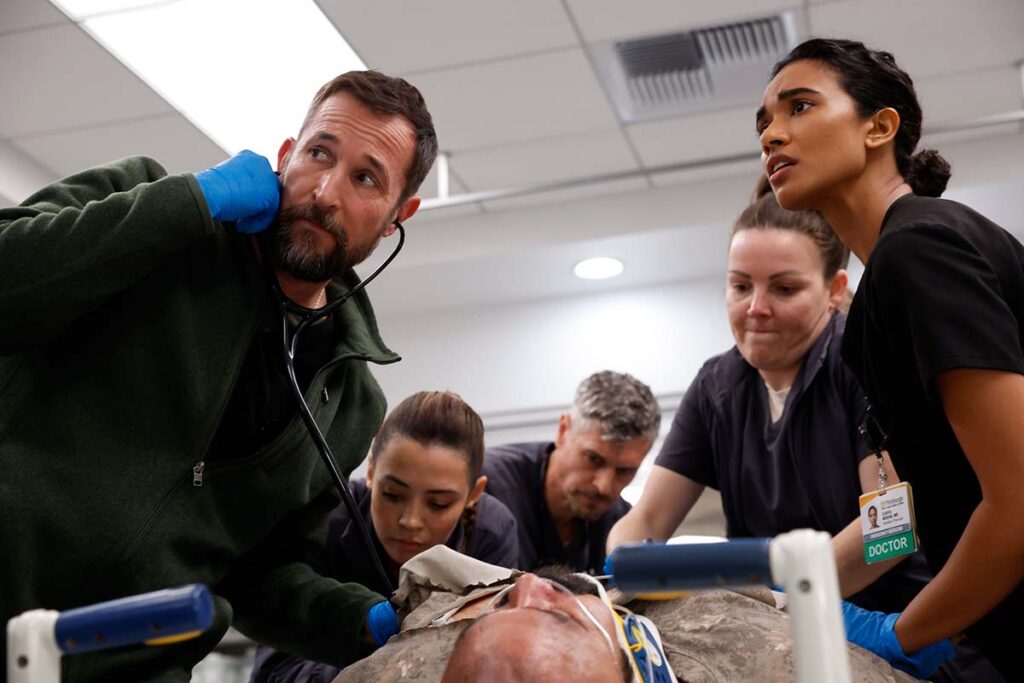
Faring far less well in season two was the breakout Dr. King (Taylor Dearden), the warm and sharp neurodivergent-coded doctor. Having to deal with an impending deposition later that day—she’s part of a malpractice suit, which is par for the course for doctors in America, and something the other healthcare workers are an occupational hazard, not to worry about—she’s zoned out. Preoccupied, Dearden plays the character as if she’s somewhere between drowsy, inattentive or narcoleptic and while this may be accurate behavior for ADHD-sensitive people, it’s annoying and leaves her usually vibrant character feeling like a listless third wheel and liability, as if she’s suddenly verged into the harder edge of the autism spectrum.
And that problem might be one of the defining glitches of season two, as some characters press on the pedal of their character with too much force; even the terrifically played Nurse Evans seems to be extra with her Pittsburgh accent.
Still, the issues are mostly minor. Not to mention, there’s a new breakout cast member this season, Irene Choi as Joy, a third-year medical student with a seemingly dismissive attitude. Abrasive, sarcastic and seemingly callous, Joy irritates at first, but as her character’s competency and strong medical knowledge unfurl to their full potential, she definitely becomes the most compelling new cast member of season two. Likewise, Lucas Iverson, as a very competent and competitive fourth-year medical student, is also a terrific standout. There’s no doubt, bot
Created by R. Scott Gemmill and producer/director John Wells, part of the reason it continues to work is that the show’s real-time gimmick isn’t really a gimmick anymore—it’s the engine that forces everything into consequence. It’s also a confident show, with absolute self-belief in its structure and rhythm; it trusts the hour-by-hour design and the clipped scene grammar, never seeming like it’s scrambling to justify the conceit. One hour bleeds into the next in interrupted conversations, scenes that cut short, and moral debates taking place while someone is actively dying in the next bay. Even a small misread chart, a bad assumption, or an unchecked A.I. note can quickly metastasize into something catastrophic.
Season two is sharper about systems—how “progress” often arrives dressed as efficiency and quietly shifts the burden onto already overtaxed workers. Al-Hashimi’s A.I. evangelism isn’t a cartoon tech-bro strawman; it’s that familiar institutional push to streamline care into something measurable, trackable, and faster, whether the humans doing the work can keep up or not. The show uses that tension to define Robby, too: he isn’t only stubborn (though he’s that too and defensive); he’s also resistant because he’s seen bureaucracy and shiny fixes turn patients into data points. When “The Pitt” is at its best, it argues that care can’t be automated into a workflow without losing something essential.
And yes, the series remains gleefully unflinching about bodies. It makes you wince and, at times, look away. But the gross-outs don’t feel like a dare; they underline the ER’s blunt realities—biology, panic, humiliation, fear—and the vulnerability of the people on the other side of the curtain. That’s why LaNasa’s Evans remains such a crucial anchor: her compassion isn’t performative or precious; it’s practiced, bracing, and sometimes expressed through tough love because the job doesn’t always leave room for softness.
If anything, the season’s biggest limitation is also its comfort zone: “The Pitt” is less interested in big reinvention than in grinding, incremental pressure, and for some viewers, that may feel like another shift, another cascade of crises, another set of on-the-job fractures that only half-heal. But that’s also the show’s honest point of view—hospitals don’t hand you narrative closure; they hand you the next emergency. And even when it’s messy, occasionally overplayed, or a little too broad in its character strokes, season two still lands because it refuses to confuse cynicism with realism. It keeps returning to the dignity of the living, especially the ones forced to keep showing up. [B+]

Rodrigo Perez is the founder and editor-in-chief of The Playlist, which he launched in 2008. He has worked in entertainment journalism since 2000, including at MTV, and has written for SPIN, IndieWire, Pitchfork, Complex, Magnet, and various music, film, and entertainment publications over the past two decades.

