


You’d never written a screenplay before. How did you convince the producers of this film to let you co-write the screenplay? And then, when did you realize, wait, as a movie, it needs to start somewhere else?
Well, actually, I didn’t persuade the producers. Chloe persuaded me because I heard that she wanted to come on board, and I was thrilled. She’s brilliant, and I knew that she wasn’t going to make a kind of cliched, pristine, costume-y drama because I didn’t want it to be that. And I also knew that she wasn’t coming from the angle of adoring Shakespeare. And I knew when she said, “I want to make it about Anne, and I wanted to make it about the children.” And I just felt that she was in my bones, that she was the woman for the job. But she sent me a message via the producer saying that she wanted to write the screenplay with me. And I said, “Oh, no, no, I’m moving onto another book. I’ve got other things going on. I’ve written the novel, and that’s enough.” So, I got on a Zoom call with her fully prepared to say all this to her, just to say, “I’m not going to do it, but best of luck, and let me know how it goes.” I dunno what she did, but Chloe is a very persuasive person, and by the end of the Zoom call,l I had agreed to write the script with her and to do the first pass. I remember shutting my laptop and just thinking, “Wow, what the hell just happened? I don’t really know. I think she may have put a spell on me or something.” But I’m really glad that I did have a change of heart. I’m very glad that I did.
What was your writing process? How would you guys work this out?
I think we started with the kind of macro scale of it all because obviously, as you say, the film is chronological. The book, I mean, it doesn’t play that much with chronology, but it does go backward and forward in time from the day the twins get ill to the meeting. And it is fine on the page, but it doesn’t translate brilliantly to the screen. So, the first job that we had to do was to disassemble the non-chronological order of the book and reassemble it chronologically. And also decide what had to go because cutting a 350-page novel down to a hundred-page screenplay, there’s a lot of cutting that has to happen. And it was an interesting process because Chloe had quite a clear vision about what she wanted, the sort of endoskeleton of the book that she wanted to take and move into a film. At that stage, it was my, job to say “Yes, but if we take that out, then further down, so there’s a kind of domino effect, and nobody understands why that character does X or Y if we remove this.” So there’s a lot of back and forth about that. Then, gradually, the focus became more micro and individual scenes or lines. I’m usually out in Scotland or an island, and Chloe was mostly in California. I think she was living in LA at the time. So there’s a big time difference, obviously. And Chloe’s a very good leaver of voice notes. She loves voice notes, and I would often wake up in Edinburgh, and I’d switch on my phone, and then the phone would go, “Bing, bing, bing, bing, bing, bing, bing.” 14 voice notes from Chloe. I think in a way our skills are quite different but quite complementary. I think she tends to work out how she thinks. Her thought process is often done by verbal reasoning, by sort of extemporizing on something, whereas I always have to write if I’m going to work out a sort of naughty problem in the narrative. So, some of these voice notes would be a minute, and the longest one ever was 58 minutes.
I didn’t even know you could record a voice note for 58 minutes.
Neither did I! But yeah, so I have a notebook, which was just for the screenplay. I would transcribe what it was she was saying, but that’s just the way she works. I think we have very different but very complementary skills in a sense. And I think that’s why it worked.
Was there anything that you were maybe sad that you actually had to not take out of the film screenplay that had been part of the book?
I think so, but I mean, obviously, you couldn’t make a replica of a book into a film. There’d be no point in making it if it were going to be exactly the same. The film isn’t going to be a twin of the book. It’s more like a sibling or maybe even a cousin. I think we had to cut a lot of the lives of the siblings in the film. And you don’t quite see the full texture of their parents. But that’s the way it is. I mean, for me, the huge strength of the film, which is really joyous for me, is that the end section where you see Hamlet in The Globe in the novel, that’s quite telescoped because you can’t put in massive chunks of Shakespeare [in a book]. It just won’t work.
Oh, right.
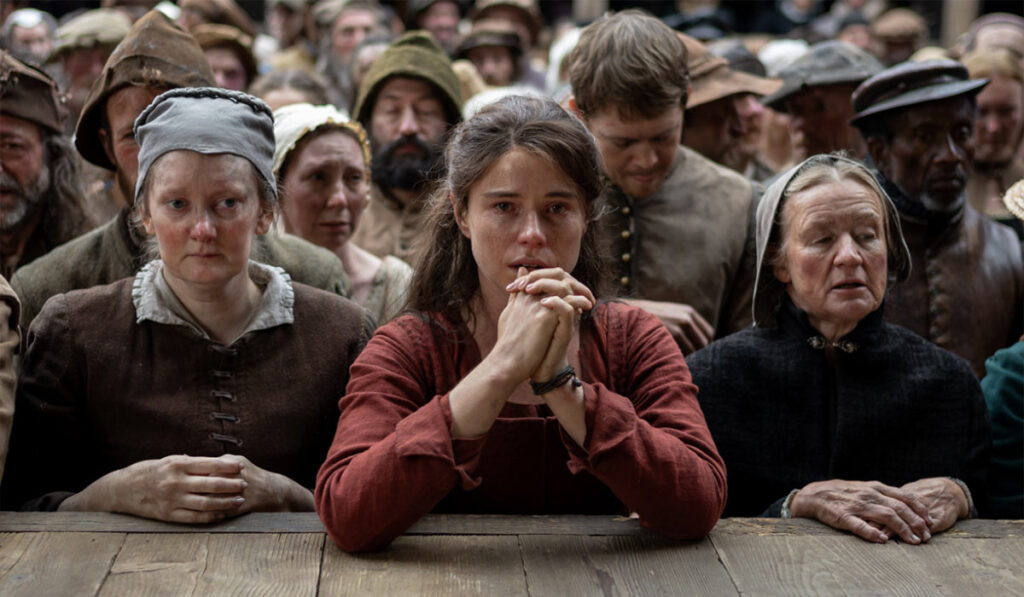
You can’t transcribe “To be or not to be” in a novel. So, actually, in the film that’s really fully fleshed out in full color, and you get a lot more of the play in there, which for me is wonderful. I love seeing that. I mean, if I were allowed one journey in a time machine, I would say, “Please, can I go back and see the first production of ‘Hamlet’ at The Globe?” But here it is. So, I think that’s a huge bonus of the film, which you don’t get so much of in the book.
I’m going to ask, on the flip side, was there something that was in the book that you were passionate about making sure was in the movie?
There’s one speech, actually, which Emily Watson delivers as Mary, William’s mother, which is about her losing her children. Mary lost three daughters. There were two girls before William was born, and then another girl, Anne. And that one for me always held the essence of the book. And I always said to Chloe, “We have to find a way to put that in.” And also Emily Watson, I mean God, the way she delivers it. When I saw the close-up of her face, I thought I literally could not have asked for a better actor. If someone has said to me your dream casting for this role to deliver the speech. I’m so happy every time I see that on screen, I think, yes, it’s there. And it’s almost word-for-word from the book. She’s a queen.
What do you think fans will appreciate the most about the movie compared to the book?
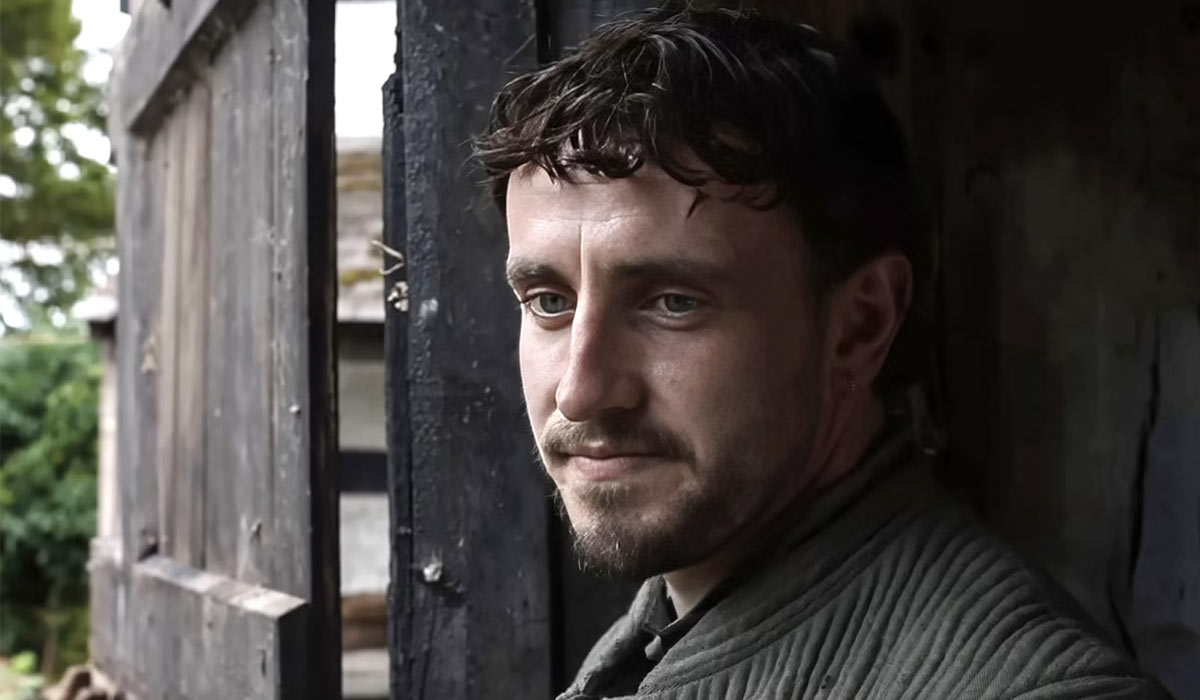
I mean, I think it’s similar enough to the book to make people who love the book happy, but Chloe’s kind of taken it and run with it, which is exactly what should have happened. I think it’s wonderful. I mean, even the last 10 minutes in The Globe is worth the entrance ticket alone. It’s so fantastic to see it like that. And the cast is just incredible. Every single person on screen, I think, is just so perfect and gives an incredible performance. And Chloe pulls those performances out of them. I mean, the child actors are incredible. The boy who plays Hamnet is just jaw-dropping every single time he comes on screen. You can’t look away from him. And Jesse’s a kind of dream as Agnes and Paul is fantastic as Shakespeare. I always wanted it to be Paul. I saw him on stage years ago when he was probably still a student in Dublin at the Gate Theater, and he was playing Stephen Dedalus in “Portrait of the Artist as a Young Man.” And even then, I thought, “My God, who is that? He’s so good.” But also, there’s a kind of thematic link between Stephen Dedalus and Hamlet. So, I always said Paul Mascal, Paul Mascal for Shakespeare. And I mean Jesse’s just incredible. She’s got the most amazing face. You can just see the emotions pass across it. Sort of weather on the landscape.
Also, that score is unbelievable.
Yes!
You had not planned on being a screenwriter. This wasn’t something on your bucket list, but do you have the bug mow? Do you want to write more screenplays?
I don’t know. I’d definitely be open to it. I would like to do it again. I think it’s a really nice. I mean, I’m not saying I really want to carry on writing novels. I’ve just finished one. It’s a really interesting contrast. The life of a novelist or a writer is very solitary, and I really like that. I love that kind of very focused attention on just a project that you’re doing on your own. But then, to contrast that with being on set with 800 people and extras, it’s amazing. When I walked onto the set of “Hamnet,” it was so clear that everybody from the grip to the set designer to the costume designer to the director of photography, everybody was absolutely at the top of their game. And it was fascinating seeing all these different personalities working together. So, I have to be up for it again, just because it’s really interesting.
One last quick question. You said you just finished a new novel. Can you say anything about it?
Oh, it’s not a secret. It’s coming out next year, on June 26th. And it’s called “Land,” and it’s set on a 19th Century Island in the years after the Great Hunger, the famine.
Oh wow.
Based on the life of my great-grandfather, who was making maps for the British.
After the success of “Hamnet,” you may have some producers wanting to get rights to that, too. They’ll be coming.
We’ll see.
“Hamnet” is now in limited release. It expands nationwide on January 16.
Follow Gregory Ellwood on Bluesky
Follow Gregory Ellwood on Threads
Follow Gregory Ellwood on Instagram
Sign Up For The Breakdown Newsletter

Editor-at-Large Gregory Ellwood is one of the entertainment industry's most respected journalists and critics. Based in Los Angeles, he's the only current awards expert who previously worked on Oscar campaigns at a major movie studio. Over the years, he has written for the LA Times, Variety, The Hollywood Reporter, and Vox, among others. He also co-founded the entertainment news site HitFix, which spawned a legion of influential Emmy and WGA Award-winning alumni.


