



In the HBO drama “Industry,” co-creators and writers Mickey Down and Konrad Kay—both veterans of the dizzyingly fast-paced finance world they’re dramatizing—track a ruthless ecosystem where young bankers and power players scramble for leverage inside London’s investment scene. What starts as a portrait of grind and aspiration quickly becomes something sharper: a series about how money distorts relationships, how loyalty becomes transactional, and how ambition turns into a kind of daily survival.
No character embodies that constant churn more than its volatile protagonist Harper, played by Myha’la. Ferociously driven and ruthlessly ambitious, she’s brilliant, resourceful, and always reaching for the next rung—often with an all-or-nothing intensity that can look fearless one moment and self-destructive the next. She’s distinct not just for how fast she thinks, but for how willing she is to bend rules, burn bridges, and gamble on herself to stay ahead.
READ MORE: The 75 Most Anticipated TV Shows & Mini-Series Of 2026
In our conversation, Myha’la talks about why the role has been such a rare long-form gift, reflects on the show’s steady audience growth, and unpacks the messy love-hate DNA of Harper’s bond with one-time mentor Eric (Ken Leung)—a relationship that keeps reshaping itself, even when it looks, on paper, like war.
Harper continues to reveal new sides of herself with each passing season. What’s it like getting to play a character who’s constantly evolving?
It’s an absolute blessing—joy, privilege, the kind of once-in-a-lifetime opportunity you hope for. Building a whole life over multiple years is incredible. You get to evolve with a person, challenge who they are, and discover new parts of them as their world expands. It’s fun. It’s every actor’s dream to dig that deep.
Did you expect the show to continue growing at the same pace it has over the past four seasons?
You never know. You never know how something’s going to land—whether it’ll find its audience or even get the chance. But I knew the show was good. I thought the writing was incredible. When I finally saw it, I felt: whatever happens, I believe in it. There’s plenty of great work that never finds its audience or its accolades.
Growing the audience each season and being critically appreciated in a way that I have always enjoyed—and in a way that validates Mickey and Konrad’s writing—is truly meaningful. I’m grateful for the attention the show gets.
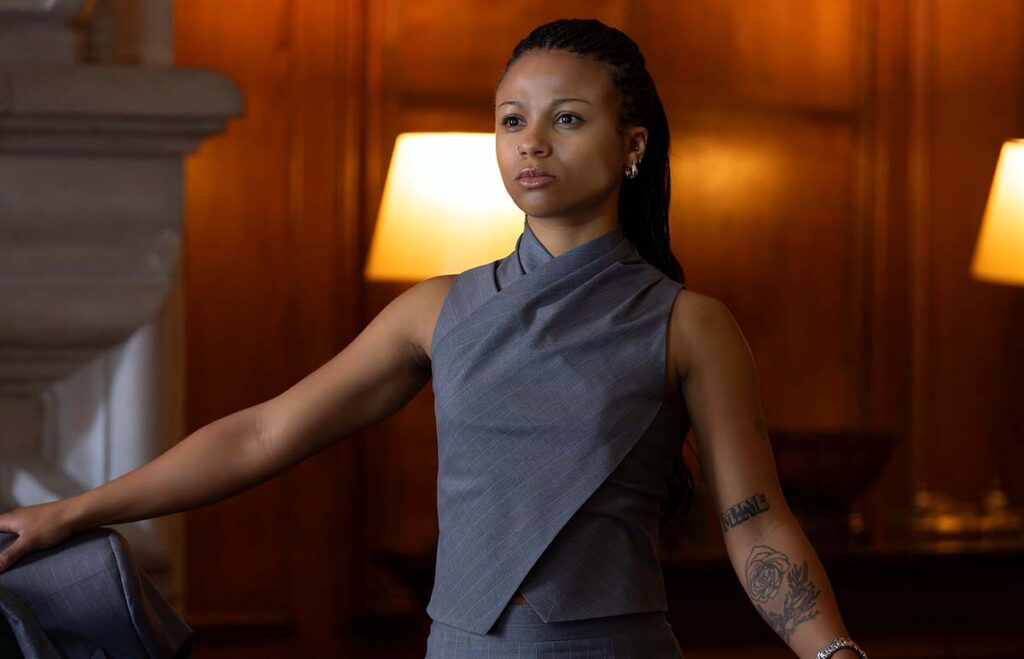
Harper and Eric are essential to the show. What’s it been like building that relationship with Ken Leung over four seasons—especially now that they’re starting Season 4 in a steadier place?
We were fortunate to have so many successful relationships on this show. On a human level, we genuinely enjoy each other. There’s natural chemistry. Over four seasons, we’ve built love and respect creatively and as people, and I think that comes through in the characters. When viewers say it feels like they love and hate each other, that’s true—on the page, they can look like enemies, but underneath it, there’s so much love between the actors. That complexity is what makes it sing.
Ken is one of the greatest of our generation. He’s so talented, and working with him is an honor—he makes all of us better. So being apart for most of Season 3 was torture. In Season 4, getting to work together again—and feeling our characters back together—is enormous.
Were there any Season 4 dynamics you especially enjoyed exploring?
I really loved working with Miriam Petche this year. I didn’t get to work closely with her in Season 3, and she’s brilliant. What she does with Sweetpea is genius. Outside of what Harper’s been asked to say over four seasons, she’s the only one who rivals Harper with the jargony bullshit they make her speak.
On the page, it can be half a page of dense blocks of text—just her talking for pages—and that is hard. She does it with ease, making it feel like breathing. Sweetpea feels like a kind of protégé to Harper: another badass woman who won’t take no for an answer, who’s subversive, hungry, and wants to make money and do the job well. Harper likes giving her that platform because she recognizes that hunger—and Sweetpea also doesn’t take Harper’s shit. I’m excited for audiences to see what Miriam can do. She’s no joke, and I’m really proud of her.
Harper isn’t always “right,” but people still root for her. Why do you think that is—and what’s it like playing a complicated woman like this on TV?
People root for characters who feel real. They don’t have to be relatable because they’re good—they’re relatable because they’re honest. I’m not much like Harper at all, but I respect her struggle. I appreciate her underdog story. We want her to win because she’s fighting the power—and the power is men. A male-dominated industry. She’s often a lone agent inside all of it.
Harper is doing things that male characters on TV have been allowed to do for a long time. She’s complicated, full of contradictions, complex—and she’s a woman. That’s why people want more of her: she feels real. And even though I’m not like her, I feel represented by her because she’s a woman doing things—many things at once—without being an idealized version of anything. That permits being different, too, and still feel like your story is worth telling.
“Industry” Season 4 premieres January 11 on HBO Max.

New England-based Tomatometer-approved film and television critic. Ally is a member of the Boston Society of Film Critics, the Boston Online Film Critics Association, and the Online Film Critics Society. Her writing has also appeared at RogerEbert.com and The Mary Sue.


