


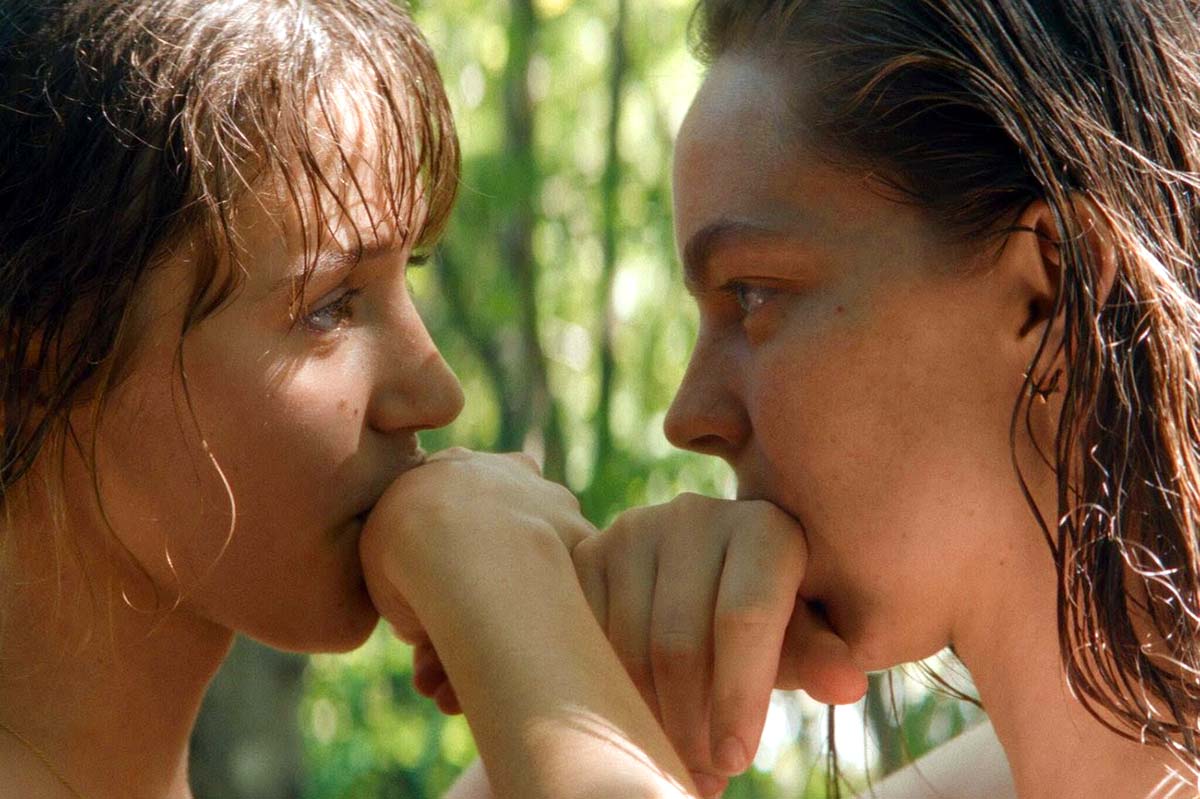
From a thirty thousand foot view, a phrase used to describe taking in the big picture of a given project as opposed to focusing on the small details, Urška Djukić’s “Little Trouble Girls” seems as simple as the premise describes: the story of a Slovenian girl who, while taking part in a choir trip, finds herself exploring her orientation with assistance from a group of fellow singers seemingly intent to humiliate, though one might possess more wholesome intentions. Several brief plot detours later, the credits begin to roll, and one questions what they’ve seen and what there may be to take away. It’s those small details, however, that can’t help but be worth mentioning, and do help to elevate such a fascinating, compelling film.
READ MORE: 16 December Films To Watch: ‘Marty Supreme,’ ‘Anne Lee,’ ‘Is This Thing On?’ & More
It may be challenging to describe Djukić’s latest effort as anything but what’s already been mentioned, with our introduction to 16-year-old Lucia (Jara Sofija Ostan) happening just as quickly as the first appearance of her mother (Nataša Burger) and the subtle disapproval of the way in which her daughter is coming of age. Lucia’s assignment to a religious school and subsequent placement in the all-girls’ choir seem to be an attempt to guide Lucia in a manner her parents see fit. Still, it’s here that the former meets Ana-Maria (Mina Švajger). Ana-Maria, as can be seen shortly thereafter, has around her a small group of friends of similar personality, that of the stereotypical “mean girl” always armed with a cackle or two, but in the apparent innocence of Lucia, she sees a friend as opposed to a target. As the choir heads off to a convent for a musical retreat of sorts, the relationship between the two girls begins to grow, as Ana-Maria notices her new compatriot may very well share the same feelings as her when it comes to their sexuality. A late-night game of truth or dare elicits revelations from Lucia of her apparent unattraction to men, and a follow-up dare sees her charged with kissing the most beautiful woman within the convent; in an interesting turn, she chooses a statue of Mary. Lucia hasn’t yet kissed an actual person, but Ana-Maria’s ready to show her what to do, in one of the film’s more tender moments.
Meanwhile, a nearby construction crew has caught the eye of this small group, though any attempts to gain their attention soon start to feel like a purposeful distraction, a childish, playful teasing without any genuine attraction. A scene between the two girls showing their consumption of bitterly sour grapes as a symbolic form of penance will reevaluate eventually, but another seemingly random side plot involving the group’s conductor (Saša Tabaković) and his uncomfortable interest in Lucia does lead to an about face when a third act confession from Lucia regarding Ana-Maria’s interest in her, presumably stemming from her own overall confusion, soon prompts the man to verbally attack a beaten-down Lucia during a choir rehearsal as the girl continues to endure her mounting inner struggle. Where is it all heading? Has Lucia slammed the brakes on Ana-Maria’s intentions while simultaneously, albeit inadvertently, denying her own?
Plenty is happening, though none of it overwhelms the film, both individually and as a whole, somehow maintaining a story that tells a straightforward narrative powered by two leads who fill in the gaps with unexpected complexity. At the core, however, this film belongs to Ostan, with her wide-eyed demeanor masking something else within; Švajger allows Ana-Maria to conceal as much as keep it all successfully hidden, barely. It’s a true commitment to a pair of complex characters, and in less than ninety minutes, the trace amounts of information surrounding these girls somehow feel, at times, almost whole.
It’s a perfect example of how there’s more to a story than meets the eye, a film with a limited number of layers, yet layers nevertheless, which, upon slowly peeling back, reveal something completely unique. It’s a film over just as soon as it began, and in our stroll through a short period of time in the lives of two teenage girls, you’ll be thankful you were there to take it all in. [A-]


