


Speaking of that, you are such a cinephile. I’ve seen you at Telluride a few years in a row, having a blast.
The best place. It’s the best place.
And I feel like you might see more movies there than I do, and I have to like review a bunch.
That’s definitely not true. [Laughs.]
This may sound silly to ask, but when are you going to direct? There’s no actor, I hear speak about movies that sounds more like a future director than you.
I would love to, I don’t know if I would love to direct, but I’d love the idea. I think it would scare the sh**t out of me, to be honest. Yeah, I think it would be something small. Not to diminish, but I think that’s the problem that I would have. It’s like, I would want to make something…
Like “Aftersun”?
Like “Aftersun,” but the craft that went like watching how [Charlotte Wells] made that, or even watching Harris [Dickinson] direct “Urchin,” I’m like, “Oh, I think acting is hard enough as it is sometimes.” And I think I definitely wouldn’t rule it out. I think I want to absorb as much as I can from the directors that I’m working with. And if it was in 10 years’ time, great, but I’m not in a rush for that. I’m loving the concept of like learning music at the moment because I think I was nervous for a little bit in terms of like how much … I love my job, but I was also like, I would find it so hard to stop, but I know that I have to like not stop, but just like have breathers from it. And I think finding music is a real, positive force in that regard because it means that you can find something else that feels immediately creative that you don’t need permission to do from a director or a studio, or you need to find a script, and it can just buy you time in terms of recharging the feeling creative. And I’m sure directing could be something that would be very similar to that in X amount of years.
Do you want to release your own music, or are you just enjoying it for yourself?
I think maybe at some point. I have no idea. I’m basically just loving the act of learning it and figuring out how songs work and how instruments work and how they give us different feelings immediately when you hear a piano versus when you hear a violin or …
Did you learn piano for the “Beatles” movie?
I could play a bit of piano, but guitar is a new thing for me. And bass. It’s all exciting.
And you like it? Learning those instruments for a role isn’t stressful at all?
Love it. Love it. Love it.
Oh, that’s amazing. I did want to go back to Chloe. You mentioned working with directors and taking things from them. What do you think you took from Chloe?
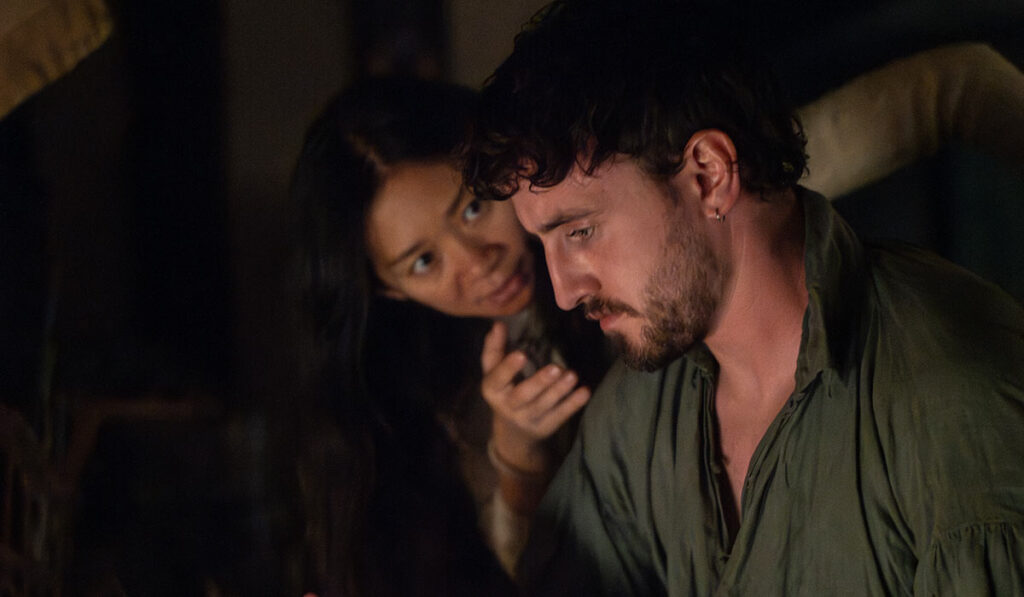
I took, or learned…Chloe doesn’t want actors to live in their heads, and I think lots of directors, brilliant directors that I’ve worked with, and I, myself, love the act of discussing the human condition. But that oftentimes means that you know roughly where a scene is going to live, and I really appreciated how Chloe trusted that that was going to be something that was well thought out and considered privately so that she could just focus on curating an emotional space for us to be in. And it meant that it felt super animalistic and heart-led rather than brain-led.
I spoke recently with “Hamnet” author Maggie O’Farrell about how little is still known about Shakespeare’s life. Did that matter in crafting your performance?
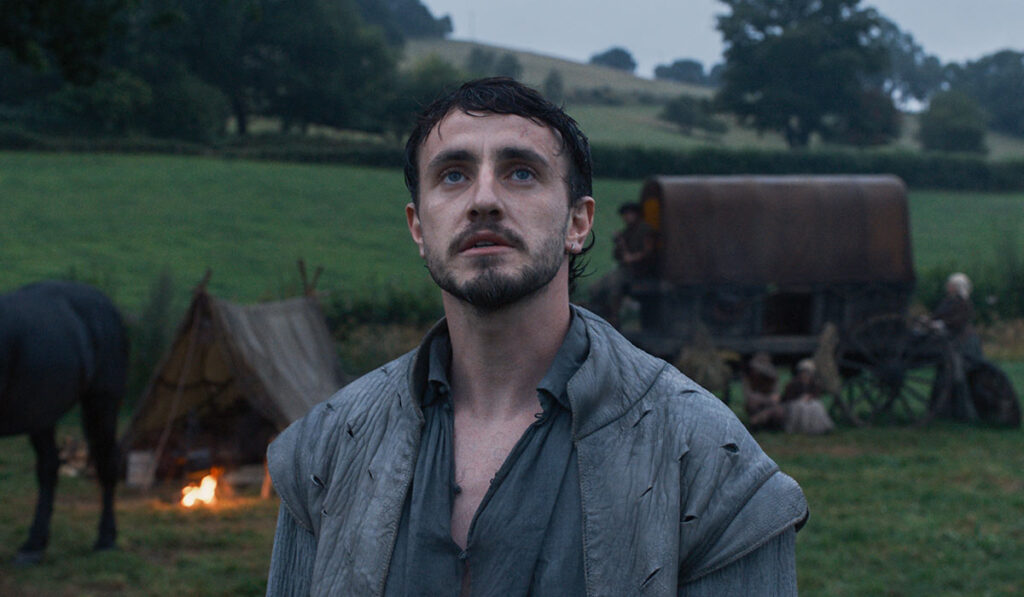
It did matter because it means that you’re not tied to, “Oh, Shakespeare lived in this point, and he wrote this then.” It matters in a positive way. It’s very freeing because we know so much about Shakespeare, but only through his plays, only through his art, really. We know where he lived and where he died and how many children he had. But after that, it leaves a lot for the actors and the writer and the director to devise, which is the kind of dream biopic situation where you’re like, “We’re not really interested in the facts of his life. We’re kind of building our own narrative for how we assume this man lived his life and this family lived their life and how I just lived their life, and that’s very freeing.”
So you didn’t feel like you always had in the back of your head, “I see him this way because I read this and it told me about this”?
No, I think I did have an assumption when I was younger, which was totally incorrect, that he was this bookish man trapped in his attic, writing, doing lots of middle distance, staring. And then when you get into the throes of it, you’re like, “There’s no f**king way he was like this.” I think he was like an animal and raw and kind of heart on his sleeve and like brutal and warm and really propulsive.
And you play him as a tough director.
Yeah, yeah. J.K. Simmons in “Whiplash” stuff. Yeah.
Was that in the script, or was that something you came up with?
I pushed for that to be included. That wasn’t in the script, and it’s not in the book because I was reading through the play and I was reading through that scene, and Hamlet has that amazing line where he talks about, “that it were better, my mother had not borne me,” and all of this. And I was like, “Oh, that is like not Hamlet. That’s Shakespeare talking about himself.” It’s like it’s written in the throes of him feeling like he’s abandoned his family. I was like, “Oh, that’s a fascinating … If we can make this work where he’s not upset with the actors because they’re not getting the lines right, he’s upset because they don’t mean it, and they don’t understand what he’s trying to communicate.” So getting the opportunity to speak Hamlet, not as Hamlet, but as Shakespeare, I think gives the audience a real invitation to understand there was nothing casual about him writing that play. It was a very personal piece of work that I think would have driven his company mass because he would have … I don’t know. I think he would have really cracked the whip generally as a director, but definitely with that play in terms of where the root of that play comes from, in terms of the death of his child and his own kind of concept of self-loathing. I loved shooting that scene.
Looking back, you’ve done films that must have seemed tough at the time. I would assume all the physical aspects of making something like “Gladiator II” must have been a lot. Was this a project that felt like a lot on your shoulders, or was it more of a free and creative experience?
It was a very free, creative experience. Like the shoot is the shoot and the scenes dictate ultimately how you feel, but I think that’s the kind of work I’m drawn to at the moment. I think I understand what films like “Hamnet” or actors on “History of Sound” are trying to communicate, and I feel like the right guy for that job in my head, like that’s what I want to mine and that’s what I want to explore. But that doesn’t mean that the feeling of the film dictates how I feel. Oftentimes, it’s the opposite. Like you could shoot a crazy difficult scene to watch, but you come home like high as a kite because you feel like you’ve really exercised something that like is challenging and hard and that you feel proud of.
Doing something like the “Beatles” films, it’s not a weight on your shoulders?
Well, it is, of course, but it’s also exciting. And there’s real joy in the world of the Beatles, but it’s also discussing this kind of concept of like ambition and artistry and collaboration and the frustrations that can come with that. And also like the concept of losing anonymity in the world, but feeling like an artist, and then suddenly you can’t hear the art that you’re making because people are screaming so loud. Like, there’s real color in what we’re getting to do, but fundamentally, it’s definitely a more joyous life that we are discussing than the life of say, Shakespeare at the time when he lost his child, but it’s definitely not one thing.
I heard this crazy rumor. Someone was mentioning to me last night that you’re not going to work for two to three years or something. Is this true?
This is categorically not…I said in an interview that after this press tour, I just won’t be doing press for two years because I have nothing to promote. I’ll just be making “The Beatles” and then doing a play.
Oh, that’s why.
I find that I should just keep my mouth shut with things like that. But for clarity, I’ll finish the press tour for “Hamnet,” and I’ll make “Beatles,” and then I’ll do two plays in ’27. So, I’ll get to disappear in terms of talking about making things, and I’ll get to just make things for two years, and then we’ll be running around the world come Beatles time. Does that make sense to you? But I’m not doing like a “I’m retiring” situation, definitely not.
You have two plays for 2027.
2027.
So, no movies.
No movies for me.
____
That might be your cue to make sure you see Mescal on the big screen in “Hamnet” while you still can.
“Hamnet” is now playing in limited release. It expands nationwide on Jan. 16.
Follow Gregory Ellwood on Bluesky
Follow Gregory Ellwood on Threads
Follow Gregory Ellwood on Instagram
Sign Up For The Breakdown Newsletter


