


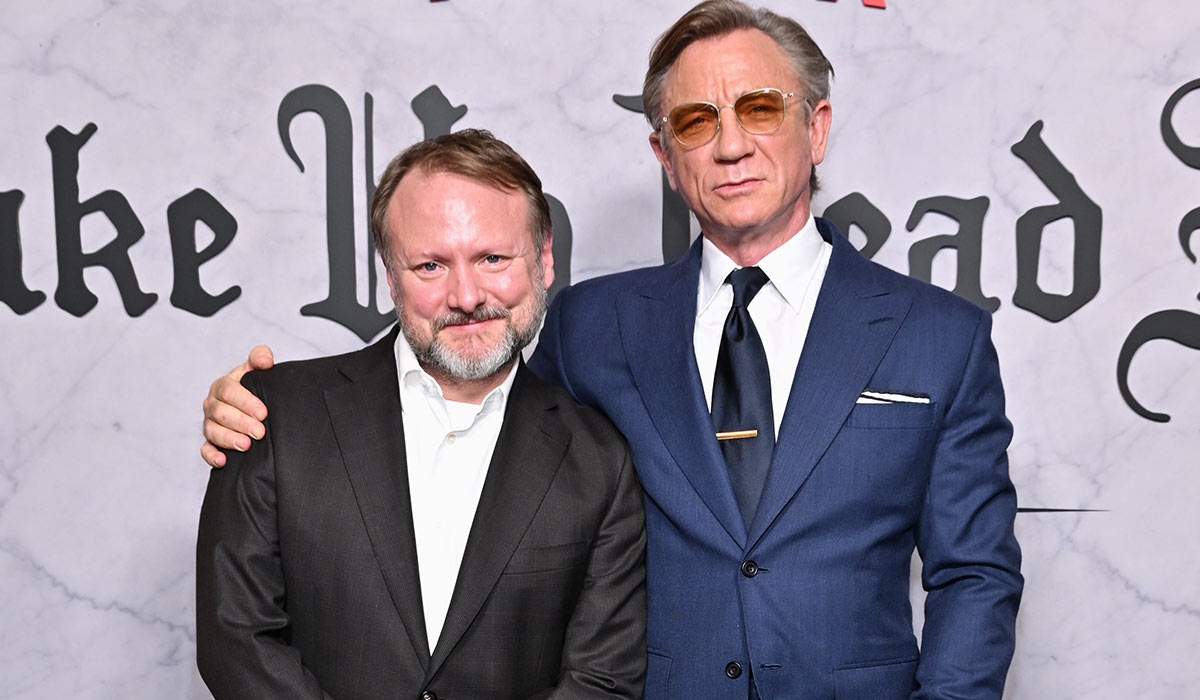
The screening room at CAA in Century City is packed, and no one has left the theater following the screening of Rian Johnson’s “Wake Up Dead Man.” And as we sit down to discuss his latest “Knives Out” installment, it appears this is his most personal mystery yet. Well, that’s at the top of our minds, at least.
Set in the fictional Catholic parish of Our Lady of Perpetual Fortitude, “Dead Man” centers on Reverand Jud Duplenticy (Josh O’Connor), a young priest who finds himself the primary suspect in the murder of his superior, Monsignor Jefferson Wicks (Josh Brolin). He seeks the help of the legendary private detective Benoit Blanc (Daniel Craig), an atheist who is intrigued by the almost “impossible to solve” nature of the crime. Along the way, Blanc will have a long list of credible suspects to grill and motives to explore.
During our conversation, Johnson discussed a variety of topics, including how Craig turned him on to O’Connor’s talents, Glen Close’s already underrated performance, and his decision to intentionally “date” these films. However, it was his forthrightness regarding his evangelical upbringing influencing this particular “Knives Out” chapter that piqued our interest. And, perhaps, is why “Wake Up Dead Man” is the best film in the series so far.
This conversation has been edited for length and clarity.
_____
The Playlist: At this point, do you have a list of murder ideas you jot down in a notebook or notes app?
Rian Johnson: My search history tells a taudry tale [Laughs]. No, I guess the real genesis for this one was kind of twofold. It was coming off of “Glass Onion.” Daniel and I had a blast making that movie. It was exactly what we wanted to make. Very proud of it. It was a very big, broad kind of comedic version of the murder mystery, and we thought the most interesting thing would be to ground the next one. To figure out a way of bringing it back down to earth. And the way I decided to approach that was to pick something really personal for this one to be about, and that’s why it’s about faith. I grew up very, very Christian, oh, you almost gasped.
I was unaware. Your religious inspiration was one of my questions. I was sort of surprised.
I take that as a compliment. I didn’t grow up Catholic, I grew up evangelical. I was a youth group kid, but up through my early twenties and all through my childhood, I grew up in a household that was very much in the evangelical kind of Christian-Reagan era and everything that entails. But more than that, personally, my relationship with Christ was how I filtered the entire world. And I’m not a believer anymore. I kind of fell away from it in my twenties. So, I have a lot of feelings about it. And so the idea of possibly talking about those in the context of one of these movies that still needs to be a big fun entertainment that welcomes people into a big tent to have a good time, that was kind of the challenge of, “God, can this thing work?”
What made you decide to stage it in a Catholic setting as opposed to an evangelical one?
Well, most of the churches I grew up going to kind of looked like Pottery Barns. If I had to set it in the type of mega church I went to, I would shoot myself in the face just visually. Catholicism absolutely carries the day in terms of aesthetics, but beyond just that is kind of what the movie is about. It’s the storytelling of religion. And so Catholicism got it all beat, but also, I think I felt like I was part of why the script ended up being so hard to write. I was very conscious of not wanting to be didactic or finger-wagging or preachy on either side. At the same time, I didn’t want to just be trying not to offend anybody and dodging around. So, I was going to be coming at a lot of stuff that was on my mind in a very straightforward way. And doing it as Catholicism instead of evangelicalism, which is, I think, what the movie is actually about. It gave me just a little bit of distance to feel comfortable doing that.
Considering your own life experience, should we assume that a character like Jefferson Wicks is someone you have experienced in your life?
Well, he’s a concentration of a big diffuse cloud of stuff that very much was an aspect of my experience with faith, but the idea was to kind of take all of those things and kind of distill them into the worst. Someone that Josh Brolin could just tear to pieces, yeah.
What’s so remarkable, though, about the film and the screenplay is that you have this very complex murder that’s happened, and how it’s going to get solved unfolds in a very specific way. When you’re writing the screenplay, are you starting with the murder first? Do you feel like that has to be the sort of the gestation of the narrative, or do you write around it?
No. I don’t start with the murder or the mechanics of it first. Although I did kind of have John Dixon Carr, the author that we name-checked in the movie, he was a very big inspiration. And I did start with the idea of the impossible crime, wanting to pull one of those off, which is really, tantalizingly tricky. And it’s like, “Oh, why hasn’t this been done in a satisfying way on the screen?” And then once I started writing, I realized exactly why it hasn’t been because it is a pain in the a**. So, I had that idea, but the mechanics of the murder stay very, very vague until very late in the writing process. And a lot of the work goes into the story, and it goes into kind of Jud versus Wicks that turns into the arc of Jud and Blanc’s relationship, and starting them at odds, and then Jud getting swept up in Blanc’s whole gamified process, and then remembering he’s a priest. And then the idea of a confession at the end. It’s kind of the story that’s actually going to root of the whole thing. And then hopefully you get in there, and you can build the mystery elements to support that.
Did Daniel have ideas about where he wanted Blanc to go in this mystery? Was the intent to show different shades of him than you had before?
Well, the very first scene where Blanc enters, and [he and Jud] have that big conversation about religion, that was the thing that we had the most collaboration on. When I first wrote that scene, it was a much gentler scene, especially with what Blanc says with his rants and Daniel, who I don’t want to speak out of school, but he’s very much on Blanc’s side than Juds in terms of religion. And he was like, “I think Blanc should come at this harder and should hammer this more.” And at first I was like, “Well, you’re trying to just put your thumb on there, you’re trying to get your thing in there, which might be fine.” But then I kept listening to him, and I realized he’s absolutely right. And so his point really was that the harder these two are at odds at the beginning, the more satisfying the arc will be of them forming this relationship. And then Blanc genuinely draws something from Jud by the end, for his kind of sacrificing the biggest thing for him, which is his purpose in these movies. His purpose in life, which is to have his big denouement, you know?
Every time you’ve made one of these films, the casts are just so spot on. Are you thinking of actors at all during the writing process?
Yeah, I try not to just because it’s a pathway to heartbreak, and yeah, inevitably, if you think about an actor while you’re writing, they won’t be available. But also more than that. I think generally you try not to because it’s also kind of unfair to the actors. Unless you’re close friends with them, you’re not thinking of the actor. You’re thinking of another role that they’ve played. And also with these, I think it’s a lot more fun to try and bring in great actors and give them something you wouldn’t necessarily have expected them to do.
I might be answering this question myself, but I was wondering why you thought Josh O’Connor might have slight comedy chops, and then I realized, “Oh wait, he played a funny priest in ‘Emma.'”
In “Emma,” yeah, he was great.
Was that your touchstone for him, or did you think that he was talented enough to pull anything off?
I kind of just felt like he could do anything. I mean, I wasn’t really aware of Josh. And Daniel had known about him, I think, through Luca [Guadagnino]. And so “Challengers” hadn’t come out yet, and they screened it for me, and I was just like, “Holy.” It was my favorite movie of that year, first of all. But also, I was like, “Oh my God.” And then I watched “La Chimera” and a performance on the exact opposite end of everything, and no less completely just captivating. It just pulls you into the screen. And so I was kind of just in the mode of, “I think this guy, this kid can do it with anything,” yeah.
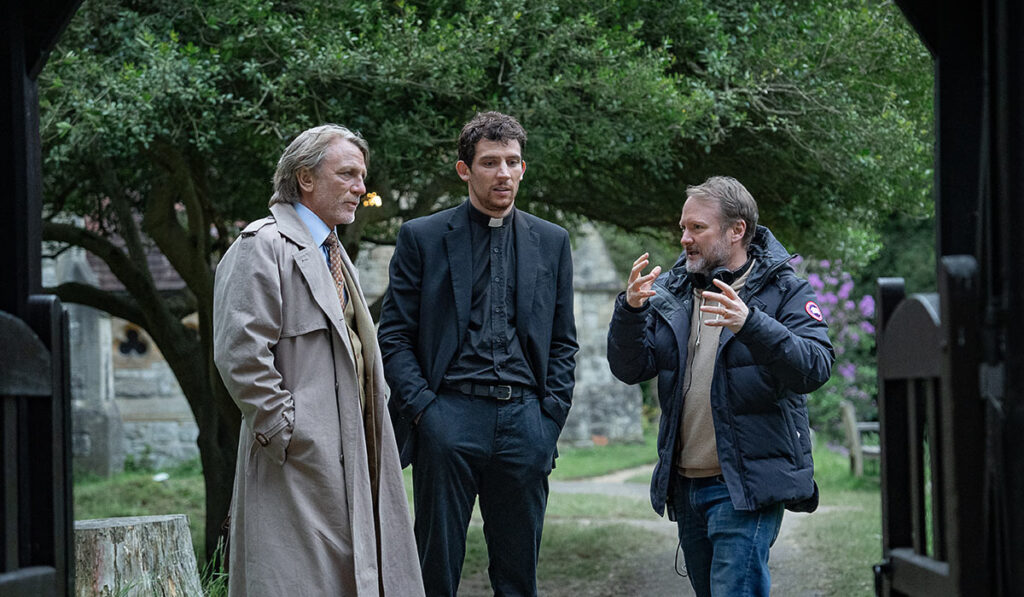
Did he surprise you on set?
Oh, every single day. Yeah. And he and Daniel are kind of birds of a feather, and I don’t know if it’s kind of the stage-trained actor thing. I dunno if it’s the British thing. I don’t know if it’s what it is, but they were just hilarious, and there would just be constant banter and just f**king with each other right up until you call action, and then they would click in and start doing their thing. So yeah, every single day I felt like I just kind of had a front row seat for that guy.
You worked with so many great actors, Daniel being one of them, but in this movie, Glenn Close is utterly fantastic. She has an intensity that none of the other characters have. What is that like on set? Does it take you back, or is it just part of the everyday production process?
No, it takes you back, man. It takes you aback. I mean, Glenn, first of all, it was like a bucket list thing for me to work with her, but also I think we were all just a little bit nervous when she showed up on set because she’s Glenn Close, man. The legend. And her energy on set. She showed up, and I mean this in the best way possible. She showed up with the energy of someone who was right out of drama school and had gotten their first job. She was so excited to do the actual process of making a movie, and she was just giddy with the invention of every little thing. She’s so excited in the morning, and she’s so joyous with the other actors and everybody on set. The youngest actors there, I think, were drawing inspiration from seeing her. It’s dizzying to look at her resume and look at all the legendary things she’s done, and she’s still showing up to work every day just with this fire inside of her. I dunno, it was amazing. And then she turns it on, and, I mean, it’s a part that has to start very broad, and it’s almost “Young Frankenstein”-ish at the beginning, and then by the end, it’s gotten down to this scalpel work that really the whole movie depends on her landing emotionally at the end. And that’s such a high degree of difficulty, and it’s something that, I don’t know, I feel really, really lucky that we had her there for it.
Many other filmmakers would want to remove any timestamps in a film like this. Make it as timely as possible over the last 15 to 20 years. But this movie could not have taken place in 2015 or 2010. It takes place now. Why is that important for you when making these “Knives Out” films?
Yeah, it is fun. The movie is 2025, to the point where it was a futurism movie when we were shooting in 2024, and we didn’t know who was going to win the election. We were shooting it. So, that made it weird. But to the point where the baseball game that’s on the TV is a baseball game that happened. I found a Cubs game that happened at the right time on Good Friday in 2025. And right before we did our mix, we dropped it in the TVs, so it all lines up anyway. And I thought, oh, this is great. This could have actually happened on that day. And then the next day, after Good Friday or the Monday, the Pope died. And I was like, “Oh, well, it’s no longer quite accurate. They probably would’ve been talking about that in the movie.” But anyway, I think that’s something that was a very deliberate, big kind of marching order for myself from the first movie. I am a huge, huge whodunnit fan, and growing up watching a lot of stuff, and anyone who’s here probably knows it. Like you watch a lot of [Agatha] Christie adaptations, which are period pieces set in England. But that’s not what Christie was doing at the time. She was never writing period pieces. She was writing to her moment and through her whole career, you read her books in the sixties that you were set in the sixties. And so the notion of just throwing away timelessness and unapologetically setting them exactly in the present moment? The Murder Mystery Forum is a great vehicle for that. If you think about the basics of it, you have a group of suspects, you have a little community, you have a power dynamic within that group, and a hierarchy to it. You have someone at the top. Everyone has a motive to bump off. It’s a fantastic way of creating a microcosm of society, and it’s a tool in that way that I feel hadn’t been really employed for a long while. And the notion of applying it to the modern moment in each of these movies seemed like something that was low-hanging fruit.
Because of that, are you thinking in the back of your head, “I want to make sure we do this in another three or four years. Don’t rush it”?
Well, yeah, so far it’s good. Although I have done three of them in a row, I feel like I am writing something totally different to do next. But I guess more than thinking in terms of the spacing of ’em, for me, the important thing is not thinking of these as a franchise or a series or something, but just when it’s the most exciting thing in the world to make the next one of these, that’ll be the time to make it. And then it’ll be responding to something that’s happening in life in the world around us right then, as opposed to planning ahead, “We’ll do this three years from now.” I don’t know where our heads are going to be at. And so God knows, that’ll be the time, though, to figure that out and write it.
Was there one scene, or one day of filming this particular movie, that was the most fun to shoot?
I mean, every single day on set. In “Glass Onion,” most of the movie was everyone in the room together and, in this, there’s just a few scenes like that, but those were always the most fun scenes to shoot those scenes in the rectory where all of the actors are there and just seeing all these actors watching each other and adjusting the level of their performance to each other and goofing off with each other and hanging out with each other in between. I don’t know. That’s these film sets and film casts where we’re carnies, man. We’re weird traveling circus freaks who kind of formed these little ad hoc families. And to see this particular group just getting the opportunity to hang out in that little space each day, that was the most fun for me.
You have continued to work with the same fantastic cinematographer, editor, production designer, and producer on almost all your films. Why do you think you all keep staying together, working on these movies?
I mean, I think I grew up making movies with my friends. That’s kind of just how I learned how to do it. And I also feel like with Nathan [Johnson], who’s my composer, he’s my cousin. So, we’ve been making movies together since we were 10 years old. Or Steve [Yedlin], my DP, we met when we were 17 volunteering on a student film set. I feel like with each of them, though, I feel genuinely beyond just working with your friends, which is wonderful. I feel like with Nathan, it’s not like sometimes, as if you’re just hiring closer, I genuinely feel like we could sit down and say, “What could this be? Let’s try anything.” And we go for it and do some version of it. And the same thing with Steve. I feel like maybe because we’ve been doing it so long, he’s not a hire for a specific purpose. He’s a collaborator. And in that, we can aim for anything we want to aim for, which opens up the doors. It’s really nice.
“Wake Up Dead Man: A Knives Out Mystery” is now playing in limited release. It arrives on Netflix on December 12.
Follow Gregory Ellwood on Bluesky
Follow Gregory Ellwood on Threads
Follow Gregory Ellwood on Instagram
Sign Up For The Breakdown Newsletter


