


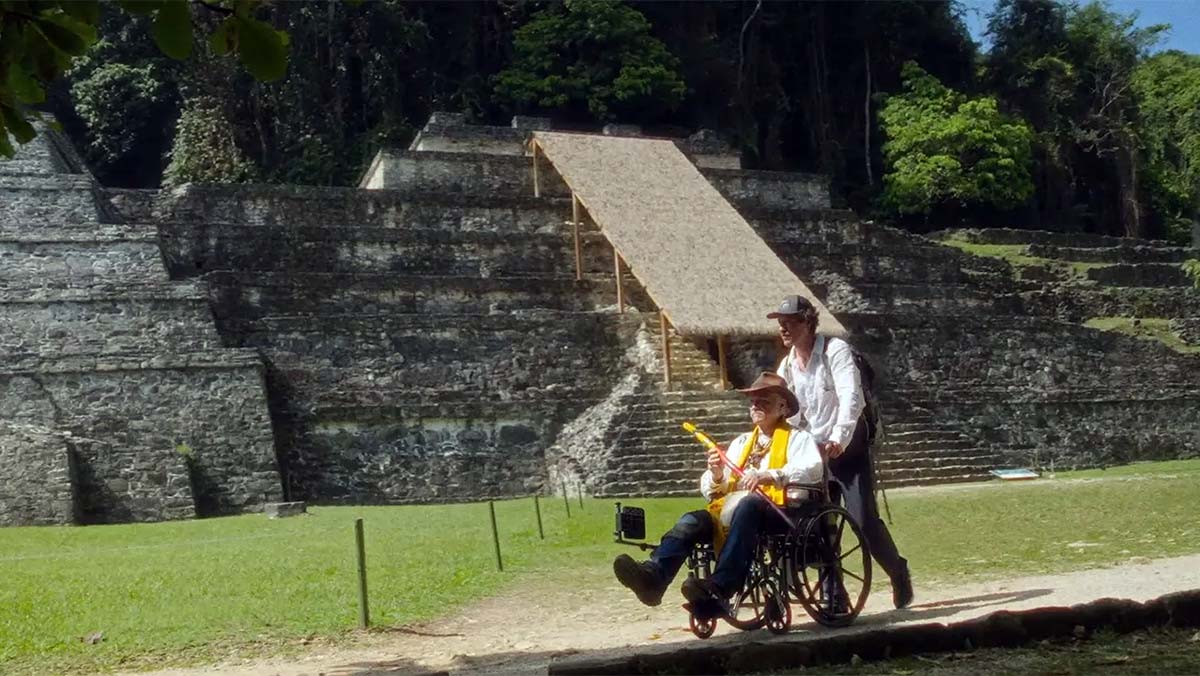
It’s refreshing, in an era where the majority of documentaries share, at best, a muted opinion of their subject matter, regardless of whether the tone carries a down-to-earth approach or off-the-wall momentum, to find such a film where the man behind the camera seems content with a warts-and-all approach as he barely conceals his skepticism. The man before the camera? Why, it’s Patrick McCollum, an elderly prophet who believes he possesses an ability to see what the future holds for society, in particular one cultural subset which could very well spiral into something capable of saving a sizeable part of the world at large. He’s a man of many things, but this one mentality seems to capture much of his focus. The film? “The Man Who Saves the World?” Yes, that question mark is intentional.
READ MORE: Fall 2025 Film Preview: 61 Movies To Watch
McCollum has worn many hats. His outward appearance suggests any unassuming elderly gentleman, but don’t let this fool you; such resume’ landmarks as a background working in the carnival, mastering kung fu, and designing jewelry for the Queen of England, the latter of which he’s somehow able to verify onscreen, work wonders to show those hats he’s worn. However, it’s a prophecy that dominates his apparent true calling, one that suggests he’s to bring together Indigenous Amazonian tribes so as to ensure the future of the rainforest; it’s something his wife wholeheartedly supports, alongside such noteworthy figures as the late Jane Goodall, who does indeed show up several times and seems to deeply revere McCollum. A self-described peacemaker, an early scene of McCollum brewing homemade matcha frappucino for his wife seems to belay his chosen lifestyle, and in showing this simple act of love does it help to render McCollum as, ultimately, a man.
Enter Gabe Polsky, the film’s director, who appears onscreen throughout, and as the film progresses do we see Polsky’s eyebrow figuratively raise as hardly a trace of physical evidence materializes to back up McCollum’s claims of a prophetic touch. Substantial portions of the film support this, with the men traveling together for meeting after meeting with Indigenous elders, even leading to a somewhat anticlimatic moment when a phone call McCollum receives prompts the man moments later to declare that the prophecy has apparently rung true, and that his mission has been fulfilled. Nevertheless, as the film surges forward, nothing stands in the way of Polsky questioning his subject on the task at hand, narrating the moment with his transparent disbelief, and eventually seeing McCollum express his anger at what he may very well perceive as a hatchet job on behalf of Polsky. It’s impossible not to see Polsky’s side, and in taking such an angle, does a truly honest film emerge.
Did a higher power legitimately tap Patrick McCollum for something greater than one could begin to understand? Just as it’s impossible to ignore Polsky’s viewpoint, standing behind Patrick McCollum’s claims and what he sees as the conclusion of his quest easily becomes as tricky, if for no other reason than for the man’s unspoken plea to simply take him at his word. There’s no question as to the compelling way in which McCollum goes about his journey, less a tent-style preacher barking commands at a receptive crowd but rather a kind individual with nothing more than the belief that his life has a larger purpose. The bigger questions remain unanswered, but just as the film’s title carries a question mark, was that ever the point? [B]


