



What is that single comedic narrative for the pediatric oncologist episode? Because my friends and I think we know what it is, but I don’t know if we’re just projecting or not.
I mean, that episode is very much based on my own [experiences]. And it’s funny, I’ve been reached out to by people who fall on different sides of it, and that episode almost probably had the most discussion as we were shooting it. It was the episode where the DP and the camera people, because we have a very open dialogue with everyone, and literally the camera guy would come over and be like, “You might be losing me on this one.” I was like, “No, I don’t think I am.” But to me, the single narrative is how do you deal with your ego being challenged in a way by people who don’t truly understand what you do, even if they may be ultimately right. The fact that they don’t seem to care to even think about it that deeply is what’s incredibly insulting to my character. And it is supposed to be a very simple comedic exploration of ego. It’s about ego, and the idea basically is, is it more important to me to be in a relationship with a beautiful, smart woman, or to have what I do viewed as important, and is it more important? And I think saving lives is objectively one of the most important jobs that there is. But I do think that in my worst moments, I’ve been sitting at a table with a bunch of doctors, looking at them being like, “Why don’t you respect what I do as much as what you do?”
But also, have you not sat down at a table with a bunch of doctors and said, “Oh, you actually do something that helps people.” I cannot tell you how often I’ve heard that. And the flipside is the episode is also saying, “Yes, they are amazing people, but they can also be assholes too.“
They can also be assholes and be belittling, and it doesn’t mean that they don’t, even if they’re right. And I think that to us was a big part of it. But the simple joke of the episode is that, I mean, the way we would describe it is it’s very what it is. It’s like a guy starts dating a doctor, he goes to one of her events, and outside of the Hollywood world, he cannot function because he’s used to feeling incredibly important. And as soon as he’s around people who view themselves as more important than him, it literally fritzes him out.
And at the end of the episode, he’s back dating someone in the industry again.
He’s dating an agent who doesn’t seem to particularly like him very much, but they could talk about Michael Pena’s backend points, and that makes him happy.
“The Oner” is something of a masterpiece of an episode that can completely stand on its own. How many hours of rehearsal did it take to prep for it, and how many times did you shoot it?
We didn’t have that much access to the house beforehand, so we had a map of the house, and we tried to plot it out, but we really only had the cast and the house for the week of shooting, basically. I think we had the house for five days total, but I think we had to shoot it basically in four. I think there were only four actual days of shooting. And so it was shot in four chunks that were put together essentially.
So it is stitched.
It is stitched throughout it because I mean, honestly, it would’ve been impossible because of the car. There are so many different things happening, and with comedy especially, the rhythm is so fast, and if one millisecond beat is off, it doesn’t work anymore. You know what I mean? And so it literally would’ve been unfilmable unless we had weeks and weeks and weeks and weeks and weeks to rehearse and dial in and do all that, but we didn’t have that. We could also only shoot during magic hour, which is what made it very hard. And because the whole house is glass, we could essentially shoot for 90 minutes a day. So what we would do is we had each day’s chunk, and we would show up in the morning, and we would rehearse it all day and sort of reblock it as we needed to. So the timing all worked, and then we would shoot that chunk during magic hour till it got too dark. It started to feel very meta at times. There were times we didn’t have it as the sun was getting too low in the sky. And then those pieces were essentially put together using a few very specific wipes and moments that we make fun of in the episode.
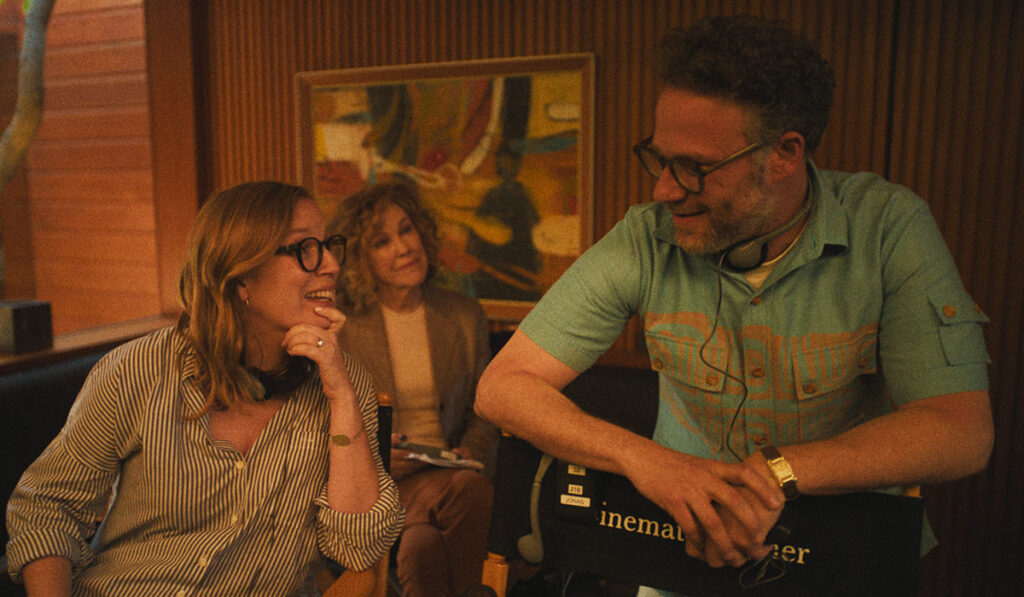
So, Sarah Polley had not acted in front of a camera in 15 years. I know you’re friends, you starred in one of her films, but was it an easy yes? Did you have to convince her?
No, she was actually the first person I reached out to. It was while she was here for the Oscars for “Women Talking,” which was way before we shot the show. The whole strike happened in between all that, basically. And “Fabelmans” stuff was kind of happening around the same time. But yeah, I had breakfast with her then and just kind of explained it to her and asked her to do it, and she was like, “Yeah.” She seemed into it, and then I could tell she got really into it. She started sending a lot of ideas and a lot of ways to improve it, and she made it so much funnier. Her version of Sarah Polley was much funnier than the version of Sarah Polley that we originally had, and we had her be much nicer. And her whole idea that was very funny is she’s like, “I should f**king lose it.” She’s like, “I would not deal with this well in real life, I should. It should just be more comedic between me and you as well, and more outward conflict between us, ultimately as it goes on.” And she really ratcheted it up, which really helped us find the tone of the whole show in ways early on.
Before I wrap it up, I know that season two is happening, which is fantastic. Do you have a laundry list of ideas that you couldn’t make that couldn’t fit in season one? Or will you go in with sort of a new…
[Rogen turns the camera to reveal a big whiteboard with multiple ideas covering it]
Oh, that’s a yes…
No, we have tons of ideas. Honestly, there’s no shortage of ideas. And that’s what makes it hard in a lot of ways, which is again, my mantra. What I’m always saying is, “What’s the episode?” There’s so many ideas that we’ve had. And, honestly, since the show came out, we’re getting flooded with stories from people, which is great. But, and this happened a few times in the first season, we had an idea that we loved and something that seemed fertile, comedic, but we just couldn’t crack it as one 30-minute pressurized story. So, we’ve been writing for a few weeks. We have been up and running, and I’d say if you asked me now, yeah, I’m looking at a board with 30 ideas on it, and I’d say there are two or three that I would put money on actually becoming for sure episodes next season. But I’m still not sure. Sometimes we’ll write the whole script and be like, “No, this didn’t quite get there.” That happened a lot in the first season. We wrote four scripts for entire episodes, and I was just like, “I don’t think this is good enough.” Sometimes it’s easier to just pivot to a whole new idea, and so I expect that to happen a lot. But I think, yeah, there are a lot of ideas we have and we’re slowly starting to come up with versions of a few of them that are incredibly exciting, really funny scenes.
You filmed so much of the first season in this one-shot aesthetic. Do you want to continue that? Or would you consider another cinematic aesthetic for the second season? Have you guys even talked about that?
We have. I think we’re going to stick with it. I think we’re going to look for ways to sort of build on it. And I think the one works because it’s actually a real-time experience. And I think the finale, especially the second half, people really seemed to enjoy because it’s also a very prolonged real-time experience. So that’s a thing we’ve talked about more is how to condense the timelines and pressurize them even more. But also I think people like the oner because it is a comment, not on genre so much, but filmmaking technique itself. And that’s something that we definitely have an eye for trying to do, which is how to incorporate the filmmaking process itself into the show.
“The Studio” is available on Apple TV+

Editor-at-Large Gregory Ellwood is one of the entertainment industry's most respected journalists and critics. Based in Los Angeles, he's the only current awards expert who previously worked on Oscar campaigns at a major movie studio. Over the years, he has written for the LA Times, Variety, The Hollywood Reporter, and Vox, among others. He also co-founded the entertainment news site HitFix, which spawned a legion of influential Emmy and WGA Award-winning alumni.


