


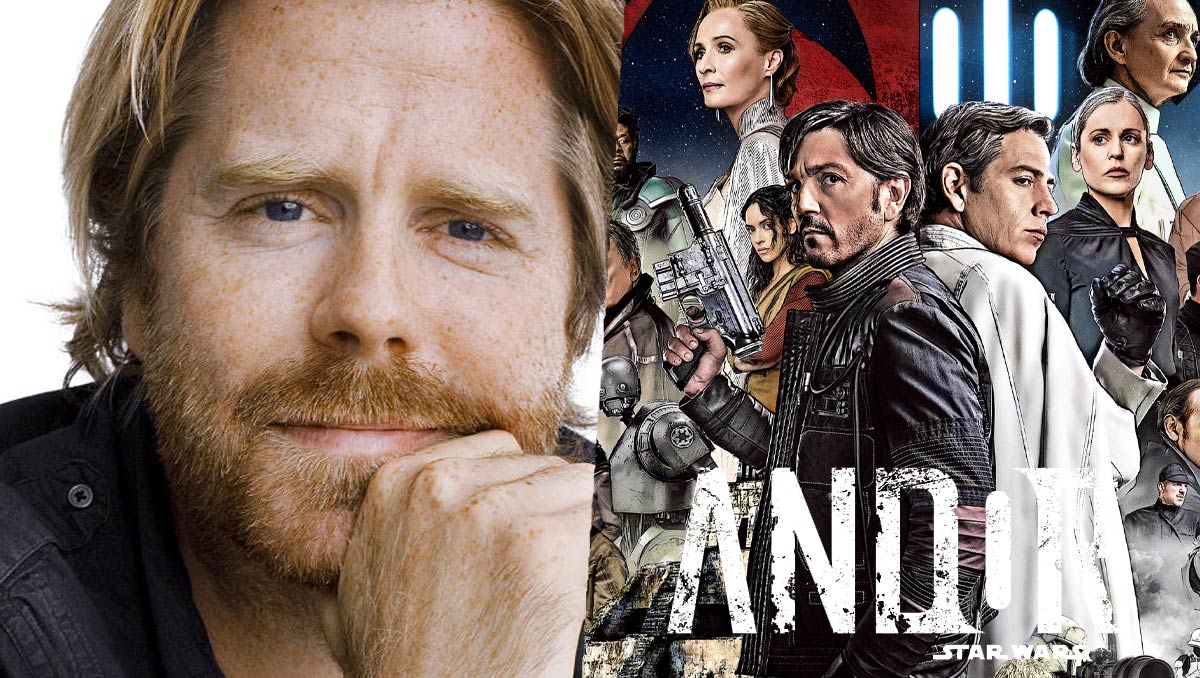
Danish filmmaker Janus Metz took a big leap of faith before jumping into hyperspace. He was “Star Wars” conversant, but certainly wasn’t at a fanboy-style acolyte, and he hadn’t seen any of the new Disney+ shows. But despite never seeing a frame of footage—nothing had aired yet—or being allowed to read any scripts, he said yes to directing the “Star Wars” series “Andor,” a prequel series to “Rogue One: A Star Wars Story.” Primarily thanks to the involvement of “Andor” showrunner/writer /producer and Academy Award-nominated filmmaker Tony Gilroy (“Michael Clayton”).
After Gilroy pitched the show as the “Ken Loach version of ‘Star Wars’,” Metz, still slightly skeptical, phoned friend Stellan Skarsgård for a reality check, took the leap, moved his family to London for a year, and then — weeks later — watched “Andor” episode one drop, relieved to find it was exactly what Gilroy had promised: “so f*cking cool.”
For Season 2, Metz steered the Ghorman massacre run (Episodes 7–9), helping turn a sprawling Pinewood backlot into a living city square by selling a 5,000-strong crowd with a few hundred extras, resets, smoke, and smart camera placement. He and DP Mark Patten live-storyboarded the plaza battle on iPhones and cut stunt-viz in prep, setting up indelible beats: the slow-motion wrap on Syril’s horror as the square tips into a massacre; alt-tested versions of the “Who are you?” confrontation; Mon Mothma’s courage-through-fear Senate address; and Bix’s straight-down-the-lens goodbye.
Metz frames it as a trust-first collaboration with Gilroy — one where the showrunner’s long-view instincts (like insisting on Syril’s one-sided obsession) guided decisive moments — and a production so well resourced and prepared the crew could “shoot the sh*t out of it” while chasing the human core beneath the spectacle.
We spoke to Metz shortly after his Emmy nomination, all about working with Gilroy, the crew, Diego Luna, Genevieve O’Reilly, and more. Here’s that conversation.
I just rewatched all of “Andor” season one and two straight into ‘Rogue One,’ what a blast. Tell me about this: how do you get a gig like this? Tony once told me they were having a tough time finding directors because everybody was busy. How does it work exactly — do you pitch yourself, or do people come to you?
Yeah, I heard him saying that, and I was like, “Oh, okay, well, thank you. Then I guess I was number 55 on your list” [laughs]. I don’t know, but there you go. And you know, you’ve got to get a chance to prove yourself.
The world we live in is challenging because the same people get offered the good jobs. I think I was fortunate in some ways that I had just come off a feature called “All the Old Knives,” and I worked with a wonderful producer on that project called Matt Jackson, who was part of the producing team on Tony’s ‘Bourne’ films. “Michael Clayton” was one of the main reference points for “All the Old Knives,” so I was obsessing over “Michael Clayton,” and I thought Tony was such a brilliant writer.
When I got a call from my agents asking if I was interested in doing “Star Wars,” I had to be honest — I’d never really seen myself working in that world. I wasn’t a fanboy. I have deep respect for the franchise; I’ve watched all the films with my kids, and I’m old enough to remember the first movies, but not quite old enough to have been part of that initial fan base. Still, it’s the biggest franchise in popular cinema culture, and some of the greatest filmmakers have put their mark on it. It was a great honor to be asked.
I said, “Yeah, sure, I’m interested,” and I had an interview with Tony and executive producer Sanne Wohlenberg. I loved everything they were saying about what they were trying to do with “Andor.” This was before season one came out. I said, “Look, I haven’t seen all the spinoffs,” and Tony said, “No, no, don’t watch anything. This is something else. Don’t watch anything, because it will just give you the wrong idea.” With all respect to what’s been made, he really wanted to take “Andor” in a different direction. He framed it as the Ken Loach version of “Star Wars.”
At that point, I wasn’t allowed to read any scripts — “Star Wars” is such a protected universe — so it was pretty much: do you want to take a leap of faith? I said, “I’m going to call Stellan Skarsgård, because he’s a friend of mine, and then fact-check,” and Tony’s like, “Yeah, call Stellan; he’s going to tell you how great it is.” I called Stellan — he said it was really great — so I took the job. Tony had seen my work, and he was happy with my series “Zero Zero Zero” and “Borg McEnroe.” We spoke about those in our interview. Before I knew it, I was on a plane to London and relocated my whole family there for a year to make this.
So you were hired before season one was even made?
They had already shot it, and I think it aired just a couple of weeks after I had that initial interview. I’d already said yes, and then I saw episode one, and I was like, “This is so fucking cool.”
It’s funny — if someone says, for example, “Marvel meets Ken Loach,” you kind of want to roll your eyes, but then you see it and you’re like, wow, they really did it.
To his credit, every single thing Tony said in that interview — and Sanne as well — was exactly what I saw on the screen. Tony is a straight shooter. He’s one of the best screenwriters out there. Being entrusted with Tony’s scripts was enough — and the writers’ room he built with his brother Dan Gilroy, Beau Willimon, and Tom Bissell was extraordinary.
We spoke at length about my movies. I’d shot a war movie in Afghanistan called “Armadillo” back in 2009, so I had firsthand experience of war and combat. Aligned with what he’d seen in “000,” I think that’s why he put me on 7, 8, and 9. It was a beautiful fit for me — it let me draw on my previous work.
How did you land those specific Ghorman episodes? They’re meaty, killer episodes.
It was very exciting. episode nine, when I was in prep, was still being written — there was a great outline, and I don’t know what draft they were on, but it wasn’t finished yet. episode eight was pretty finished, but the battle sequence had a lot of descriptions. When you write action, it’s hard — “runs across the plaza; blam, blam, blam” — so you have to take those pages and make them come alive.
It’s all shot on a backlot at Pinewood Studios. It was a huge location build — probably three football fields or something. I remember standing there with my DP and my first AD, looking at the place they were building and thinking, “How the fuck are we going to fill this up with people?”
Because that whole plaza is real?
We built it up to the first floor. The second floor is a digital set extension. But the whole plaza — the ground floor, the hotel, the ISB office, the café — all that is real. And all the side streets are built. It was a huge operation. The collaboration with the VFX/CGI guys was amazing. We needed 5,000 people, and we had three or four days with about 400 extras, then about 150 extras a day. We had to make that look like 5,000 people. So we came up with tricks — how to stack people, how to use a lot of smoke, how to shoot in specific ways — to sell the illusion.
And after one shot, everybody comes over and goes into the back?
Everyone comes over, changes position, and someone puts a new hat on. It was really collaborative. Tony has a lot of trust in his people. He gives his directors a lot of trust. I was able to fill in how I saw it, present it to him, and he was happy. The strike happened, so once he delivered his scripts, we were kind of on our own — but mostly it was a very trust-based working relationship. Looking back, I think we saw eye to eye about a lot. It felt effortless.
On the plaza, Mark Patten (the DP), the first AD, and I went there and blocked everything out — live-storyboarded it with iPhones, running around and pretending to be Cassian, Dedra, and K-2SO. We set all the shots. The stunt department made their stunt-viz videos, and we cut that together. We almost had a full cut of the battle sequence — just us running around in orange security jackets — so when the day came, we knew exactly what we needed.
Something that big and expensive — you kind of need to do that, right?
There are a lot of ways to do it. Some people storyboard the shit out of it. We had the location, the place, the time — we prepped four months — and a lot of that was spent making sure the Ghorman massacre would be every bit as spectacular as it needed to be.
It’s immense, epic, and pretty horrific — as it’s meant to be.
When I read Tony’s script, it resonated with my experience of being in a war zone on “Armadillo,” and my firsthand experience of combat. It’s really a fall-from-grace incident — how the horror of the situation weighs in on everybody, whichever side you’re on: if you’re Cassian, if you’re Mon, if you’re Dedra, if you’re Syril.
Especially Syril, right?
We created this slow-motion wrap around on Syril. In the script, it was described like “Syril in the middle of the chaos,” but the slow-motion wrap idea felt organic to the moment. It became a transcendent cinematic moment — tying his disillusion and the horror of the situation into what the camera does. Sparks and squibs and flares, stunts and extras falling — it just magically came together. It’s probably the shot I’m most proud of in that episode. It’s the moment where everything shifts.
We wanted the episode to shift from action and claustrophobia and tension to utter horror and aftermath — this void opening up, the Nietzschean abyss of emptiness. It goes into the fight with Syril and Cassian. When Cassian asks Syril, “Who are you?” that sentence gets a metaphysical layer — the essential question.

