


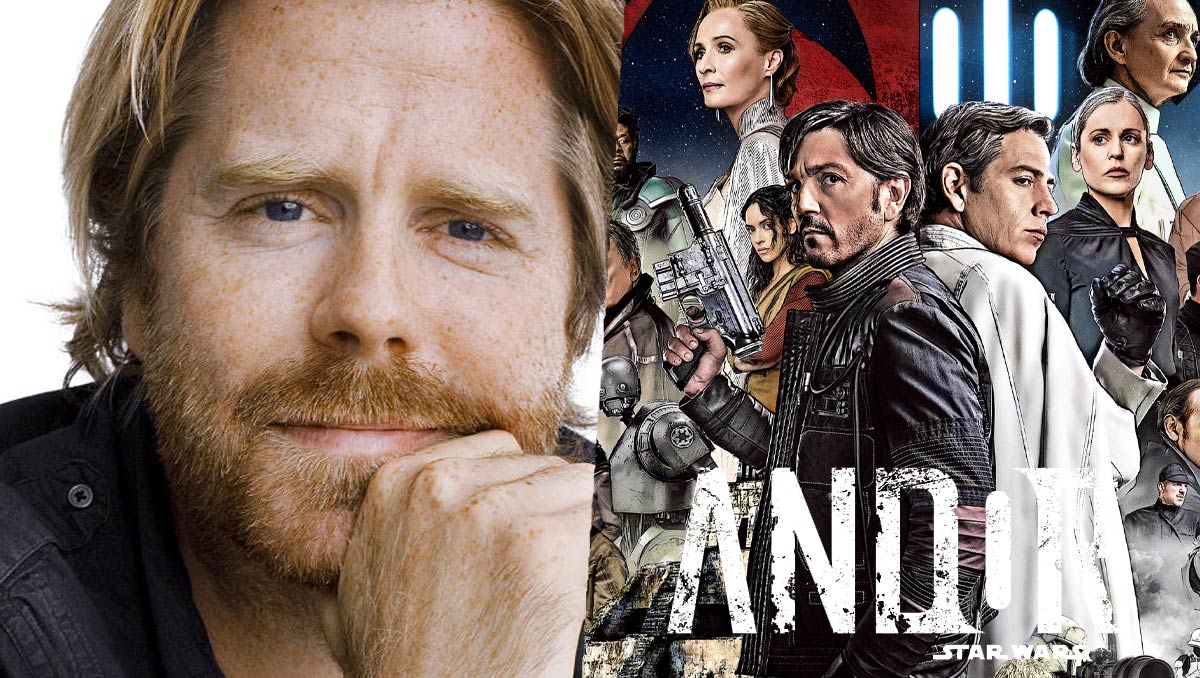
He’s more and more disillusioned, and that moment is the crisis point. Then he’s scrambling — maybe in another world he could have joined the Rebellion — but Cassian says, “Who are you?” and he’s been living rent-free in Syril’s head. He turns into another person.
We had a lot of discussions about that moment. The set was divided: a lot of people thought there’s no way he doesn’t recognize him — that it takes away from the moment. Tony kept saying, “No, it’s a one-sided obsession. That’s the tragedy.” I was leaning a little into the other interpretation, but seeing it all put together — that’s where the showrunner’s deep knowledge matters. As an episodic director, you can’t have the full scope. You come in, do the job, make it work. There’s a deep-seated knowledge in a writer/creator/showrunner. If you as a director say, “I’m the author; it’s my way,” you’re remiss. It’s a beautiful collaboration. To Tony’s great credit, he was absolutely right. It’s probably the most important line — if not in the whole second season, then at least in my episode.
It’s become a bit of a thing in how people talk about the show. Can you tease the alternate versions of that ending?
We shot a couple of different endings because we weren’t sure whether to trust that moment. We shot alts where he didn’t say “Who are you?” — where he just gets blasted, or where he recognizes him. We had options. But it was such a crucial, decisive moment.
It’s wonderful stuff. You also get to direct “Welcome to the Rebellion,” which I believe is the episode where Mon Mothma gives her speech, right?
I was very grateful to have those episodes. Eight and nine are two very different episodes — and seven even more. Nine is a spy movie. I’d just come off doing a spy movie, so I had all the tricks: how to make it as tense as possible — gazes, looking over your shoulder, not trusting anyone, extending as much suspense as you can.
And then you have Genevieve O’Reilly, who’s just the most wonderful actress, giving the speech — the most politically direct speech “Andor” has, maybe even in “Star Wars.” We toyed with the temperature of that speech. We ended up with a version where she’s speaking up against a dictator in Parliament — imagining whoever that would be in the current political landscape — and what it would take, the courage you’d have to muster to cover your fear. You feel how much is at stake; you’re risking your life, but you’re doing it with courage — the speech of a decade.
She steps out of the shadows and becomes the leader of the Rebellion. I remember shooting that and being genuinely moved behind the monitors by the strength and emotion. The world is built — this huge Senate chamber — but what you’re actually shooting is a pod on a green screen, a couple of meters up, with some camera moves. When you’re doing that kind of stuff, you need a pretty good roadmap of the camera moves so CG knows what to do. It’s choreographed — not fully; there’s wiggle room — but you need a good idea. In some ways, that’s liberating, because you can concentrate on the performance. It’s all about Genevieve.
I’m glad you mentioned the fear. She’s kind of terrified before the speech, right?
She’s got to be able to get out of there alive. She knows it’s coming down after she’s given that speech. Bail Organa is there; maybe her team is corrupted. Trust gets killed off — everything that’s become a risk and a threat before. So, yeah — a huge moment.
Another huge moment I got to direct is in episode nine when Bix leaves Cassian. People who know “Star Wars” know he dies in “Rogue One,” so I knew this was the last time they would see each other. It was quite emotional. Adria drew on personal stuff to bring out that performance. It’s one of those moments where you give the camera to an actor and let them sit through the takes they need. We came up with the idea of her talking directly into the camera because we wanted the audience to be in Cassian’s seat at that moment. She’s looking straight down the barrel — unusual, but very effective in Episode Nine.
The whole series is heartbreaking, and that moment certainly is. Any other major challenges beyond pulling off Ghorman?
When you think back, you forget how crazy it was because you pulled through. You forget the four months of prep and the thousands of decisions. Generally, shooting “Andor” was a joy. I don’t feel like we were under the gun in an outrageous way. I’ve been on shoots where sets got rained out — that happened to me in Montreal. I’ve shot in sandstorms in Morocco, insane hours. Here, we were really well prepared. There were days we were fighting, but in general, there were so many solid people. The crew was so good. We were pulling off very complicated stunts at a speed I’d never experienced. Every time you walk onto a set, you’re walking into a world — everything designed so you can shoot the shit out of it.
That’s a nice luxury — having the muscular world of Lucasfilm behind you.
Huge luxury. And I don’t know — in the landscape of financing and streaming — if stuff is going to get made at that level anymore. We had a huge budget. I don’t know if things will be made at that level. It felt like the era of “Game of Thrones” and big stuff, and “Andor” was a world where no expense was spared. It was so ambitious — and supported — so we were allowed to be ambitious.
Yeah, I think Tony intimated that himself, essentially suggesting, “I’m not sure we’re going to see a show made on this scale ever again.”
Yeah, I felt like I was riding shotgun at a bank robbery [laughs]. It was pretty crazy what we were able to do, and I’m just grateful I was able to be part of this experience.
All episodes of “Andor” seasons one and two are available on Disney+ and Hulu.
Rodrigo Perez is the founder and editor-in-chief of The Playlist, which he launched in 2007. He has worked in entertainment journalism since 2000, including at MTV, and has written for SPIN, IndieWire, Pitchfork, Complex, Magnet, and various music, film, and entertainment publications over the past two decades.

