



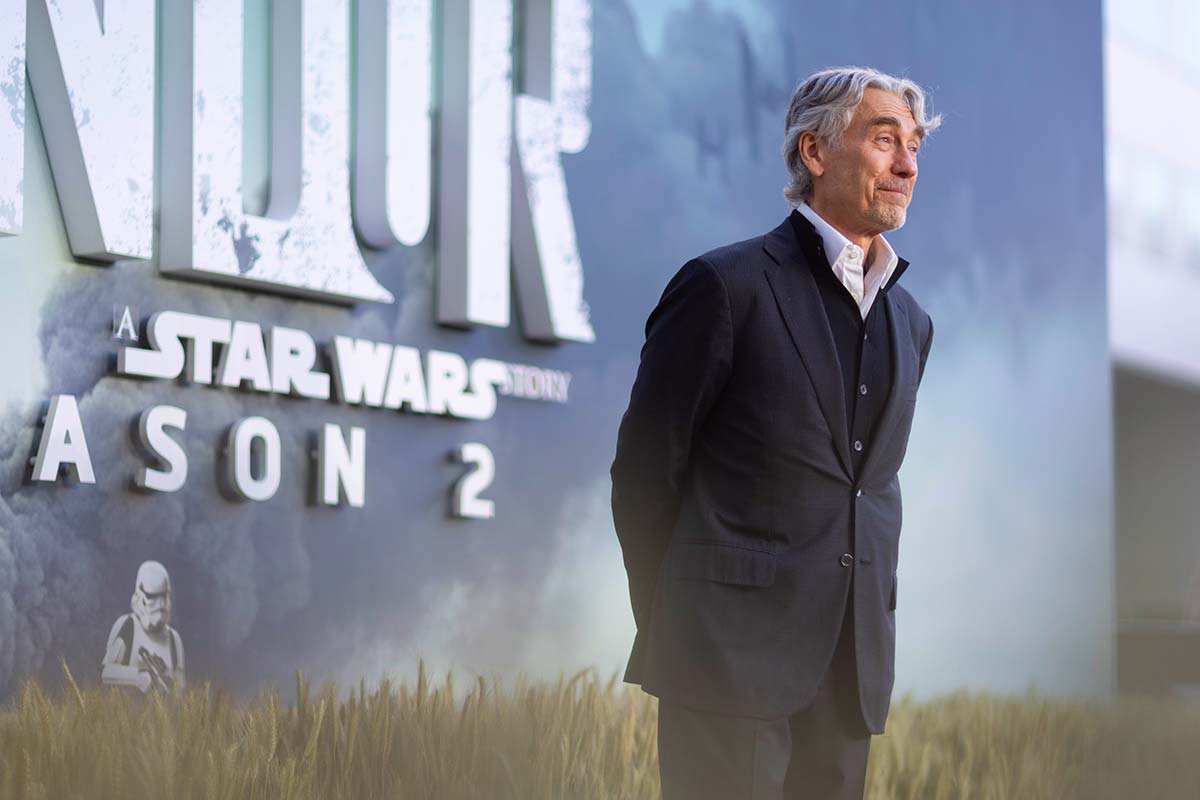
“Making ‘Andor’ was the most all-consuming creative experience imaginable,” Tony Gilroy says, and he would know. The Oscar-nominated filmmaker behind “Michael Clayton” and one of the key creative architects of “Rogue One: A Star Wars Story,” Gilroy has spent the past five years reshaping the “Star Wars” galaxy through his rebelliously-minded “Andor,” a series essentially about living under the oppressive shadow of fascism and how mounting a rebellion is as challenging as it is to maintain the unnatural state of subjugation (“Tyranny requires constant effort. It breaks, it leaks. Authority is brittle.” as Nemik writes in his now famous manifesto).
As showrunner, creator, and lead writer, Gilroy oversaw two sprawling seasons of the acclaimed Disney+ series, which has now earned 14 Emmy nominations for its second season—including several for Gilroy himself, such as Outstanding Drama Series and Outstanding Original Music and Lyrics for the rousing “Gormani Anthem” he co-wrote with three-time Academy Award-nominated composer Nicholas Britell.
That intensity defined every aspect of the series. “We thought about every single buttonhole in that show,” Gilroy admits, underscoring the obsessive craftsmanship that went into each frame. From world-building entire cultures from scratch—“We were literally playing God,” he says of creating the planet and culture of Ghorman—to co-writing a national anthem he now openly covets recognition for (“I don’t care about anything else, but I want that award”), Gilroy poured himself into every level of production.
In this conversation, he reflects on weaving spirituality and destiny into the otherwise grounded “Andor,” the preparation that allowed the series to weather the writers’ strike, the thrill (and exhaustion) of creating television at such a massive scale, and the precarious realities of a streaming-driven industry. He also looks ahead to his next project, “Behemoth!”—an ambitious Los Angeles–set musical that he admits could only exist because of the success of “Andor” (and it might just star It-man of the hour, Pedro Pascal).
What follows is a wide-ranging discussion that balances craft, philosophy, and blunt honesty, revealing how Gilroy sees his work as storytelling and a fight for ongoing creative survival.
I showed “Andor” to my friend, who knew almost nothing about “Star Wars,” other than the general pop-cultural awareness of it all, and she loved it and was hooked. We mainlined both seasons and then straight into ‘Rogue One.’ That must be the ideal reaction.
Oh my God, that’s everything we wanted. Do you know how hard it’s been to reach those people? When I took the show, my wife thought I was out of my mind. She wanted nothing to do with it until it was done—then suddenly she wanted to watch it and then watch it again with subtitles because she had missed some of the dialogue. That’s my dream. That’s awesome.
Congrats on the 14 Emmy nominations. Though some actors were unfortunately overlooked…
Yeah, I guess so… I think it’s just not enough people seeing the show. If they had, we’d be in play. It’s a heavy lift—voters think, “I hear it’s great, but I need to go back and watch twelve hours before season two.” That’s tough. I wish we had the actors. I wish Diego [Luna] and Genevieve [O’Reilly] had been nominated. Genevieve in particular—that’s a career-defining performance, a lifetime’s work.
I think it’s epic, a definitive career maker, and I’d put it up against anybody’s major performance. It’s a really serious thing that she put together, and Diego too, all of them. Anyhow, what can you do?
Many of the cast were unfamiliar faces at first— Kyle Soller, Denise Gough, Faye Marsay, Elizabeth Dulau, Alex Lawther, Anton Lesser—and now they all feel indispensable, like we’re going to see them booked everywhere now.
I hope you’re right. Some of them didn’t even have agents or representation when we started. They finished the show and were calling me like, “What do I do?” I really hope this launches them.
It’s perhaps quaint, but I saw a photo of Denise Gough after the fact, and she is very beautiful, but on the show—that super tight pulled back hair, the constant scowl, the harsh lines of her costume fitting, the cold visage—it just suddenly gave me such a reappreciation for the transformative qualities of hair and make-up and hell, lighting too.
We thought about every single buttonhole, man. Nothing on screen was accidental. Every frame came out of hundreds of conversations. We had all these amazing creatives and created a culture where people could just let their freak flags fly— and people really want to do crazy good work—and we had just enough money to sneak it all through.
There isn’t any detail or element in the show that wasn’t deeply considered. I hope it can be watched a second or a third time and be watched ten years later. That level of bespoke detail gives the show a resonance I hope lasts for years. It’s fun too—obsessive people in an environment where obsession isn’t a problem. But, man, there isn’t one thing on there that people didn’t sweat over, not one thing.
On a rewatch, the Force healer subplot really stood out, especially as a more mystical element in a very grounded,
No, there was a lot of pressure to try and put it in—everybody wanted it. So, it was definitely on me. Could I find a way, to my taste, where I could get it in? Could I make it feel legit? My key in was “Ghost”—I love “Ghost,” the Patrick Swayze movie, Bruce Joel Rubin’s script. Whoopi Goldberg plays a psychic who’s basically scamming people. She’s forgotten her real gift, given it up, and become a total grifter. Then Swayze’s character comes in and activates it again. Suddenly, she’s terrified her old power is back.
I loved that idea—that fear of the gift returning. That gave me the hook. It’s the Force healer’s reaction to him that makes it special. She thanks Cassian for reviving the feeling in her. And he’s confused, totally resistant—“I don’t want any part of this.” Her thanking Cassian freaks him out. And the cool part is that Bix is clocking all of it. She’s our audience surrogate, seeing everything. That moves her to do what she does.
I had to find a way to make it palatable for me, and that was the path. I liked where it landed. And it came at the same time we were really trying to load the musket for Bix’s departure from Yavin, to leave Cassian. Early on, the idea was, “She’s going to sacrifice her relationship with him because she thinks he’s more valuable to the Rebellion than to her.” People said that might be tough to sell, so we needed to build it carefully. The Force healer thread helped us along that path.
It becomes a step toward her eventual decision. There’s a lot that happens to Bix, but this was a really helpful piece of the emotional road that gets her there.
It occurs to me that we never discussed the writer’s strike and how it potentially affected “Andor.” I admit I was really worried at first.
We got lucky. I’ve said before—COVID basically saved our show. If we’d gone forward as initially planned, it would have been a complete disaster. COVID shut everything down, and honestly, I was relieved. I thought maybe the show would just go away. But when they decided to resurrect it, I knew I couldn’t go back the same way, so I started rewriting everything. I thought, let’s take this time and get these scripts to an entirely different level.
When production started again, I was running the show remotely. For about eight months, I couldn’t go overseas because of COVID, so I learned how to run the show remotely without ever being on set. And that system became locked in—it really worked for us. It was all about having exquisitely blueprinted scripts, nailed down to the comma, and then doing dozens of meetings, page turns, and four months of prep. Every single thing was locked. Once the actors and directors went to set, I never interfered. I didn’t visit, didn’t hover, just let them swing away. I’d watch dailies and check in, but the groundwork was so detailed that a writer was never needed on set. That became our system, and over time, it got perfected.
In fact, when I finally did visit the set, it was uncomfortable—I felt out of place, like I shouldn’t be there. I’d smile and say hello, but the system was built not to need me in that environment. And it timed out perfectly: that process wrapped about three or four weeks before the strike hit. Every script was finished. We were all done.
In those final days, I was in L.A. waiting to see what the strike vote would be, and I spent two days frantically writing every scrap of extra alt-dialogue I could think of—party chatter, radio calls, anything that might extend a scene. A mad dash to get in all the junkyard dialogue we might need. After that, we were set. Not perfect—if people had questions, they had to answer them themselves—but the system held. In that sense, we were very, very lucky.
Right, the first trial by fire prepared you for the next one.
Had we not gone through that first time with COVID, I don’t know what would have happened.
Most shows don’t finish their scripts before they start shooting; some shut down. But with “Andor, “everything was done by the time we started. On another show, under those circumstances, there would have been panic. And that’s what happened elsewhere—people panicked, things fell apart, shows got ruined and shut down.
Some people cheated [the WGA strike rules], some bent the rules. All kinds of different things happened—good, bad, and some cheating went on. But for us, because we had already locked everything, we were in a very different position.
I talked to a lot of people about “Andor” and one of the really interesting details was talking to director Janus Metz, and he told me about building, creating, blocking and then shooting around the massive Ghorman plaza set and how it was all real for the most part.
Oh yeah, the whole plaza existed. The lobby, the café, the embassy entrance—all of it real. Our production designer, Luke Hull, was my number one creative collaborator before even other writers or directors. Before anyone else came in, Luke and I were already building the culture, language, economy, and aesthetic of Ghorman. We were literally playing God.
What a fantastic opportunity to build all that up, especially given that so much of “Star Wars” is already so created, but you’re creating new worlds within your own rules. Speaking of that, you’re also an Emmy-nominated songwriter for co-creating the Ghorman national anthem.
Can you tell I want to win that award? I don’t really care about all the others [laughs], but it’s like you want to win that award. Yeah. Like, yeah, I, I’ve been told I’m going to lose to Adam Sandler for the “SNL50: The Anniversary Special.” I was hoping that he would concede [laughs]. But no, I really want that one. Nick Brittel and I had to write a national anthem, right? Together, we listened to a bunch of national anthems from other countries, and there were some good ones and some really shitty ones. And yeah, we had to write it in Ghormani. And, yeah, man, I want that award. I don’t care about anything else [smiles]
And it’s a story—it’s storytelling too. Singing it is incredibly hard. It’s meant to be heartbreaking. It really is. Early on, we did it with Nick. But when he couldn’t continue with us for the second season, Brandon Roberts came in. What ended up being submitted for the Emmys is actually Brandon’s orchestration—he brought in an opera singer and built out the arrangement. We also had the tail credits version, and I think that’s the one Emmy voters received, because we didn’t have a finished track of the performance in the square.
But when Brandon put that orchestration together, when he got the opera singer… no, I’m very proud of it. Very, very proud.