


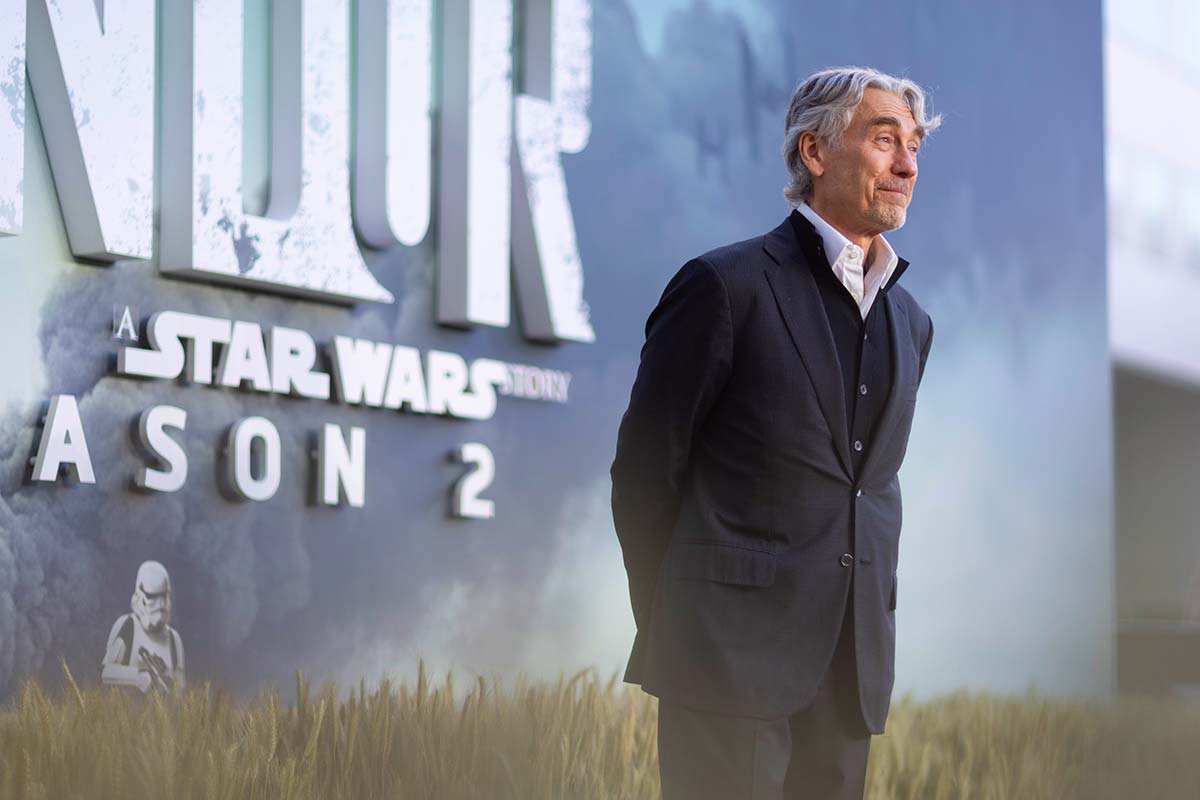
The show seeds details across seasons—Scarif in season one, Ghorman in season two.
Sometimes it’s deliberate. Sometimes it’s me being really smart, knowing something’s coming. But a lot of times, I’m laying things in without really knowing what I’m going to do with them later. And then you realize, ‘Oh, I can pick that up here, and this is a good place for it to go.’ You use things you’ve already done. Sometimes it’s chicken and egg. Sometimes it’s planned, sometimes it’s not.
After “Andor,” intense and overriding for so many years and the rhythms of TV, how does it feel returning to film with “Behemoth!”?
I mean, making a show like “Andor”—you can’t imagine. What’s great about it is that it’s the most all-consuming creative experience you could possibly ever have. You’re in all areas of creativity, all day long, every day. You’re writing, you’re designing, you’re looking at music, you’re looking at fabrics, you’re looking at hair, you’re doing edits, you’re doing special effects. Every single day is a buffet of imagination.
But the downside is, you can never take a day off. You can never get underneath it, or it will swamp you. You can never get sick. You can never fall behind. If you fell two steps behind, you’d be in a tsunami, just rolling. For me, it was literally every single day for five and a half years. It never stopped. It was relentless.
That’s why it feels very comfortable now to be back making a movie. With a show like “Andor,” you have to be really young and strong to do it. And at the same time, you have to be old enough to know an incredible amount of things—because the amount of things you need to know to do it right is epic. Every day you’re using everything you’ve ever learned. But you’ve also got to be strong enough, energized enough, to actually carry it, because it’s hard, man. These big shows are really, really hard. They really are.
“Behemoth!” is fairly personal with your music background, but is it safe to say you’re cashing in the cache chips you earned from “Andor” and spending them on this project?
Yeah, I’m making a movie that normally would not be financed right now. I’m making it in Los Angeles, which is basically impossible. It’s all about Los Angeles musicians, it all takes place on scoring stages, and it’s all going to be cut live with the musicians performing. The residuals and fringes on something like that are incredibly prohibitive. It’s a way more expensive movie than it should be. It’s not a giant film, but it costs much more than it ought to. It’s very, very unusual.
And I don’t think Searchlight would be stretching for it if Disney didn’t feel like: okay, job well done, and we trust that you’re going to do it. There’s a lot of trust, and I’ve been around for years, and we’ve made a lot of money for them. So, yeah, I think this is one of those situations where you cash in. You have to do that.
In the past, if you’d accomplished what you had with “Andor,” you might have had three or four “Behemoths!” lined up. But now, with the fragility of the business, it feels like you only get one.
Oh yeah, no, no. You get one. No one’s cutting anybody a break.
The industry feels fragile—shrinking margins, streaming instability, and even Marvel receding.
It’s so confusing. Because everywhere you go, everyone you talk to—whatever line you’re standing in, whoever’s sitting next to you on the plane—“What are people talking about? What are you watching? What did you see? Did you see Episode Five? Oh, we’re watching this, what episode are you on?” People are just eating and devouring narrative nonstop. It’s become a basic food group of existence at this point.
So how can that be so powerful and potent, and yet everyone making it is working for free—or scraping by? I’m basically putting my new project together as a charity project. I’m hiring ten composers, but the composers are getting nothing. I get on the phone with these heavy composers and say, “Look, let me start here: there’s no money, this is essentially a charity project.” And they all go, “Yeah, that’s what everybody says.” Everybody’s saying that now.
I don’t know why streaming hasn’t balanced out yet. It hasn’t found its equilibrium. The hyperbole was, “Oh my God, we need a ‘Game of Thrones.’ We’ll spend anything to have an ‘Andor.’” And then suddenly, on the second season, they’re like, “Oh my God, we can’t possibly do this.” Well, what do you want to do? Either we stop, or we go forward. It’s that whiplash. Maybe it’s leveled a little bit now, but where that equilibrium is—what’s profitable, what even counts as profit—I don’t know.
People are still trapped in a traditional way of thinking about it. They’ll ask, “Is Disney telling you how many people watched the show?” No, absolutely not. Netflix sort of tells people, but what does it matter? If you talk to anyone who really understands the numbers, they’ll tell you: these numbers don’t matter at all. It used to be a ticket was a ticket. My ticket was the same as yours. Nielsen made it the same.
Now? It doesn’t work like that. It’s: how much disposable income do you have? Did you just refinance your house? How much did you travel? What did you watch before this and after this? Did you take a piss while you were watching? The incredible, multidimensional aspect of that single decision to turn on a show has a completely different value than it used to. Are they banking all our money? I don’t I nobody knows what’s going on, man.
It’s all data harvesting these days. So, with that, I suppose you can’t really you’re your head around so you just make the work regardless.
Exactly. You can’t worry about it. I’m lucky—I mean, I’m doing my movie. And you’re right—I’m basically a unicorn right now. The fact that we’re getting to make this film, the way we’re making it, in Los Angeles, at the budget we have, with the support we’re getting… nobody can believe it. Nobody can believe we’re actually pulling this off.
Well, I’m glad you’re still here, and I can’t wait to see how you pull it off.
Yeah, man, I’m sticking around.
All seasons of “Andor” are available now on Disney+ and Hulu.

Rodrigo Perez is the founder and editor-in-chief of The Playlist, which he launched in 2007. He has worked in entertainment journalism since 2000, including at MTV, and has written for SPIN, IndieWire, Pitchfork, Complex, Magnet, and various music, film, and entertainment publications over the past two decades.

