


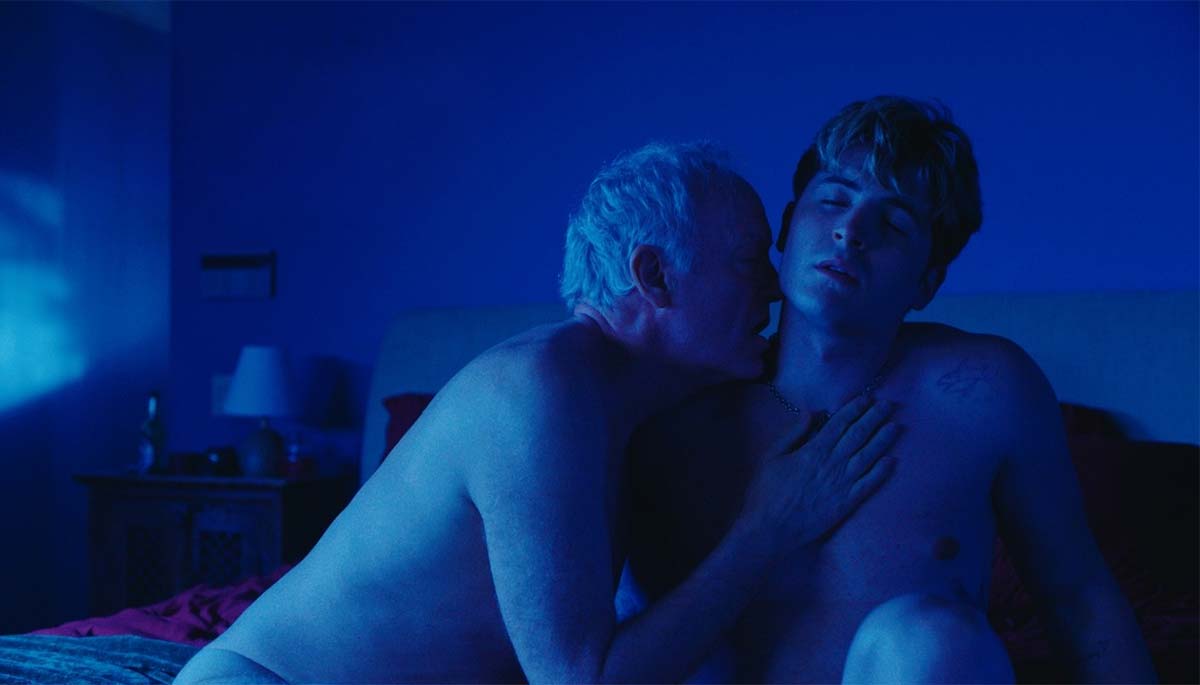
If you absorb any information about “Blue Film” before seeing it, you’ll get the sense that you’re in for a ride. The film’s only actors are Reed Birney (“The Menu,” “Home Before Dark”), who is 71, and Kieron Moore (“Boots,” “Masters of the Air”), who is 29, and the title refers to an old euphemism for pornography, to start. Add to that the trailer’s ominous references to the characters’ shared past, and you’ve stirred up some real intrigue. But despite its seedy trappings, Elliot Tuttle’s first major release has plenty of interesting things to say about sexuality, loneliness, and even spirituality — and some interesting ways to say them. If only it knew when to shut up.
READ MORE: 53 Must-See Films To Watch This Summer
The premise is this: Aaron (Moore) is a swaggering cam boy who’s signed on to be a rent boy for the night. A fan named Hank (Birney) has promised him $50,000 — $25,000 just for showing up, the rest if he stays the night. Seems straightforward enough, until Aaron unmasks his client and reveals their shared past. (I won’t spoil any details, but given the age gap and the meet-cute, you can correctly presume prurience.)
At the beginning, “Blue Film” revels in provocation. The very first line of the film is “What’s up, faggots?” That’s Aaron’s pet name for his clientele, who lust after him — or his cam boy persona, at least — because they want to be forcefully dominated. Hank’s reasons for luring Aaron into a meeting are genuinely disturbing, and they result in one sex scene that is particularly so. But once you get past the stomach-churning fallout of these characters’ shared backstory, “Blue Film” is ultimately more existential than it is, well, blue.
That’s not a bad thing, per se. For one, Tuttle’s script excels at toeing the line between controversy and outright awfulness. This story is oddly human, given the subject matter, and that’s a real feat. Secondly, there aren’t many films frankly asking the questions that “Blue Film” asks — for instance, “What does it mean to make a film about sex?” Even if it thinks more with its upstairs brain than one might expect, this movie has compelling things to contemplate.
It’s also a tight, well-composed film. If you’re going to set your movie entirely in one location with just two actors, you’ve got to be economical to keep the narrative going, and you’ve got to get good performances. Tuttle achieves both, delivering a compelling story in just 82 minutes and directing killer turns from both Moore and Birney. Birney’s performance is perhaps the most commendable, as he gamely does things that most septuagenarians would never consent to do on camera, but Moore is a revelation. As the “Blue Film” proceeds, it becomes clear that Aaron’s bravado is a facade, and Moore switches from aggressive to vulnerable with startling ease, often multiple times within the same take. Cinematographer Ryan Jackson-Healy (“Mass”) smartly stays close to both men, particularly Moore, whose character has much more to react to than he really does to say.
“Blue Film” is not without its warts, though. It’s an ample use of home movie footage that’s unnecessary at best and sickening at worst; its premise strains credulity, and it’s a little too talk-y after a certain point. (There is also an entire sex scene lit in — you guessed it — blue.) For a film centered around the vulnerable nature of sex, it’s pretty tame. There’s no full-frontal, and most of the acts happen out of frame. There are about a hundred European films that make “Blue Film” look tame by comparison, and countless American movies that subject women to far more punishing sexualization.
If this movie has a standout fault, it’s that it ultimately feels more like a play than a film, a protracted philosophical discussion punctuated by blowjobs. That’s no cardinal sin, but by the end of “Blue Film,” it’s hard not to feel like it didn’t quite live up to its potential. As a novel, it would be engrossing. As a movie, it’s got good bones but a cowardly lack of boners. [B-]


