



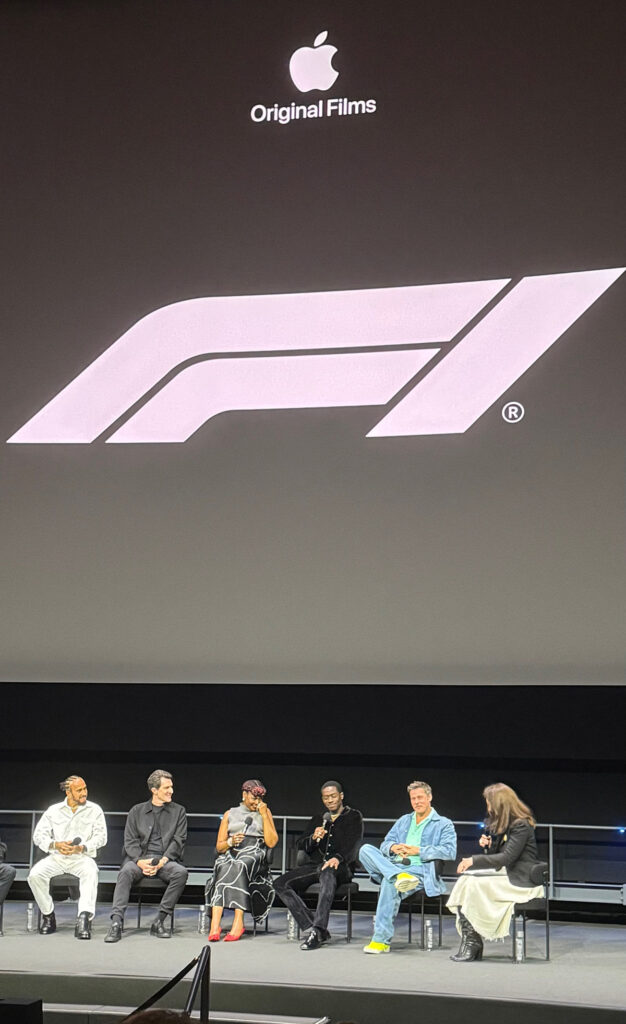
On a gorgeous Sunday morning in Los Angeles, the David Geffen Theater at the Academy Museum of Motion Pictures is packed. The audience isn’t here to see any movie, however. They didn’t get up early to even see a world premiere or an early screening of a brand new awards contender. No, this audience of AMPAS, guild, and SAG nominating committee members is on hand to (likely) rewatch Joseph Kosinski’s global summer hit, “F1.” Oh, and experiencing a Q&A afterward featuring the director, producer Jerry Bruckheimer, stars Damon Idris and Sarah Niles, as well as Formula One racing legend, Lewis Hamilton, who also happens to be a credited producer on the Apple Studios endeavor. Oh, and of course, the film’s leading man, Brad Pitt.
READ MORE: Sequel to “F1” reportedly in the works
Pitt was actually a few minutes late to the panel, having just landed somewhere across town, but was excited to talk about the semi-unexpected $628 million worldwide hit. As he immediately remarked, “We did have the time of our lives.”
If you haven’t caught “F1” yet, the thriller centers on Sonny Hayes (Pitt), a race car driver for hire who is running from the ghosts that scuttled his promising F1 career thirty years prior. When an old friend, Rubén Cervantes (Javier Bardem), approaches him, desperate for him to join his team, Haynes takes a chance and jumps back into the world he’d left decades ago. He predictably comes into conflict with Joshua Pearce (Damon Idris), an up-and-coming driver, who isn’t interested in any old-man advice Hayes has to give. As the racing season progresses, there are highs and lows, and the question isn’t whether Hayes will get his groove back, but whether he’ll stick around when it matters.
Hamilton not only contributed storylines and a wealth of insight into the sport, but also gave the Oscar-winner some much-needed driving advice and encouragement. Because, yes, if it’s a Bruckheimer and Kosinski movie, the actors know going in they are going to do a lot of their own driving.
“In fact, Lewis was brave enough to first get in the car with me, my first time I got on any kind of track,” Pitt reveals. “But it was an amazing experience that we had the real pit crews, we had the real deal, we had the real cars, the real machines. And we drove for two years, really. So, I wish we could do it all over again. We are so much better than when we started.”
“F1” was something of a surprise success, and it’s not just because of Kosinski’s incredible staging, cinematic eye, and the overall contributions of a stellar production team. There is something universal about Sonny’s journey that speaks to audiences around the world. An Pitt is pretty sure he knows why.
“I think the Sonny Hayes character is a redemption story. We’ve all stumbled in our lives. We’ve all had times where we’ve had to pick ourselves up, and it seemed impossible, and the odds seemed impossible to get back in the fight,” Pitt says. “And that’s when we grow, that’s when we see the most growth. That’s when we probably see the most rewards as individuals. So, that would be my guess. That’s what appealed to me about it as far as Sonny Hayes goes.”
But then Pitt pivots to his director, noting, “But we got to go back to the world in this incredible [movie]. I mean, I can’t say enough. I take so for granted what Joe did with these cars and building these sequences that we got to put our story into is just something, it’s staggering. I look back now, and the two years, three years we spent doing that, it’s just something I’ve just never seen before. I think it was this amazing confluence of events of story, of F1 really being introduced in another way to the U.S. What Joe was able to do with the technology, it just all came together. Lewis coming in, of course, Jerry, who just can’t make a bad movie. And then the rest of us, I think it was just something extraordinary that all came together at once.”
The end of the film features a key moment between Sonny and his love interest Kate (Kerry Condon), who is also the racing team’s technical director. It’s a heartbreaking scene that resonates for many, but according to Pitt, it didn’t come from screenwriter Ehren Kruger. The “bulk” of that scene was sparked by anecdotes shared by Hamilton.
“We developed our script, fair to say, until the very end,” Pitt recalls. “Whatever hadn’t been shot was still being worked on. But it really stemmed from a 12-hour session with Lewis, who gave up 12 hours of his day to spend with us, and we just kept querying him about questions. ‘Does this float? Does this pass the smell test?’ ‘No, that doesn’t work, but it could be this.’ And really, it was what Lewis had described for us at these moments of absolute pure bliss that I don’t even think we portrayed it as well as Lewis described it on that day. But it really stemmed from that. And this idea of winning is one thing, but the purity of the sport, the feeling that thing that fulfills you. We don’t question. You don’t doubt. You just are and define those moments where I guess just that kind of purity where you are the ultimate presence. And this certainly [Damson] and I talked about it. We felt it in the car, and that’s, to me, in all our discussions, what we gathered from what Lewis was describing to us that day. So, we really have him to thank.”
“F1” is full of genuine tension on the race track, but one of the more horrifying moments is a car crash involving Idris’ character. It was based on a real crash that occurred in 2020. And Hamilton, who has had numerous crashes in his career, provided some firsthand knowledge on what the experience is like for many drivers.
“What you need to fight for in order to get out of the car during those precious moments is your family and everyone you’re fighting for,” Idris notes. “And he explained to me of that moment of potentially giving up, and as soon as he told me that, I knew how to play it. And I was in the fire for real, by the way.”
After the audience laughs, Hamilton adds, “It’s kind of crazy. So, we have to do a test at the beginning of the year, when we get to the first race, we have to do a jump out of the car test, and you have to get out of the cockpit. They time you. You have to be within seven seconds of taking the steering off, getting out, putting the steering wheel back on. But of course, since they introduced a halo, that gets harder because it’s harder to get out of the cockpit with…”
The moderator interrupts, asking what a halo is, and Hamilton responds, “The halo is the big ugly thing that sits kind of around the top of us. It’s called a halo.” He recalls the safety mechanism was introduced less than a decade ago, “And it was something that all the drivers were against because it looked so ugly. So, before it kind of looks a little bit like those kinds of sliders, flip flops, the bit that goes between your toes. And none of us liked it, but the improvement in safety was like 17% or something like that. So, we couldn’t deny it, and it’s been great, and we [got] used to it. But that crash in Bahrain that was one of the things that made it really difficult for him to get out because it’s between the halo and the barrier. So, he was under in those flames for a lot longer than any other drivers of recent times.”
For the seemingly always humble Kosinski, the most important thing he can do as a director is hire a great cast. If you do, they should grab hold of whatever material you have and elevate it. You won’t have anything truly compelling without it.
“And the truth is, each one of them took this part that was on the page, and obviously, we had these hopes and dreams of what it could be, but they elevated it beyond my expectations every day,” Kosinski says. “So, hire a great cast and create space for them to create and do their thing. And hopefully you get those little magic moments. But yeah, I mean, just the chemistry you see on screen was there off-screen as well. I think we just had a great group of people, and we all wanted to make Lewis proud. I think we all felt an enormous amount of pressure to represent this sport because we knew he was really putting his reputation on the line, and the sport was counting on us to make a great movie. So, we all worked hard every day, and we never quit until we felt like we had gotten it.”
Bruckheimer concurs, noting, “It’s the energy that this team put into making this movie, and it’s not just the driving that they did, it’s the energy that they put into the script that creates the emotion. That’s what moves you. And just the hours and days and months that Brad and Lewis and Joe spent time working with our writers to make this as good as it can be. And then after that, the energy that they put into making the movie and then editing the movie, because Brad was involved and Lewis was involved. They were in the editing room. You know what? He’s got a day job, and Brad’s got a hundred movies to make. But they took the time to spend it on this project to make it as good as possible.”
Apple TV (no longer Apple TV+) announced that “F1” will arrive on its streaming service worldwide on Dec 12. Just in time for the holidays.
Follow Gregory Ellwood on Bluesky
Follow Gregory Ellwood on Threads
Follow Gregory Ellwood on Instagram
Sign Up For The Breakdown Newsletter

Editor-at-Large Gregory Ellwood is one of the entertainment industry's most respected journalists and critics. Based in Los Angeles, he's the only current awards expert who previously worked on Oscar campaigns at a major movie studio. Over the years, he has written for the LA Times, Variety, The Hollywood Reporter, and Vox, among others. He also co-founded the entertainment news site HitFix, which spawned a legion of influential Emmy and WGA Award-winning alumni.


