


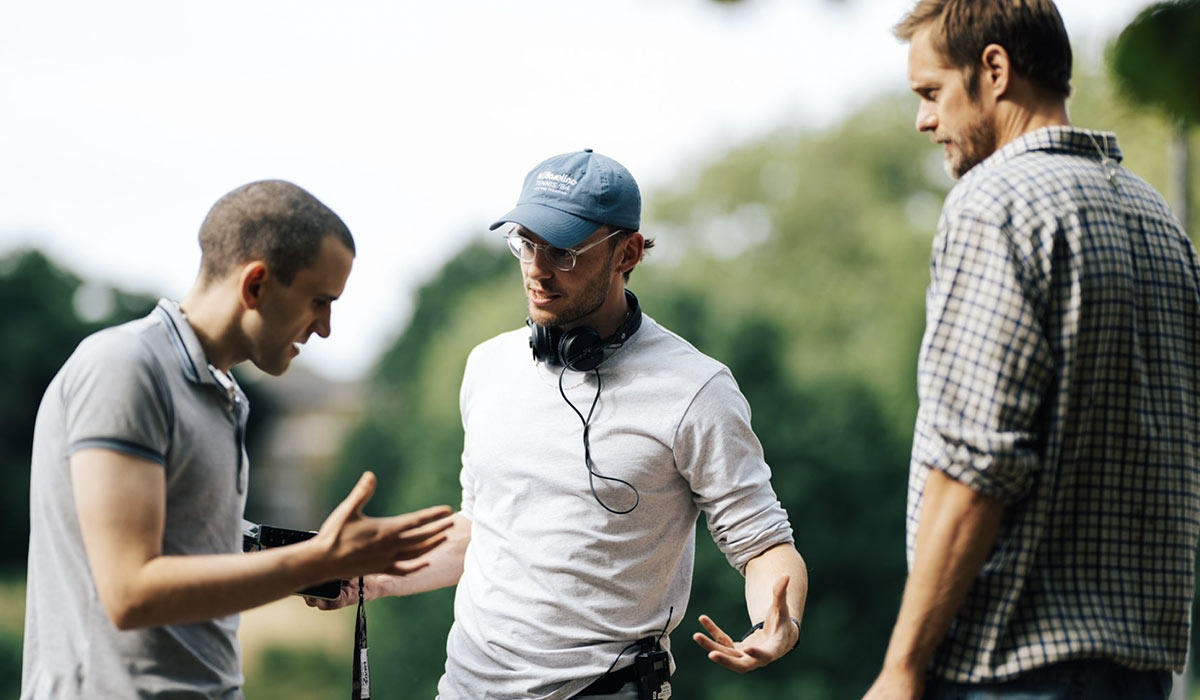
Full disclosure. I gave Harry Lighton LA party advice. He then got tonsillitis after taking said advice. Thank god he recovered in time when awards season and a burgeoning campaign for his feature debut, “Pillion,” really needed him. In the weeks since he picked up the top prize at the British Independent Film Awards and, in a delightful surprise, won Best Adapted Screenplay at the 2025 Gotham Awards over some very stiff competition. A wonderful turn of events for A24’s underdog awards contender.
Adapted from Adam Mars-Jones’ novella “Box Hill,” the Cannes Film Festival selection centers on Collin (Harry Melling), a timid parking enforcement officer who is perhaps more lonely than he or his family wants to admit. When he meets Ray (Alexander Skarsgard), a mysterious, jaw-droppingly hot and domineering member of a local motorcycle club, his life completely changes. As the two bond, however, it increasingly becomes clear that one of the pair is either unable to deal with his emotions or simply doesn’t believe it’s necessary.
During our interview last month, Pillion made a startling revelation about a previous conversation, discussed the difficulties of getting the movie made, what he learned working under Oliver Hermanus, whether he’ll ever reveal Ray’s background, his fear over notable actors turning down these very sexual roles, and much, much more.
Note: Some spoilers are insinuated in the context of this conversation. This interview has also been edited for length and clarity.
_____
Harry Lighton: I saw you at the after-party in Telluride, right? And you were giving me advice on [redacted], and I went to…
The Playlist: Wait, where did you go?
I went to [redacted gay club night in Los Angeles].
What was your opinion?
I thought it was fantastic. But then I was flying home the next day, and I went a bit too hard, and I then got the worst tonsillitis I’ve ever had in my life. And I was in bed for two weeks. Clearly, I can’t hack [redacted] or LA…
Oh, my God.
I was humbled this time round. I’m going to be steering well clear of all of your suggestions.
Wait, this wasn’t the one that Demi Lovato showed up at, was it?
If she did, I was unaware.
No, you would’ve known it.
Know what? She had turned up the month before because I remember I spoke to the guy who runs it, and he had shot me a photo of him with Demi. No, no pop girls for me.
No pop girls for you. It’s O.K. Let’s talk about your incredible movie. I know you did a ton of shorts before you made this film. What made you say, “I want to fight to make this my feature debut”?
I think that IMDb, if that’s where you’ve seen the shorts, is slightly deceptive because I’ve sort of done three shorts. I’d say “Wren Boys, “Sunday Morning Coming Down,” and one other one. And basically, after “Wren Boys,” I was then asked by the BBC, “We want to make a feature with you, come up with an idea, and let’s try and get the ball rolling on a feature.” And I thought at that time that it was the right moment to make a feature. But I kind of just dilly-dallied for eight years, and I became obsessed with sumo wrestling and spent ages writing this film about sumo wrestling, which was obviously totally unfeasible as a first feature. I think it cost like 20 million or something. And so the real change was that I knew I wanted to make a feature, but I then worked for Oliver Hermanus, and I did “Living” with him and a TV series. And after doing that, I was like, “O.K., I’m certain now I know how a film set can be run, and I know how I want to run one.” And that was the missing piece of the jigsaw. But I’m also an incredibly slow developer. My writing is a painfully slow process for me. So, five years was actually reasonably quick.
I’m getting ahead of myself, but for your next feature, do you feel like it will be another long gestation process, or are you willing to direct someone else’s script if something you liked came your way?
I think it’s interesting. I’ve been asked this by all sorts of people, agents, and things like that at the moment. And I’d never say never to someone else’s script. It wouldn’t be like a point of pride that I have to write and direct everything. But that said, I think that certainly on “Pillion” it was such an essential part of my directing process. Being able to make quite significant changes to things in the moment, directing. So, I worry about how that would work if someone else had a script, which had been the reason the production was funded. I don’t want [the next one] it to be nearly as long as the wait to make “Pillion.” I’m going to try and really just learn how to be a bit quicker, I guess. But that’s what I’m working on at the moment is writing my next film.
I rarely hear about directors who talk about how they worked for other directors and learn something that helped them on their first features or other projects. Was there one thing that you were cognizant of that Oliver does on his sets that you wanted to add to your repertoire?
There’s plenty of things, but one that really sticks out is I think he’s very, very good at protecting the actors and making sure that all the pressures of a film set don’t impinge on the actors. And that the actors never feel like they’re being rushed into a performance. I think in my experience, actors absolutely love working with Oliver. And before I worked with him, I think actors probably hated working with me, and he made me a bit better at that, I think.
Why do you think actors wouldn’t like working with you? Do you think you’re tough?
No, I think I can be. I certainly am sure of what I want, and sure when I’m very happy to say, “I don’t know how to get to what I want, let’s workshop it together.” But before working with Oliver, actually, they wouldn’t have liked working with me because I was scared of actors. I didn’t really know how to work with them. And so my tactics, which worked to a certain degree, were to starve them of information. To try and create naturalistic performances by taking their scripts away or not giving them any direction. And it creates quite a hostile environment for an actor, and it can really create quite livewire performances. But I think that I’ve learned to balance my own way of working with actually cuddling actors a bit more and listening to their processes.
My guess is that, especially on a film like this, the actors would need a lot more attention, especially for what you’re trying to pull off. Or did you feel like Alexander and Harry sort of knew where this was going the whole time?
It is interesting because certainly a lot of the actors, a lot of the bike gang, needed lots of attention. They hadn’t been on film sets before and were doing quite complicated, intimate things. But actually, I spoke to Harry a lot beforehand about Colin and references and ideas about the character, and I spoke to Alex very little. I probably spoke to him on a couple of Zooms because my approach to Ray was that the more you try to analyze him or psychoanalyze him, the more boring he became. And I didn’t want to try and have any answers to or try and narrow down the answers to why he is like he is. And actually, the exciting thing about working with Harry and Alex was, I’ve worked with great actors before, but it was the first time I felt totally comfortable on set working with people who were bringing plenty of ideas. It truly was leading with curiosity. That thing where you’re on a set, and you have multiple people putting forward ideas, but not in a dogmatic way. And so I was quite hands-off beforehand, and then on set, I think there was quite a lot of discussion and play. I hate when directors use the word play, it makes them slam them, but that is how I describe it.
!['Pillion' Review: Harry Melling & Alexander Skarsgård Find Unexpected Feeling In The Role Play [Cannes]](https://cdn.theplaylist.net/wp-content/uploads/2025/05/16122918/PILLION-Harry-LIGHTON-Photos-1-Films-kit-Cannes-1024x575.jpg)
The movie debuted at Cannes, you’ve been to many festivals with it, and you’ve still got release dates coming. You’ve already done a bunch of interviews. How are you handling everyone always asking for more details on Ray’s character?
I think I’ve worked out my answer, which is just, “No, I’m not going to help you.” But, two nights ago, someone in the audience put their hand up and was like, “Can you just explain to [spoiler]?” And I was like, “Sorry, mate. Absolutely not.” But I really understand the desire for that knowledge in an audience because it is the kind of thing which I share, but it’s also the kind of thing where I know that if I were reading a book or a film and it answered that question, it would ruin the whole thing.
You’re better than I would be in that situation. But I will ask, though, in the back of your head, do you know why?
No, I did drafts where, very briefly, I dug into one idea more. For instance, I explored the idea of someone in Ray’s past causing him to be so emotionally constipated and sewing that more into the film through backstory. It was a very light backstory. But anyway, as soon as I started dropping in bits of backstory about Ray, I was like, “God, this is terrible.” And it makes this kind of myth of a man, this character who does have one foot in fantasy, suddenly feel very, very, like I’m doing a course on how to write about characters. It just reduced him to a kind of generic idea of what you need to make a character interesting or satisfying. And so I learned quite quickly to just not answer for myself.
Did Alexander ever ask you, or did he just come up with his own reason?
No, what we discussed was actually exactly the process that I’d gone through writing, and how I’d realized that when I tried to pinpoint things, it became less. It narrowed it. And so he did the same thing. I think sometimes he’d explore one idea in a scene and then another idea, and he didn’t close down the answers for himself to try and keep that kind of variety open.
I can see a casting director looking at your script and going like, “Oh, Ray, let’s go to Alexander Skarsgard.” It would be a natural. But for Colin, how did Harry land this role? Had you seen him in something else?
Yeah, well, we cast Harry as Colin first, and I’d written this character, and then it got to casting, and suddenly, I don’t know if there’s anyone who I think would be good at this. And then I was randomly watching“The Devil All the Time,” which was a film on Netflix by, Antonio Campos. And Harry plays an Evangelical preacher, and there’s a specific scene in it where he follows a guy out of a car, and he’s kind of walking the plank. He knows the guy’s going to kill him, but he’s still walking after him. And in that moment, I was like, “Oh, that’s exactly how I would have Colin follow Ray into the blowjob scene. I want him to be walking to his death but kind of doing it.” And then I started looking at his other work. And the consistent thing till that point was that he had played secondary characters, and often characters who were in some way peripheral to society were in some way weird or losers or whatever, but he was always totally magnetic. I’d found myself fast-forwarding through films, which I wasn’t very interested in, to watch his bits. He had a totally captivating, not alpha male quality. And then bizarrely, well, maybe not bizarrely, when the casting director came on board, Kahleen Crawford, Harry was the top name on her list without us even discussing it. And so then we were like, “Well, let’s write him a good letter, and I hope he says yes.”
It’s funny because even on paper, you’d assume some actors would be scared to take on these roles. Were you worried that a lot of the actors you wanted would say no?
I was definitely worried, and actually, a couple of casting directors were scared of the castability of the project, and they didn’t want to do it. So, that definitely put the fear of God in me. But at the same time as those casting directors who said they didn’t think it was too difficult to cast, they also would respond by saying, “But I found the script so surprising and moving and as well as bracing and funny.” And so, yeah, you hoped you could find actors who wanted a challenge. And I hoped we’d be able to get an actor for Colin who was just really up for that challenge. I was more surprised that we managed to cast Alexander as Ray, to be honest, because Alex has brought him to life in such an interesting way. But if you ever read the script on paper, Ray, like, he says nothing. He’s described as being hot, says nothing, and that’s basically it. And so I was like, “It’s going to take someone wanting to really do an interesting, different thing and being able to see beneath the silences and the kind of lack of character there.” Yeah, I mean, I was gobsmacked when Alex said yes.


