


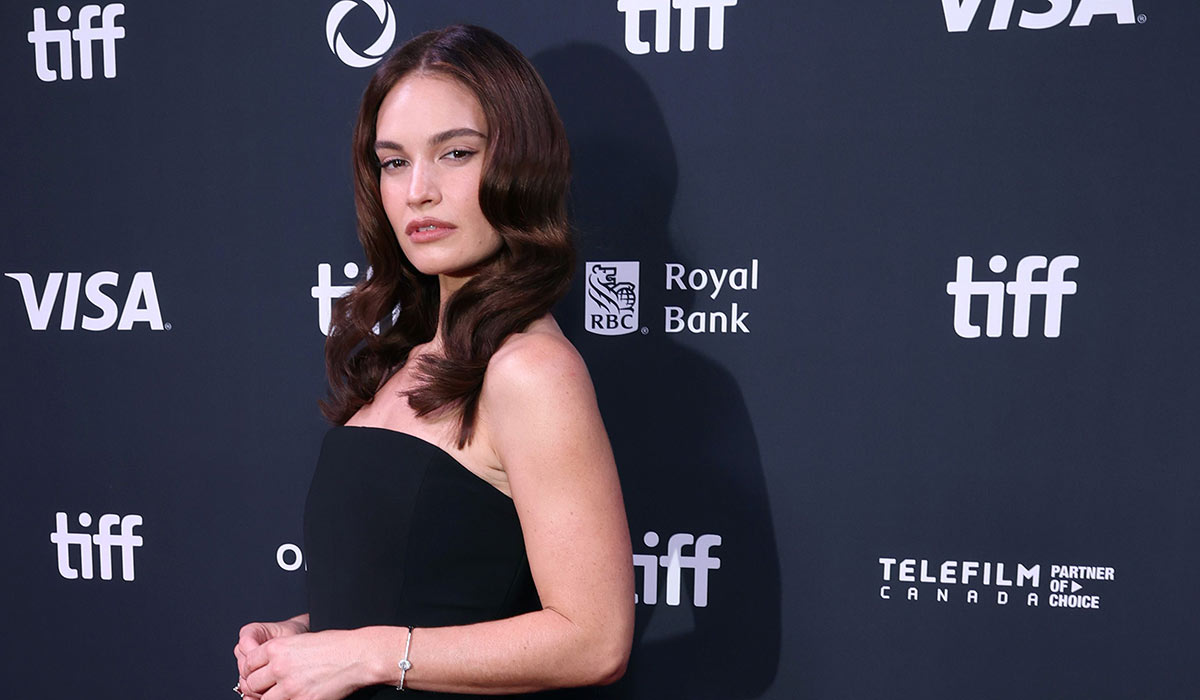
Lily James is more than down to talk about “Swiped.” The 20th Century Studios production may have premiered at TIFF last September and dropped on Hulu a little over a week later, but it’s a leading contender for a TV Movie Emmy nomination. And, as a full producer on the film, that’s a nomination and potential win with her name on it. Oh, and her celebrated performance as real-life digital pioneer Whitney Wolf Herd could land her in a somewhat wide open Leading Actress in a Limited or Anthology or Movie category.
You may not recognize Herd’s name offhand, but she may be part of your daily social life. Or, at least your online social life. Herd was one of the key creators of Tinder, until her contributions were wiped from public record by the founders of the gaming tech company behind the dating app. Due to a massively restrictive NDA, Herd has never been able to publicly discuss her time at Tinder and eventually used her knowledge to launch a rival dating app, Bumble. “Swiped” uses other eyewitness accounts and testimony to tell her story and depict the, you guessed it, inherent misogyny that followed her at both companies.
But James has shot four other movies since. There is Jaume Collet-Serra‘s reboot of “Cliffhanger,” which still has an August release date, but no current U.S. distributor due to financial issues with Row K. Guy Nattiv’s “Harmonia,” which also features Carrie Coon and Bella Ramsey, and Patrick Vollrath’s “Subversion,” which features Chris Hemsworth, and Amazon MGM Studios or Prime Video will release in 2027. But the film that got her most excited? Takashi Miike’s “Bad Lieutenant: Tokyo,” a NEON release in the U.S. expected to arrive this Fall (and potentially at a major festival or two).
And that’s just a tease of our conversation late last month.
This interview has been edited for length and clarity.
_____
The Playlist: One of the things I was most impressed with is that you don’t just have an executive producer credit on “Swiped,” you have a straight producer credit on it. What did that entail for you on a project like this?
Lily James: Well, it felt essential on a project like this, to be honest. There was this weird sort of synergy and life imitating art thing where I spent the last couple of years building a production company called Parados Productions. And the whole aim is to really take agency and really champion the stories I believe in. And really at this point in my career, be so intentional and specific in the roles I take and what I want to contribute and what I want to say. And it’s all quite a lot, and I sort of spend ages thinking about it. But as an actor, I really can’t take credit. This film was being built for seven years by Jen Gibgot, our producer, and all the real hard work of producing is coming in and getting the financing and getting it made. But when I did come on board as an actor, I wanted to be involved in this creatively and the choices we make in building the team and the heads of department and the casting. And then, in turn, in the edit and work that we did to the script after I came on board. And tonally, how to shape this film and what’s our shared ambition: “Are we all on the same page?” And it was a really rewarding and challenging experience. There was so much growth through that for me in learning and understanding the levels of wins and losses and compromise and collaboration. And yeah, just the beginning I hope, but I learned a lot.
Is there one thing that sticks out from the entire experience, even something tiny, that you’ll take with you on the next one?
I really loved being in the edit. It’s obviously super confronting as an actor to watch yourself, but if I could take a seat out of that, understanding the rhythm of how you put a story together and that if you linger just a second longer on this and how that changes our allegiance with different characters, or when you feel empathetic with each character and the growth and the sort of energy of a piece, that to me was thrilling. Having said that, I’m also so excited just to be an actor. It’s a lot because you start putting a lot of weight on your shoulders and thinking about a lot that I found at times a bit. I just went off to Cambodia for five weeks by myself to just switch off from everything because I was getting a bit bogged down in the intellectualizing. And I’m so excited to keep doing the producing, but I also really love just showing up as an actor at the mercy of the collaborators you’ve chosen to work with. Both have pros and cons.
READ MORE: Finneas On Scoring ‘Beef’ Season 2 And “Music With Cinematic Aspirations” [Video Interview]
As an actor, when this project came your way, what immediately appealed to you about it?
I couldn’t believe I didn’t know her story. And now that sort of makes sense to me given what I learned about her experience with the sexual harassment case and the NDA. She’s not allowed to talk about what happened to her, and that being only one small part of who she is and what she achieved. But I was just so compelled by this story of this incredibly young woman who was so audacious and bold and kind of carved this phenomenal pathbreaking so many boundaries when she was so young at this moment when tech was just so young, and tech was…it’s breathtaking. And then ultimately to channel a really difficult experience into something positive to recognize that sometimes those setbacks, those experiences, personal and professional, that you feel like, “Actually this is going to break me. This is game over. I give up. I can’t cope. Rock bottom.” [That] can actually be the motivation, inspiration engine for your next chapter or teach you what you really care about. And I found that story so human and powerful.
I know she couldn’t speak to you, but were you able to talk to other people who worked at Tinder or Bumble? Was that allowed? Did you want to have a wall between how you guys made the project?
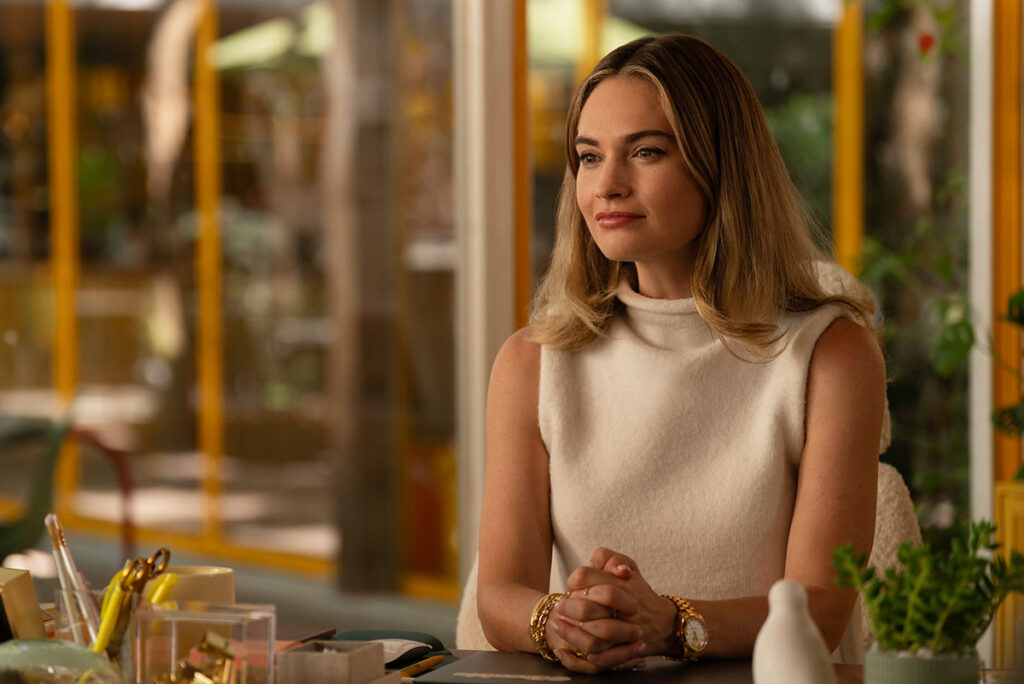
There was a wall. And I think ultimately I had to believe in the work of the researchers, which was extensive and prolific. I mean, I didn’t just get a script. I got a Bible of work alongside it and then did my own research. And there’s a wealth of information online to create this cinematic narrative, to create our version of this story, which we all felt as filmmakers and storytellers was an important story and a story that really deserved to be told and to be reframed. And also a really fun story. There are themes in this that are so heavy, but also there felt pop-y and exciting. And we’ve seen these tech films about male leaders. And I was just like, “Oh God, what a gift, what a joy to tell it from a female point of view. To go into the tech bro world with the women leading us.”
I think one of the things that struck me watching it was that this was what, 2012 or 2013?
Yeah.
So little has changed. It feels like the same tech bros are out there.
Yeah.
I actually thought, “Oh, wow, none of this has changed. It’s maybe gotten worse.”
Yeah, I agree.
In that context, so when you were doing your research about her, was there anything that you found out yourself that surprised you about her as a person that maybe you weren’t aware of in the script?
There’s a ton of things. I mean, you’re always looking for these little clues and what’s going to link you into this person? “What do I relate to? What do I recognize in myself?” I mean, the speed of her brain and the kind of clarity of thought. Her ability to connect and have great empathy, and great leaders have that. There’s this incredible tenacity and eloquence, making everyone in the room feel seen and heard and valued. And I was obsessed by that. I also thought there was great vulnerability in her, and she wears her experience not so far away. She’s not defined by her experience, but she has a vulnerability. This is my interpretation of her vulnerability. And a courage that being unafraid to talk openly about why she’s doing what she’s doing. Even if she can’t talk directly about some of her experiences, particularly at Tinder. I think the way she campaigns to make the internet a safer place for women and the way she talks about the kind of low moments along her path with great vulnerability is very inspiring. So I, in turn, wanted to be as vulnerable as her in my portrayal of her and to draw on my own experiences and find a courage there too.
This came out in September, right?
Forever ago. I mean, that’s centuries ago in this day and age. [Laughs.]
Did you or any of the filmmakers hear from anyone at either company saying, “You guys nailed it, ” or “We didn’t realize anyone would catch this.” Did you get any feedback at all?
Yeah. I mean, I know that Whitney had said that she was really honored that I’d played her, which was hugely meaningful to me beyond anything anyone could write about me. And I know that indirectly, and sometimes I don’t engage with this because it’s too much, but I did get a lot of messages from women that have gone, “Wow, I feel really seen in this, and I actually have been in a really toxic relationship and I managed to get out of it. ” And I think that stuff really matters. We work so hard, and you’re never going to know how things are received, particularly critically or whatever. You can’t really pay too much attention. But I definitely feel like there was a sense that it hit, particularly of a younger female generation, that it connected. It hit the mark where we wanted it to in terms of, “I hope women are feeling seen and inspired to follow with Whitney’s example.”
I have to ask just because he’s so incredible and he’s such a chameleon. At first, I didn’t recognize him at all. Were you surprised by the Russian accent Dan Stevens pulled off?
He’s such a chameleon. He just disappears into his roles. He nailed the Russian. So, when we were putting this film together in terms of the casting, I just took him for breakfast, and I was like, “Dan, please do this movie.” And he did. He’s so cool, and he was so good. He has not much screen time, and his presence in the film is undeniable, and he’s so beautifully nuanced. He killed the Russian.
And all the actors put in great performances.
I think there’s a great energetic feeling of these younger actors, which we needed to capture because, as we were talking about, these were just kids from college creating these apps, having no idea how they were going to impact culture. Or maybe they did, but seemingly didn’t. Who could know, to be honest. And yeah, I loved our cast. We felt really lucky, and there was a great sense of playfulness in terms of how those scenes all came together. There was a kinetic energy because Dan has brown eyes in the movie, so we both switched eye colors, and it’s incredible what an eye color does to make your face look entirely different. So, that’s probably one of the reasons why you don’t really recognize Dan apart from his brilliant acting is that he has brown eyes.
Is that important to you or to the director? Did you feel you needed to change your eye color to match hers?
I like anything that stops me looking like me so I can look in a mirror and not see Lily looking back at me to help dissolve a bit of myself to let the character lead as opposed to me. I love that stuff. And I think Dan just chose to have the contact lenses too. It was less important that I looked visually identical to Whitney, for sure, but I spent a lot of time trying to find her mannerisms and get the essence of her and how she holds herself and speaks.
You just said you took a five-or three-week break.
Five weeks.
You have at least four movies coming out in the next 12 months. I’m excited about a bunch of them. I’m certainly excited about “Harmonia,” which I know is coming out this Fall, and you’ve got “Bad Lieutenant: Tokyo,” and you’ve got “Cliffhanger,” which may or may not have studio at the moment. Hopefully it does soon [James crosses her fingers]. And then “Subversion,” but out of all of those projects, which one are you the most excited for people to see? An I’m gonna make you pick just one.
O.K. It is hard, you know.
I know.
O.K., for “Cliffhanger,” learning to rock climb and hanging off at the Dolomite Mountains with the skeleton crew and actually technically learning to climb really up there, mountain peak pinnacle. But Takashi Miike, going to Japan and being completely out of my comfort zone and working on a set where I was pretty much the only English person, so I’m working with a translator and adapting to the way that he works, which is one or two takes max. And I would say it’s a highlight of my career because it was so different. And it reminded me to step out of my head into my instinct and to take a bold swing. Who cares about failing – not that I think I failed in that, and I love the movie – but being unafraid to fail and being really brave, and I felt like I was sort of in drama school again and reminded me why I love this so much. And being in Tokyo, which is my favorite city in the world, it was really a really special experience. Yeah, that one was pretty epic.
Wait, I want to follow up on that really quickly. That movie has to have some action scenes. He must do multiple takes for some of the action shots, right? He’s not just doing one or two…
Barely, barely. We did this almighty action sequence that takes place in a nightclub. It’s so racco. And I’m working after hours doing my fight stuff, learning with the coolest stunt team. Oh my God, it was so epic. And yeah, we shot this scene that I think in bigger budget, big movies, action movies, you’re going to spend a week and a half doing this. We did it in a day, and it was so crazy. And this is not good, but the stunt guys at the act, they were like, “Just don’t be afraid. You can kind of hit us. Go for it.” I think I took it a little too literally, and there was one moment where I f**king connected crack, and I sent this guy down, and they were all laughing, but it was wild. But yeah, even that, it’s not a huge amount of coverage. And he shoots in such a clever way. He’s such an auteur, and he’s so specific about the angles and so experienced. I’ve never seen anything like it.
Is it short, spread-out days, or is it just all compact, you shot the equivalent of a two-month movie in four weeks?
Yeah, totally like that. I think the whole movie is four weeks, and I did two weeks just, “Let’s Go!” And you shoot a lot of pages, you get through a lot. He’s also sort of edited the scene [in his head already], so he doesn’t even need to run the whole scene necessarily. He knows on that angle he needs that beat. And the actors were sort of extraordinary, and a lot of them have worked with Takashi Miike before, like Shun Oguri, our lead. So, there was a shorthand there. It’s lit phenomenally. I mean, it’s such a vibe.
At CinemaCon, Neon showed clips of it, and it looked stunning.
Oh, good.
With all these releases, I’m wishing you luck on a likely nonstop publicity tour for the next five months.
I know, but I’m grateful. You’re like, “Are they going to come out? Are people going to see this?” So, I just hope they have a space and a presence and an audience. And they catch me at the end of it after I’ve been doing those, and I’ll be like…[Laughs]. But on the whole, I’m just grateful, so grateful.
“Swiped” is available to stream on Hulu.
Follow Gregory Ellwood on Bluesky
Follow Gregory Ellwood on Threads
Follow Gregory Ellwood on Instagram
Follow Gregory Ellwood on TikTok
Sign Up For The Breakdown Newsletter


