


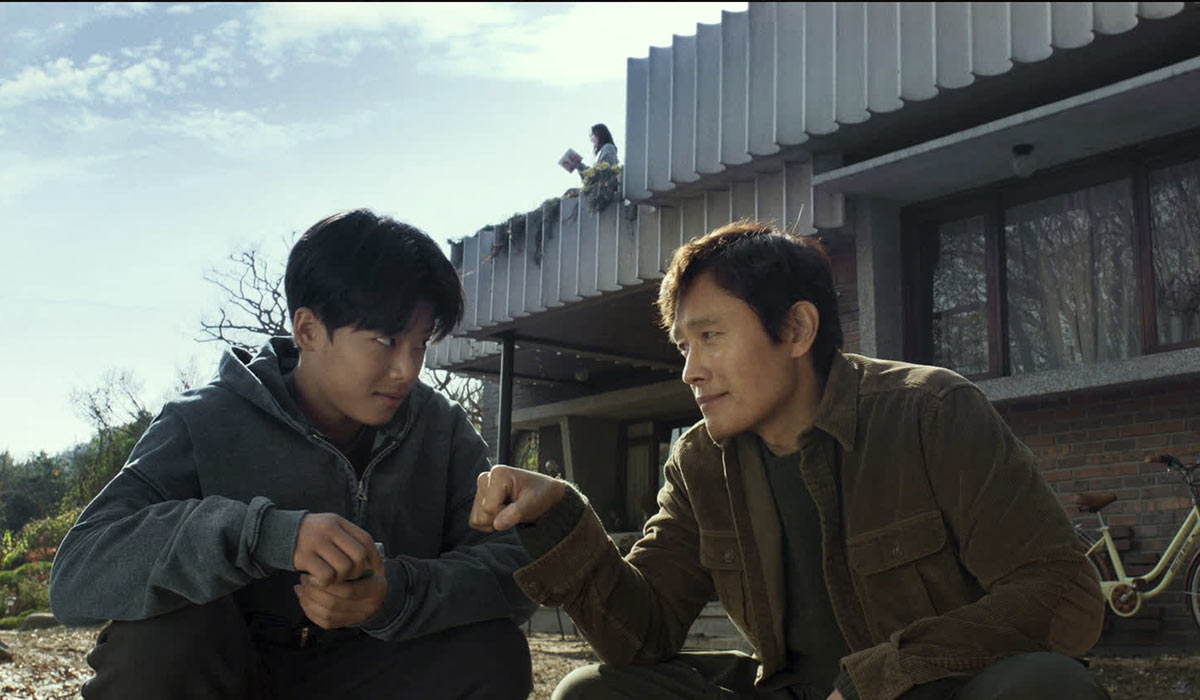
There are more than a few stealth awards players this season. You could even argue there are more than usual. But the more they screen, the more they begin to outshine some of the more hyped contenders. One film on the cusp of becoming something more than just South Korea’s expected International Film Oscar nominee is Park Chan-wook’s “No Other Choice.”
A world premiere at the 2025 Venice Film Festival and an adaptation of Donald Westlake’s novel “The Ax,” “Choice” follows Yoo Man-su (Lee Byung-hun), an experienced executive at a paper company who is laid off after over 25 years of service. As he begins a new job search, he soon realizes he’s competing for a very small pool of similar positions in his industry. Faced with the pressure of keeping up the lifestyle his wife Lee Mi-ri (Son Ye-jin) and children have become comfortable with, he stumbles into a solution to his problem that is both deadly and immoral.
But it just might work.
We caught up with the legendary Chan-wook last month to take a deep dive into “No Other Choice.” We discussed the dance between making “Choice” in English or Korean, finally reuniting with Byung-hun after 25 years, and ponder how a movie he began working on in 2009 is even more relevant economically today than it was over 15 years ago.
Note: There are minor spoilers in the context of this interview.
____
The Playlist: Correct me if I’m wrong, but this was originally going to be an English-language film?
Park Chan-wook: I wrote the screenplay at first as an American film, just like the novel. But there was always a gap between what the American Studio’s evaluation of the budget that was adequate for a project like this and the budget that I thought was adequate, and time passed. Every time this project didn’t work out, I would move on to another project. And that’s how the years have passed.
How much did it change from when you first got it to when you began filming?
So, the first adaptation screenplay was written by me in Korean. Of course, it was set in the U.S., but I wrote it in Korean. And after it was translated into English, that was when Don was involved. And since then, I’ve worked on it with Don. But after I decided to turn this into a Korean film, there was the opposite process, where a Korean writer was involved, and we had to change the setting to Korea. And throughout all of that process, I worked on the script together with three different writers. But I don’t think anything has fundamentally changed throughout those years. And I think one of the changes I remember from the American version of the screenplay is that the dance party was initially themed after U.S. History. So there were people dressed up as Lincoln or Jefferson, and Pocahontas was one of the characters that people dressed up as, which was no longer the case in our new version. And changing this into a film set in Korea, the passage of time, and the introduction of A.I.
You started working on this in 2009, correct?
2010 was the year we sealed the deal for the rights to the novel. But I found records of me having worked on the screenplay from 2009, and you can tell how much I really wanted to adapt a novel from the fact that I was working on it even before I got the rights to it.
At that period of time, there was a major global economic downturn. That being said, I don’t think anyone would have thought that the disparity between the haves and the have-nots, between different classes, would be even worse 15 years later. Was that something you were cognizant of during filming?
Of course, at that time, I couldn’t predict that the issues you’ve mentioned would get worse over the years, but I was vaguely aware of the fact that the problem of job security is not going to go away anytime soon. But over the long time that I was working on the project, I would tell a five minute version of the story to friends from different countries, and every time I told them, they would respond with something like, “Oh, this seems like a very timely story and it would work well in our country,” which was how I was confident that I could continue to work on it for a long time.
There are so many creative kills in the film. Was there one that was harder to formulate or design than any of the othes? Or are they all essentially based on what’s in the book?
Yes, it was all a new form of murder from what I remember. I don’t think I’ve borrowed any of it from the original novel. I wanted the murders to seem all different, but also show the progress of them improving. So, for the first murder, he was so bad at his job that he couldn’t even kill the victim himself. It was the victim’s wife who committed the murder. Man-su was just very lucky. And for his second murder, he did do it himself, but he couldn’t get himself to pull the trigger. And he only shot because the victim started running, and he instinctively found himself shooting him. And then in a third murder, there was a lot of detailed planning involved, and he was very brave in the actions he took as well. So I wanted to show that progress of improvement in his murders. Something that’s special and important about the third murder is that the method was based on its own experience. So, from the dialogue that he shares when he fights with his wife, his wife mentions the time when he was an alcoholic, and he fell asleep drunk, and he almost choked on his own barf. So, he got the method for the third murder from his own experience.
So each of man’s murders is kind of like murdering himself. The three victims are all very different, but they each share commonalities with him. So, every time Man-su sees his victims, it’s like he’s looking into the mirror, and the victims are, in a way, a clone of himself. So, by destroying the victims, it’s a self-destructive act at the end of the day. And I think that was best shown in the third murder. The fact that he used his own experience from his own life to come up with the murder method. It’s very demonstrative of the commonalities that they share.
I saw a panel that you and Byung-hun did together, and he was talking about how he was surprised after he read the Venice reviews, that critics and viewers had noticed an element of slapstick comedy in the film, which he had not expected while he was making it. Were you aware of that while you were making the film, and how do you balance the tone of tension and comedy, and drama when you make a film like this?
In regards to Byung-hun’s comment about the comedy, I think he meant that he didn’t intend to make the audience laugh. He was always truthful to the emotions of the character, and the audience found comedy in it after having a comprehensive view of the situation that the character was in. What we’ve discussed in prior was that if the audience reads your intention to make them laugh, then you can never actually make them laugh. I usually plan everything on the storyboard. How it’s going to be shot and edited, but he never looked at the storyboard. So when I go into shoots, I make the storyboard into a booklet and distribute it to all members of the cast and the crew before our first shoot. But he never looked at it, and he chose not to do it because he didn’t want his performance to be stuck in a small box. He had no idea that when he was getting chased by A-ra, who has a gun in her hand, that it was going to be shot in such a wide angle. So, he had no idea that it would come up as slapstick comedy to the audience. He was actually doing a very serious performance and was dedicated to the situation that the character was in. I think the best comedy comes from when the actor is doing a serious performance and then the audience finds comedy in that.
In context of that, with all the storyboards that you do for the film, how much of a runway do you leave open for inspiration to change something on set? And is there any image or shot that came to you while you were on set that wasn’t in the storyboards that you’re particularly fond of?
It would be the scene where the three people are fighting, and then the gun slides beneath the cabinet, and they stick their hands in and search for it. That particular bit came during the shoot. And it’s interesting because that scene had the most planning and rehearsals involved, but we still came up with a new idea on set. And in the scene where the couple is fighting, and the wife mentions that, “Oh, you become a dog when you drink,” and then Man-su barks like a dog. That also came on set as well.
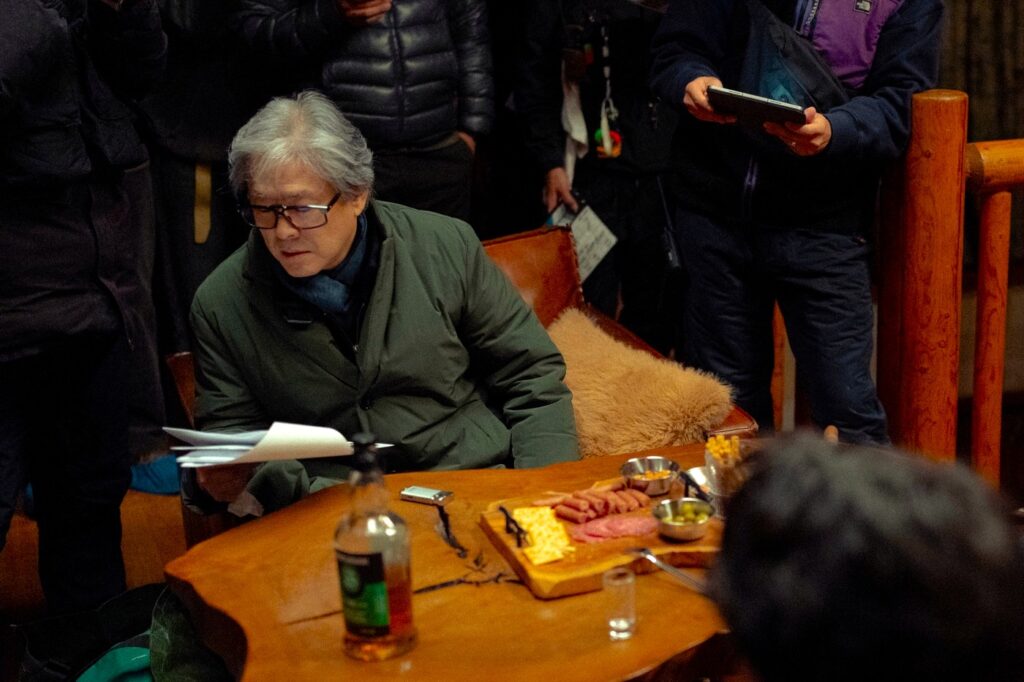
I know that it had been 25 years since you’d worked with Byung-hun, but had you thought about him while you were writing the script to play the role? And then also, what made you cast Son Ye-jin as his wife?
As I’ve mentioned previously, I’d been developing this project as an American film for a long time. Of course, I didn’t consider him for the role, but as soon as I decided to change this into a Korean film, I did have him in mind for the lead role. He was perfect in all ways. He’s the biggest star in Korea, and he gives the best performance. And over the years, he’s reached the right age for the role. And he also got married and had a daughter and a son. So, he was perfect in every sense for the role. She wasn’t in any of the films that I directed, but she was the lead in a film called “The Truth Beneath,” which was a film that I co-wrote. So, I was always aware of her and looking forward to working with her. And the character, Mi-ra, was extremely important because she was the core behind everything that Man-su does, and I expanded the character more than she was in the original novel. So, I was very attached to the character personally as well. And while Man-su’s actions take place in different places, and they’re all very large and dramatic, Mi-ra was in a limited number of locations, and everything that she was doing had to be communicated through looks or when she spoke a few words. So, I needed an actress who could play this role that I extremely adored and could also show a delicate form of expression, as well, which was why she was perfect for the role.
One last question for you. You already have several cinematic classics on your resume, and this is now one of your most critically acclaimed films. Based on the reviews that have come out so far, I’m wondering where you find satisfaction as a filmmaker? Do critic reviews matter to you? Is it the audience response?
So, self-satisfaction matters the most to me because when I watch other movies, I think I always have a good eye, and I have very high standards. I don’t know if my filmmaking skills quite live up to that standard, but I always want to try to reach that standard. That is my goal. And something I prioritize in filmmaking is making films that survive for a very long time. So, even 50 or 100 years later, I want to make a film that is still being watched in the cinema tech or at someone’s house on their Blu-ray, even though I don’t know if Blu-rays will still exist by that time, and this is something that you can’t find out at the present, obviously, but that is also a goal that I always have in mind when I’m making movies.
“No Other Choice” opens in limited release on Dec. 25
Follow Gregory Ellwood on Bluesky
Follow Gregory Ellwood on Threads
Follow Gregory Ellwood on Instagram
Sign Up For The Breakdown Newsletter


