


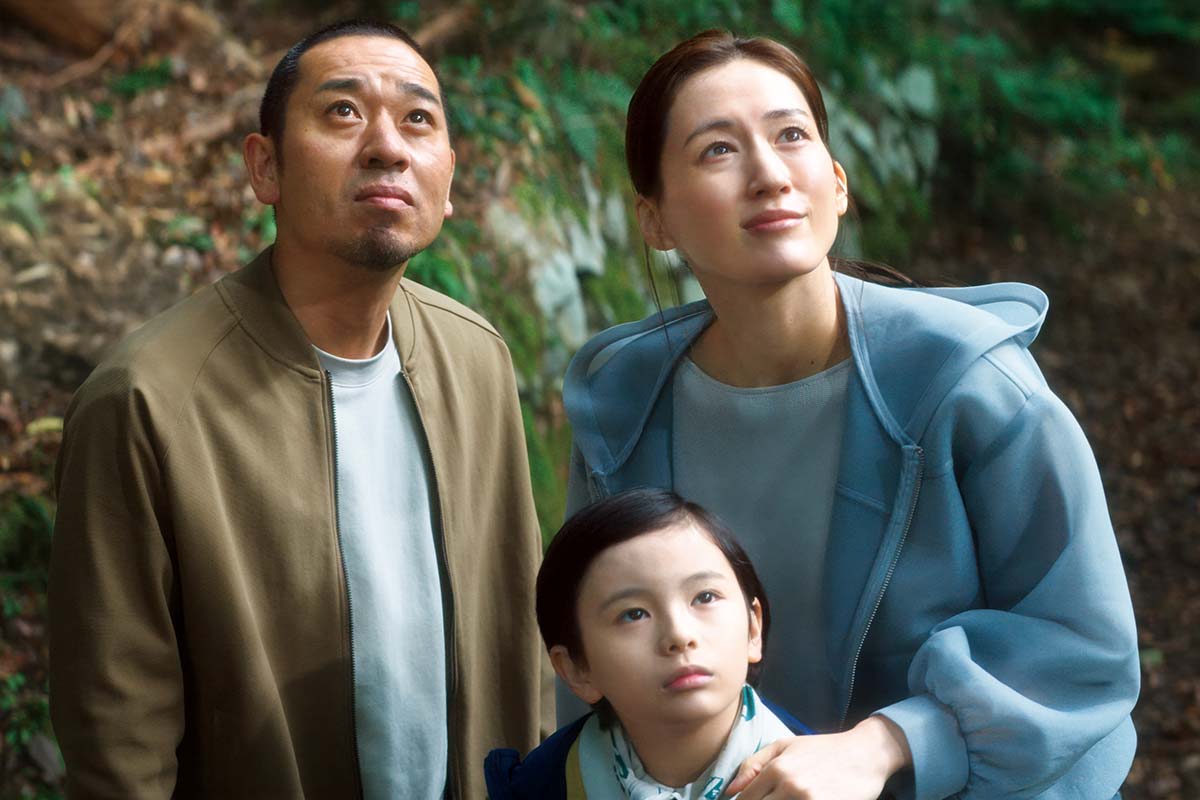
There’s a great movie lurking inside the coding of Hirokazu Kore-eda’s “Sheep in the Box.” A lo-fi science fiction film about a family trying to replace their dead son with a humanoid robot, it opens with text that makes explicit that it doesn’t consider this future to be too far from our own. Indeed, it’s hard not to watch the film and think of the many stories about people falling in love with various AI chatbots or using them to write a eulogy for a lost family member.
Life is painful, often overwhelming, and full of sadness that can be hard to handle, so a film exploring how that could drive someone to take in a child as a proxy for their own feels timely. It could provide insight not just into how we got here, but also into what it reflects about us and where we’re going next.
READ MORE: 27 Most Anticipated Films From The 2026 Cannes Film Festival
Fortunately and unfortunately, “Sheep in the Box” doesn’t really do any of that. The fortunate part is that the film leaves open many productive ambiguities about the ethics of this technology and what it all ends up meaning, leaving a lingering sense of unresolved tension about the impact this will have on us. The unfortunate part is that it never fully probes the people using the technology.
While some of this can be the point, as people can’t always easily make sense of the lives they’re leading or what it will mean for them, it also makes for a somewhat unsatisfying movie. There’s still something here, as, in many ways, it’s the director’s own version of “A.I. Artificial Intelligence,” proving to be a work of earnest humanism that does manage to uncover some earned emotions.
But it’s also not nearly as accomplished as that, seeming like it’s just about to get at something more before it comes to a close. For most of it, the film is reserved to the point of being cold, cutting itself off from anything more painful, yes, but also from everything else as well. Some of this is by design, as the central couple, Kensuke (Daigo Yamamoto) and Otone (Haruka Ayase), have settled into a sort of stasis following the tragic loss of their child. They’re still wounded, as there’s no way they’ll not be, but they’re also finding ways to continue.
However, they soon get an ad sent via a drone for a service that will replicate their child via AI, one moment of many that is quietly horrifying as you think about the prospect of a company looking into death records to find potential clients. Though Kensuke is more skeptical of the entire idea, he goes along with it to support Otone, cracking some painfully bittersweet jokes before eventually being swept up in the experience once their robotic child becomes part of their lives.
Some of this is because robo-Kakeru (Rimu Kuwaki) is believably sweet, and both his parents clearly still miss him. Still, there’s a more sinister undercurrent to their interactions as he begins to express interest in both their work and lives, in a way the real child never did. It echoes the ways AI can often be sycophantic toward those who use it, gassing them up and affirming them no matter what they’re doing. While Kakeru looks and speaks like their son, he’s a product from a company that has built him with the explicit purpose of ensuring customer retention. Every nice thing he says or moment of sweet interaction they have is part of a business plan that, even when those like Kensuke are aware of the strings being pulled and try to resist, starts to win them over all the same. In scenes like the one where he runs away in a panic upon recognizing this, the film starts to uncover deeper, more painful layers.
Unfortunately, these layers are not cut as deeply as you’d hope. For every more probing moment when it seems the film is starting to get into something complex about grieving and the stories we’ll accept to heal, it also pulls back at others. Some of this is because the characters are similarly pulling back from each other and the truth of their loss, though the film often moves from merely reflecting this to replicating it. There is a difference between observing how people shut themselves off from reality as a survival strategy and shutting yourself off from it.
What made the director’s previous films, like “Shoplifters,” “Broker,” and the recent “Monster,” so impactful was the way they found delicate entry points into delicate stories. It found beauty and grace without sanding down the more grim realities at the core of each. In “Sheep in the Box,” it still finds many of these more complex grace notes, but it’s hard to shake the sense that it’s also lacking the needed weight. Is the director’s desire to see the humanity of the characters and why they would use this technology taking away from the potency of the portrait? At many points it seems so, making it one of his more slight and shallow films of recent memory.
Yet even as there are many such tensions that “Sheep in the Box” is not able to unravel itself from fully, they’re all productive ones that make it a work worth grappling with. Even a lesser Kore-eda is still at least interesting, even frequently insightful, about the ways that we move through a world of pain and loss. It’s just a shame that, for a film that’s ultimately about the power of imagination and our ability to tell stories as a way of enduring, this one was unable to dream bigger. [B-]

Chase Hutchinson is a film and television critic whose work has appeared in The Wrap, The AV Club, IndieWire, the Seattle Times, IGN, and Roger Ebert's Far Flung Correspondents, among others. He is the President of the Seattle Film Critics Society.

