


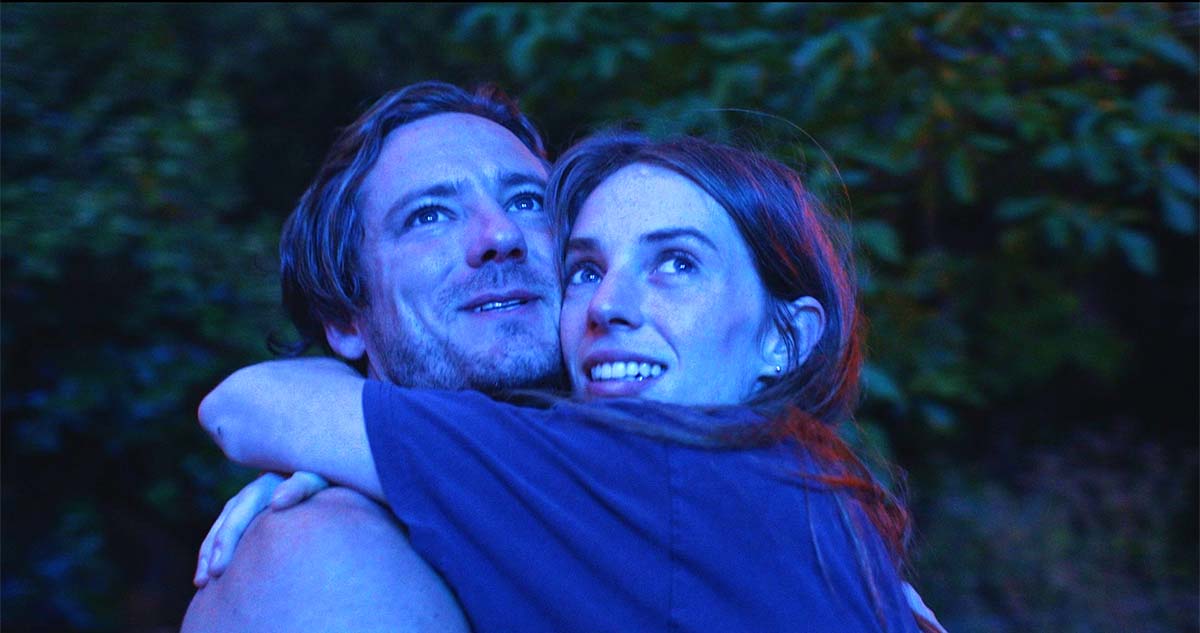
“Wishful Thinking,” the fantastic feature debut of writer/director Graham Parkes starring a never-better duo of Maya Hawke and Lewis Pullman, is a film worth falling in love with even as its characters are at constant risk of the fragile love they’ve built falling apart.
Like the great “Eternal Sunshine of the Spotless Mind” crossed with the underrated “Like Crazy” and shot against the beautifully unique, yet still perpetually underutilized, textures of the Pacific Northwest, it’s a work that’s as wondrously whimsical as it is deeply, profoundly emotional. It’s a riot of a romantic dramedy with love, its pain, pleasures, and perils, all at the front of mind as it manifests (literally) the ways all the tumultuous emotions of one of life’s greatest joys can impact the way you experience the world. At each and every turn, it’s a film that bottles up the buzzy feeling of falling in love while also capturing what can happen when you shake said bottle and everything comes bursting out. You can get fireworks, or you can get a destructive explosion.
READ MORE: SXSW 2026: 26 Films To Watch In Austin
This is something that Parkes uses to remarkable, often gut-bustingly funny effect, before he then brings the emotional hammer down in moments of both quiet contemplation and joyous dance. As we see in his familiar yet also off-kilter world, which involves some of the best split-screen sequences you’ll ever see, everything is always on the cusp of potential exuberant jubilation, just as it is emotional devastation. It’s a film about feeling deeply and how amazing that can be, as well as the immense agony that can result when these deep feelings turn into conflict.
What shape and form this takes requires some coyness, as a central sci-fi conceit comes to vibrant life in the many revelations it provides for the couple. What can be said is that Parkes has made something that’s not just clever and funny, but also astoundingly astute in how well it shows what it is to really share your time with another person in this fraught thing we call life. It’s not just the discovery of this year’s SXSW Film and TV Festival, but one of those films with the cinematic power to sneak its way into the hearts of all who watch it.
From the opening moments, this power is felt in the outstanding performances of Hawke and Pullman. Both of them not only leap off the screen, but into each other’s arms and down their throats with all the same vigor. Just in the authentic domestic rhythms, which can shift from excitement over being with the other person to anger in the blink of an eye, we come to see how Julia (Hawke) and Charlie (Pullman) are going through a bit of a rough patch. This couple has made a life in Portland, Oregon, where they both pursue their separate passions, video game design and music production, just as their passionate relationship is growing increasingly fractured.
It began with intoxicating excitement, continued into the residual buzz of the honeymoon phase and the prospect of building a life together, but now both seem to be slowly waking up from a nightmare of a hangover. The pains of regret and uncertainty swirl around the couple, even when neither speaks. When they explode into an argument in their home, we feel every wounded moment of pain and anger, just as we do the deep feelings that underpin it all. They’re like a windstorm roaring and crashing about, each capable of creating moments of beauty as well as destruction. No matter what, there are many broken pieces strewn about that must be dealt with.
This gets taken even further when the couple attends a couples-therapy seminar, where two twins, both played by the always hilarious Kate Berlant, unlock something in them after bringing them on stage. Now, when Julia and Charlie feel pain, the world descends into various stages of calamity that reflect this. When they feel joy, it again responds in kind, bringing about positive outcomes in nearly every way. The outer world becomes a reflection of their inner one, for better and for worse, as both try to figure out if this relationship is something they want any longer.
Initially, the couple eagerly explores this newfound power in an attempt to reshape their lives for the better. However, life, both in this lightly sci-fi movie and the reality it beautifully reflects, is not always so simple. After all, people want different things even when they deeply desire the person they are with. They can have different dreams as they do anxieties and fears, exposing how even the most passionate loves can fall prey to the same deep feelings that made them so wonderful in the first place. In Parkes’ film, this is given a heightened, supernatural jolt, but all the feelings he uncovers are authentically grounded in a couple that has chemistry, as they do conflict, to spare.
“Wishful Thinking” captures this all with subtle care while remaining unafraid to dive headfirst into withering comedy. While some of these comedic beats don’t always hit home as hard as the more dramatic ones do, most do. It’s then in the delicate, dexterous way Parkes moves back and forth between these two emotional states where “Wishful Thinking” feels most inspired. In the couples-therapy scene where Julia and Charlie talk through their relationship, it’s initially defined by more sly, silly humor, before becoming sincerely, shatteringly emotional as they recount their first meeting. It shows us how much wonder there is when both are not so wearied by fighting. There’s a spark here that can either become a warm fire or a roaring inferno that consumes both of them.
This is felt throughout the many moments in which Parkes and his cinematographer, Christopher Ripley, make excellent use of the aforementioned split-screen. In particular, witnessing the couple’s first encounter simultaneously through each other’s eyes is incredibly effective. This becomes a recurring way of capturing the fragmentation of the relationship, while also showing how things can still, rather poetically, align in their tiny corner of the world. Not since the also Portland-shot “Twinless” has a film made such great use of this framing mechanism. In “Wishful Thinking,” it infuses even simple scenes with resonant emotional depth when you least expect it, and the film’s closing deployment knocks you completely and utterly flat. The way we get one last look into a Pacific Northwest sky that’s full of the same boundless beauty and gentle sadness as their relationship takes the breath away while also allowing for an earned, quiet, and peaceful exhale.
Some of the film’s escalations spin out of control, but this proves to be a minor shortcoming in the grand scope of Parkes’ vision. After all, is embracing something, even with all its flaws, not what love is? One wishes it were more often, but that’s what makes a work like this so special: it embraces all these elements while never sanding down its rougher edges. These, when it all comes down to it, can be the best parts of a person just as they’re the ones that can be the most painful. “Wishful Thinking” is then one of those great films about love that treats it not just as an abstract concept, but as a living, breathing, and constantly evolving state of being, painting a full portrait of its couple who find themselves swept up in it. You fall in love with the film just as you do both of its characters, together and separately, even as they may, too, break your heart. [A-]
“Wishful Thinking” premiered at the 2026 SXSW Film & TV Festival.
Follow along for all our coverage of the 2026 SXSW Film & TV Festival.

Chase Hutchinson is a film and television critic whose work has appeared in The Wrap, The AV Club, IndieWire, the Seattle Times, IGN, and Roger Ebert's Far Flung Correspondents, among others. He is the President of the Seattle Film Critics Society.

