


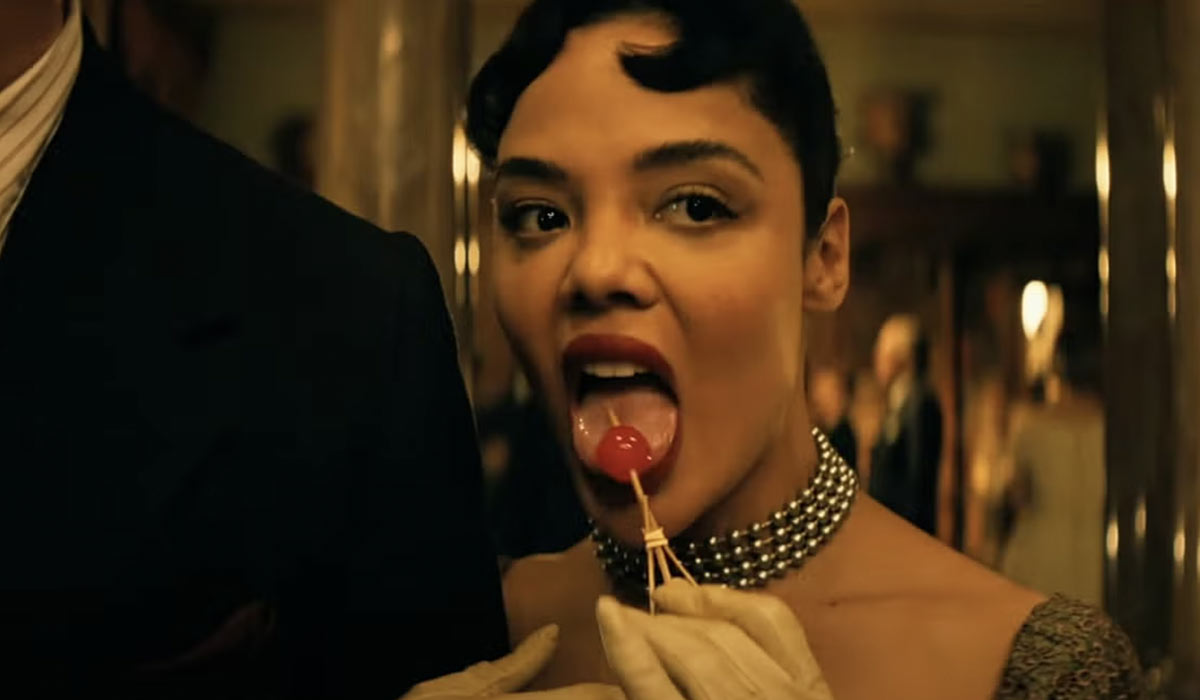
Tessa Thompson is coming. And we’re not just talking about as a force in the race for a Best Actress Oscar nomination. Thompson has earned critical acclaim for her portrayal as the title character in Nia DaCosta‘s new vision of “Hedda,” an adaptation of the classic Henrik Ibsen play “Hedda Gabler.” In a very competitive field, she secured a Gotham Award nomination for Best Lead Performance, and other accolades likely await her. But when we spoke on Monday, she truly lit up when asked about her other passion, producing.
Through her production entity, Viva Maude, Thompson not only helped “Hedda” get greenlit, but has helped shepherd Alesha Harris’ directorial debut “Is God Is” to the big screen this May, and has the thriller limited series “His & Hers” dropping on Netflix in January.
“One of the great pleasures over the course of my career is to be able to have worked with either first-time filmmakers, whether it’s Boots Riley or Justin Simien, or Nia DaCosta on her first film, to be able to identify talent really early on and take a swing with them and be able to support them as an actor,” Thompson explains. “But I also produced Nia’s first movie. I wanted to create a kind of architecture to be able to do that at scale, and also to have a collection of stories that really are the kind of stories that I long for inside of the sort of Hollywood space that I don’t always get to see.”
Thompason adds, “Earlier today, I’m on Zooms pitching a television show. I love pitching. I love that energy. I love just reading and chasing IP, and I just love it. I love being in conversation constantly with filmmakers, with authors, with incredible storytellers and storytellers and just figuring out a way for their stories to exist in the culture. It’s just been like the company has been really the biggest gift.”
Over the course of our conversation, Thompson does a deep dive into a Hedda who finds herself in the mid-20th Century, how the film’s location gave her clarity, whether Hedda is truly misunderstood, marriages of convience, and much, much more.
_____
The Playlist: I wanted to ask, I know you’ve been doing a ton of press for this movie for the past couple of weeks, but if I just say Hedda to you, what is the first memory that pops in your head? Probably,
Tessa Thompson: Probably the first time I went to the house, which was when we were still in prep and they were still moving into the house, and there’s this little nook which ends up being inside of the movie. There’s this shot that Nia does where it’s Hedda talking to Judge Brack [Nicholas Pinnock], and you don’t see Judge Brack, and you only see Hedda. She’s in this window, and you might not understand it spatially when you watch the movie, but she’s looking out at this lake. And I just remember the first time I went to the house, and Nia had mentioned, “Oh, we scouted the house. We think we found it.” And I saw it in photographs, but I hadn’t realized the proximity of this lake and this relationship. Obviously, the film begins and ends with her in this lake. It’s bookended by this, and so much is embedded for me and what the lake represents to her, and then what it represents in our film. And it was just this moment as an actor, being like, “Oh, right, anytime I want, I can look out into that lake. Everything that I need is right in front of me.” Which isn’t always the case when you’re making a film, but I think it was also just this profound moment of being like, “We’re making this movie, and here we go.” And just this sort of rush of feeling when I just entered that little nook and realized, “Oh wow, the lake is right there and it’s real.”
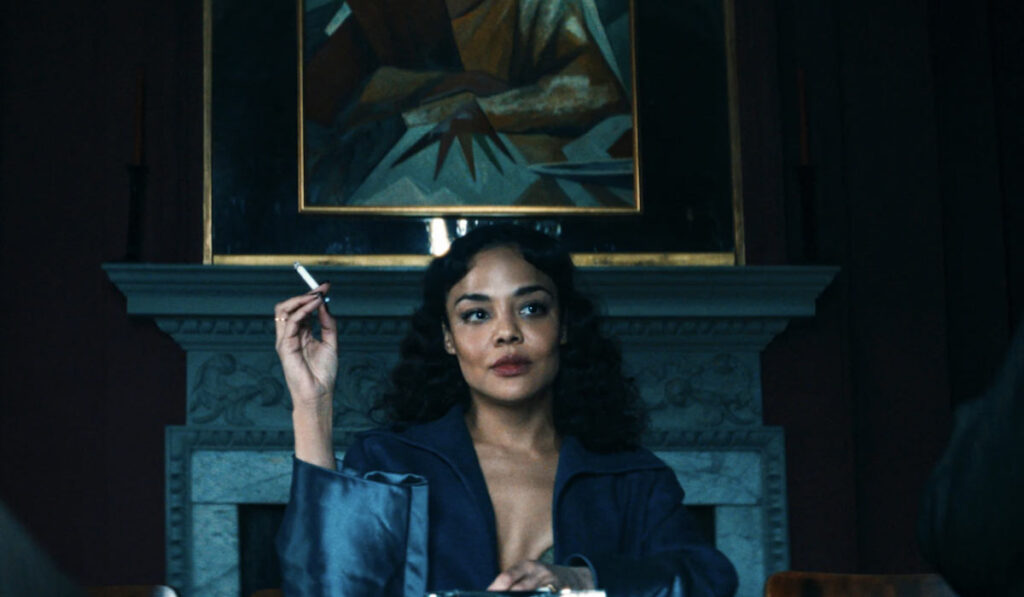
You and Nia have worked together before. You’ve appeared in all her movies so far, right?
Except for “Candyman.” I’m not in “Candyman.”
Oh, I thought you had a cameo.
I don’t have a cameo in “Candyman,” not in that movie. I have my cameo in “The Marvels,” which was lovely. I came for two days and just hung around the set, which was so nice. So I’m in most of them, and I’m not – spoiler alert – I’m not in “28 Years Later: The Bone Temple,” although I did try to convince her to put me in. Now, like, surely I could just be like a Jimmy somewhere, but it doesn’t look like it’s going to happen.
You did beat me to that question, though. You are friends. How did she first broach this project with you?
She had floated the idea to me and said, “I want to work on this adaptation of ‘Hedda Gabler,'” which definitely predates me by a couple of years. Before even meeting me, she was sort of wrestling with and thinking about, “Oh, it would be nice to make something in this world because she studied it in school in her master’s.” And then I met her three years later. But when she first told me that she was thinking about an adaptation, I was like, “I mean, yeah, that would be interesting.” I didn’t know what her take was. I don’t remember how long after she sent me the first draft of it, and she had sat down to write it with me in mind, and she had floated the idea to me. In fact, when I came to do the cameo for “The Marvels,” around that time, I ended up having to fly back, but she did a reading of it just so she could hear it aloud. So we were already in conversation about making the thing together.
The first time you read the script, what surprised you the most?
So when she floated the idea, she didn’t say anything about the gender swap of Eilert Lövborg to Eileen Lovborg, for example, even though she knew that that would be a part of the piece. And I think the thing that really excited me, to be completely honest. I would make anything with Nia just because I trust her so much and I love her so much as a filmmaker. But when she first told me that she wanted to adapt “Hedda Gabler,” I didn’t understand why, to be honest. It’s been done so much on stage. It’s been done on screen. I think people feel like there have been the seminal performances of Hedda. And also, I just think when you adapt classic work, my appetite as an audience member is always that there is some modernity to the piece. And also that the person who’s adapting has some real skin in the game that I can understand in a real way – in a singular way – why they had to excavate this piece. And so when she sent me that first draft, I suddenly understood why. She really wanted to center women in the story, to give this real foil for Hedda in the form of Eileen. So much that’s already embedded in the original work by Ibsen, of course, but it just felt so much more electric in her adaptation and in her hands. And so, I really understood what the imperative was for the piece, what the imperative is now to offer a new rendition of Hedda. It made sense to me when I read that first draft immediately.
I saw a recent interview you did where you said you thought that Hedda is often misunderstood by many audiences. Granted, you’re playing her, but why do you think that’s the case?
Well, firstly, I don’t think she’s understood at all. I don’t think there’s a consensus on Hedda necessarily. So, firstly, not only did I watch a bunch of adaptations and productions, but I also read reviews, and what was written about the production at the time. And critics were horrified. I mean, people thought it was a terrible play. A terrible woman, monstrous woman, I think was one of the reviews. Monstrous woman, terrible play. And so I think Ibsen himself was misunderstood at the time for what he was endeavoring to do and endeavoring to excavate. But I think there have been a lot of portrayals of Hedda, and many that I like, but that I don’t think are particularly interesting. The piece itself is not particularly interested in sympathizing with her necessarily, which I think is smart because you want to make sure that you don’t soften her edges. I think one of the fabulous things about this woman is that she gets to take up space. And while Ibsen gives some construction in terms of what she’s hemmed in by, she also acts out in ways that we don’t entirely understand. And I think that’s honest. I think there are parts of our humanity that remain unknowable. Sometimes we do things and we don’t entirely understand why we’ve done them. And I think that’s the thing that feels really rich about the character.

But I think a way in which she’s maybe misunderstood is the wrong term, but I think maybe she’s not given the grace that she deserves. And I do think there is a fair amount of being inside of a body as a woman that can, and if you’re honest with yourself, can stir up a fair amount of rage. And I think that’s kind of an honest thing. And I also think that this fundamental desire of hers which is to live a life that is her own. In Ibsen’s original work, she says, “For once I want to have control over a man’s destiny.” I think in our heart, there is this sense that she wants to be in control of her own destiny. And I think because of a lot of her particulars and also because of some of the choices that she’s made, she’s not in control of them. She wakes up in a life that she chose but isn’t her own. And this desire to sort of take it apart, then I think, is admirable. Fundamentally, this desire to live a life that is yours, I think, is kind of aspirational.
In that context, though, she chose this life. Do you think she cares for George, or is he just a means to an end for her?
I think she’s made a choice, as many women did, particularly in that time in the 1950s. I think many women were told that the best you can do is marry well. And I think a lot of women entered marriages where they could be taken care of financially, and in exchange, they had a host of things that they were expected to do as women to mind the house or whatever it is. I don’t think that was an unfamiliar choice to women of that time. And certainly one of the things I did in my first sort of research in trying to understand Hedda was look at both my paternal and maternal grandmothers. And one of them definitely made that choice. She married first my mother’s father, and then they divorced, and then she married another man, and she never worked a day in her life. And she was a woman who stayed home and was very much of the period. She wore lipstick every single day. She still wears lipstick every single day. Every time I go to visit her, I bring her lipstick. She was a woman of her time, and one of the things that she probably was told is that her beauty was her biggest sort of asset. And I think she’s a tremendous woman who has many other things at her avail. But I think that was primarily the thing she moved through the world knowing was her power. And so I think in Hedda’s case, she’s a woman who has been told that, and I think she’s decided to marry someone who she assumes will have access to power and thereby will give her power. I think there is this idea of having proximity to whiteness and to high society. And so she marries this man. And I think in some ways I always thought that in a way George becomes her avatar. It’s like George is the man who can go out into the world and do the things that she cannot do. I think what she discovers is very early into their wedding and into their honeymoon is that she’s married a man that has proximity to power, but personally has very little of it. And when they’re getting ready for this evening and he’s fretting about the night, I think she has really realized that she’s not maybe chosen the right person to go out and be her avatar. And I think it is a marriage of not convenience, but a marriage of ambition. But I think it’s a marriage of ambition for both of them, which, also, many people have done throughout the ages.
They’re doing it right now.
They’re doing it all the time, right?
They’re at the courthouse right now. But in that context, she’s hemmed in by this world, partially the choices she made, but mostly the society at the time. There is pain underneath this confident facade. How cognizant were you of when you wanted to show hints of that and when you didn’t in the performance?
Nia and I had a lot of conversations just about how much she’s pretending in general. And as I said in a piece that wants to be about pathways to personhood. It’s so interesting to me, the word person comes from the Latin word persona, which literally means mask. And so I think all of us, to varying extents, have a sort of mask of our public self versus our private self. And then you add all of the intersections of race or socioeconomic standing. I think we can code-switch and have to sort of play different parts depending on where we are and who we’re with. And I do think Hedda is a master of that. There is also this sort of interplay between public and private in the film in general. There’s this sort of great hall and these very public spaces, and then these more private conversations that happen with these twosomes in all of these rooms. And I always thought those moments and some of these more private moments are opportunities for Hedda to be as unmasked as Hedda can be. But I think there’s still a level of uncomfortability, actually, that this woman has with being seen. And I think you really get to see that in the scene that happens between Hedda and Eileen. When you finally understand why Hedda asks, “Why are you here?” And Eileen says, “I needed to understand if I love you anymore,” and sort of pet his vulnerability in that. I think the thing that you get to see in real time is a woman who’s decided, in that moment, to be as brave as she can be and put it on the line and ask these questions about could they be together? Could they find a way? And then you get to see someone who, as soon as they let their guard down and are hurt, decides, then it’s over for you. This sort of self-protection in a way that becomes, in her hands, incredibly, incredibly dangerous. But I had always had the thing, and this may be a way that I think audiences misunderstand Hedda, or maybe just my interpretation is very different. I always felt that as much sort of pain as she causes, it costs her something. I wasn’t interested in a portrayal of a woman who is hugely destructive without any personal cost. So, for me, I think that kind of pain was always underneath everything, even inside of the apparent delight or joy that she takes in stirring trouble or in hurting others or sort of plotting her next move without kind of any regard for the people around her. I always thought that underneath that, there is this kind of loathing side of it.
I love that. Actually, before I let you go, you’re also a producer on this, and I believe this is your company’s first project out into the world. It is. And you have “Is God Is” coming out in May. What do you love about producing? What about that flex do you like?
I love everything about it. I mean, it is just a timing thing that “Hedda” happens to be the first thing. And then the next thing is the show on Netflix called “His & Hers,” which stars myself and Jon Bernthal. So, those are the first two offerings from the company. But so many things across our slate, and I’m so pleased that you mentioned “Is God Is,” because I’m not in the frame at all. I just love storytelling so much, and I love the challenge and I love, one of the great pleasures over the course of my career is to be able to have worked with either first time filmmakers, whether it’s Boots Riley or Justin Simien or Nia DaCosta on her first film, to be able to identify talent really early on and take a swing with them and be able to support them as an actor. But I also produced Nia’s first movie. I wanted to create a kind of architecture to be able to do that at scale, and also to have a collection of stories that really are the kind of stories that I long for inside of the sort of Hollywood space that I don’t always get to see. And being able to make a bottom-line argument or to say that these stories can find an audience and they will, because there is an audience for them. Because so many of those old narratives become an impediment to new and daring storytelling happening. So I really wanted to create a company that could try to do that 365 days out of the year. And I love it. I love reading an incredible book and thinking about how to adapt it and ideating with filmmakers from the ground up.
Another great pleasure of mine is that I’ve been able to work with filmmakers who are super experienced, but their first time ever making a huge studio film, whether it’s Taika Waititi when he made “Thor: Ragnarok” or Ryan Coogler when he made “Creed.” So, also just being able to protect a filmmaker when they go into bigger spaces in their career. That is something that I’ve been doing for so long over the course of my career. So, this just feels like a natural extension of it, and I just love it. Earlier today, I’m on Zooms pitching a television show. I love pitching. I love that energy. I love just reading and chasing IP, and I just love it. I love being in conversation constantly with filmmakers, with authors, with incredible storytellers and storytellers and just figuring out a way for their stories to exist in the culture. It’s just been like the company has been really the biggest gift.
“Hedda” is currently in limited release. It is also available to screen on Prime Video.
Follow Gregory Ellwood on Bluesky
Follow Gregory Ellwood on Threads
Follow Gregory Ellwood on Instagram
Sign Up For The Breakdown Newsletter

Editor-at-Large Gregory Ellwood is one of the entertainment industry's most respected journalists and critics. Based in Los Angeles, he's the only current awards expert who previously worked on Oscar campaigns at a major movie studio. Over the years, he has written for the LA Times, Variety, The Hollywood Reporter, and Vox, among others. He also co-founded the entertainment news site HitFix, which spawned a legion of influential Emmy and WGA Award-winning alumni.


