


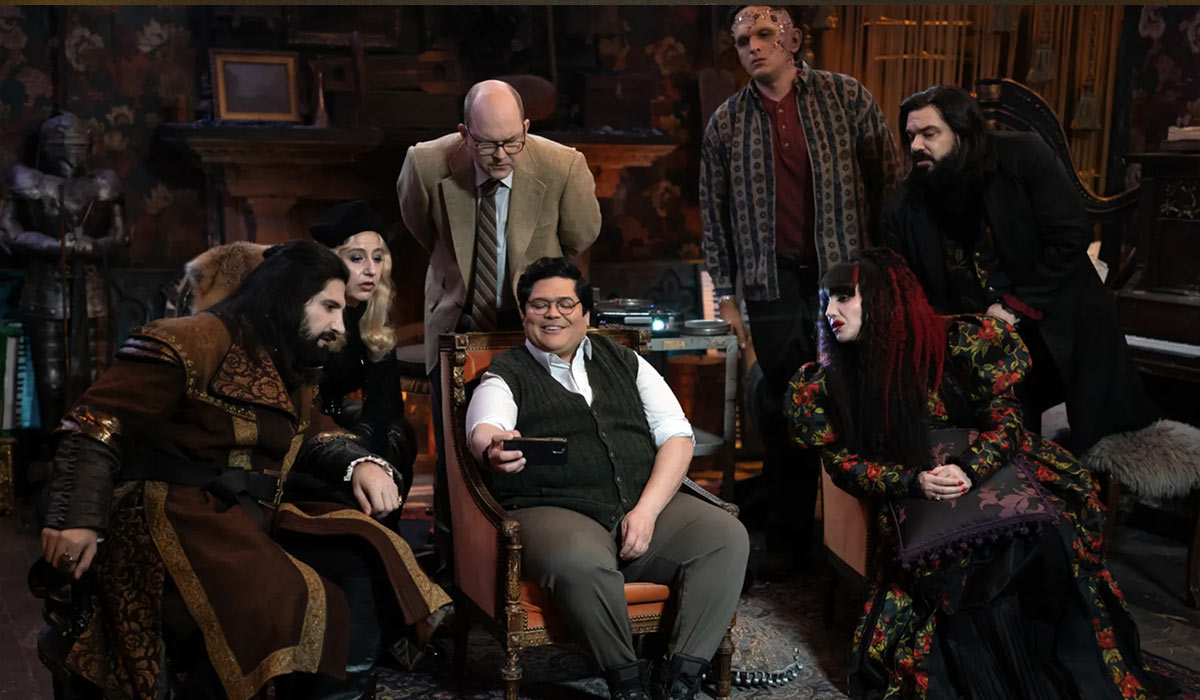
You may not recognize his name, but Paul Simms is part of some of the greatest shows in television history. Or, as he sees it, shows that future comedy writers say they saw in high school and loved. But he’s also now been part of two of the best series finales of all time. The first, “The Larry Sanders Show,” decades ago, and this past fall, the smart and funny goodbye from FX mainstay, “What We Do in the Shadows.”
As Simms sees it, “Shadows” may not have been as big as, say, “Friends,” but it had a big following. And he doesn’t take those four Comedy Series Emmy nominations for granted. And that’s pretty smart considering the other shows that said goodbye recently and didn’t land one last shot at Emmy glory.
During our conversation last week, the wonderfully candid Simms reflected on the show’s unexpected success, coming up with those alternate endings, and why maybe a revival for the show may not be in the cards. Now, bringing the cast back for something new? That might be much more intriguing.
This interview has been edited for length and clarity.
____
This was just such a random question, and I don’t even know if you know the answer. Why is Natasha from Antipaxos? I feel like she should be from Cyros or Crete.
That’s possible. Well, as with every show I think I’ve worked on, as the show progresses, the characters become more similar to the actors who play them, or at least the actors bring something in from their lives. And Natasha Demetriou‘s real-life parents are from, I think, Cyprus. So she grew up speaking a little bit of Greek. In fact, when she auditioned for the show, she improvised a lot of Greek stuff and stuff about growing up in a small village, none of which was in the original pilot script. You know what? It probably came out about as simply as wanting to pick a place in Greece that had a cool-sounding name. So, many of these decisions you make for the wrong reasons, and then you’re stuck with it, and then you actually end up finding interesting things about it.
Over your career, you have created or been part of some of the seminal shows in television history, including “The Larry Sanders Show,” “Girls,” “Atlanta,” and “Boardwalk Empire”. Your work is actually four of our top 100 television shows of the 21st century. So when you get a pilot script or hear a pitch, what tells you in the back of your head, “This is something I need to commit to”? “This could be special.”
If I knew that, I’d be on eight of your [picks]. It always comes down to if it’s a show I’d want to watch myself, you know what I mean? When I worked on “Flight of the Conchords,” they had no money, and they’d done a pilot for almost like a student film budget. But I watched, and I was like, “This is so funny. This is a show I’d like to watch.” I mean, I’ve only, there’ve been one or two times that I’ve worked on things that I was like, “Ah, this isn’t really my kind of show, but let me give it a try.” And they’ve always been the worst experiences of my entire career. “Divorce,” starring Sarah Jessica Parker, if you’re wondering. But no, it’s things that I would want to watch myself. And that’s also when it comes to writing the shows, so much of it comes down to all the writers trying to make each other laugh and just having the faith that if we can make each other laugh, that there must be other people who sort of laugh at the same things we do. You can’t guess. If you could guess what the audience wants, then you could make a thousand shows. But it all comes down to trying to make each other laugh and then trying to make the actors laugh. And then if you’re amusing the people right around you, you assume that there are others out there.
I have to ask this about “Divorce” because I remember being so excited about that show, but didn’t it always take place in the winter somewhere? It always looked super cold.
I can’t remember the name of these little towns on the Hudson north of New York, and it was the dead of winter. One of the reasons it was a winter show. It was not fun. It’s not pleasant.
No.
And even now, I love “Severance,” but whenever they go outside in “Severance” and it’s like iced over and stuff, I’m like, “Oh, please just go inside and get warm.”
I tried to get an answer about that yesterday from one of the directors, and she wouldn’t explain to me why the whole show still takes place in the winter. And the flashbacks are in the spring. They’re so close to the vest. But you had a relationship with Jermaine, you guys, they made the movie “What We Do in the Shadows.” You weren’t part of the film, right?
No, no. I knew they were making the film, and I went to a screening of it when they came through town to show it. But then the first time Jermaine mentioned to me was when he was doing a guest thing on “Divorce,” actually, and he was like, “Remember the vampire movie?” And I said, “Yeah,” he is like, “They’re talking about wanting us to make a TV show out of it.” I’m like, “That could work. I don’t know.” And then one thing led to another, and he and I worked on it and got it on the air.
Do you remember realizing when you thought it was going to be that it was going to be a hit or that at least it was going to work?
I feel like watching the auditions as we narrowed in on the auditions, like Matt Berry from the start, we knew that part was just written for him. And I’ve loved Matt Berry and wanted to work with him forever, but as we saw Kayvan [Novak] and Natasha and Mark Proksch, they made me laugh. But at the same time, we always just thought it was going to be…look, a lot of the shows I work on are shows that comedy writers like, you know what I mean? I’ve never worked on, and not for lack of trying, but I’ve never worked on a huge “Friends” type. I guess “Girls” was the closest to a show that’s like people actually know. So with “Shadows,” we were always like, “Well, this will be just a fun little show. And 10 years from now, some young comedy writer will be like, ‘Oh, I saw that in high school, and that’s what made me want to become a writer,’ and blah, blah, blah.” So, it was really an incredible surprise and a very pleasant surprise when we started getting Emmy nominations. And I think after the first season or second season, I took my kids out trick-or-treating at Halloween, and we saw people dressed up like Lazslo and Nadja, and I was like, “Wow, people really are watching this.” So that was fun.
I’m unaware of what the talks were with FX about ending after six seasons. Was that a mutual decision?
It’s as mutual as these things ever, ever are. It was sort of like we all agreed we did not want to keep going too long. We were consistently joking in the writer’s room from the very beginning about what the headlines would be if we went too long, which would be “”What we do in the Shadows’ loses its bite” and things like that. And it’s also, other people have asked me, did you guys feel like you were out of ideas? And I feel like every season we ended, starting with season one, we felt like we were out of ideas. You always feel like we never saved anything up. We always used everything we had. And then taking a few months off, and then go like, “Oh, you know what we could do?” And then suddenly you have a new sort of enthusiasm and lease on life. But no, it was important to end it the way we wanted to end it, but also to not let the last season become special or important or get too lost in the mythology of the show. Going into the last season, we said, we just want to make it as funny. The other seasons have most of the episodes being standalone episodes. It’s not building towards some gigantic conclusion where we’re assuming that everyone has watched every episode and taken notes on everything. I mean, I feel like I’m very proud of the finale. And I also feel like if you’ve never seen the show before, you can still understand and enjoy what’s going on in the finale. If you have seen the show before, there are lots of special things in there that you’ll enjoy. But it’s always been the goal, even when we’ve told season-long stories, to have it be like the old shows I like, “Taxi” or “Bob Newhart,” where you could walk in halfway through and get the gist of it and enjoy it. And we definitely always wanted to avoid having one of those shows where people would go like, “Well, you have to watch the first six and then that part will make sense.” It is like, no, I wanted someone to be flipping through the channels and find it and start laughing.
One of the things I love about the finale is that the documentary crew is basically like, “O.K., it’s over. We’ve got enough.” And the vampires are like, “Yep, whatever. No big deal.” Because it’s logical. They’re hundreds of years old. I’s a blip to them. Guillermo’s sort of emotional, and he’s sort of like he wants to keep it going, but I don’t even think he knows why. Was that just simply a two-minute conversation in the writer’s room? An easy narrative end?
No, I wish it were a two-minute conversation in the writer’s room. It was more like a six-month process of me and Sam Johnson, and Sarah Naftalis lying on our couches in our offices staring at the ceiling, feeling this pressure of “We really want this last episode to be really good and really funny and feel satisfied and feel like a happy ending” and blah, blah, blah. And in doing all that, as so often happens, going back to “The Larry Sanders Show,” the things that are happening in your real life, there’s a kernel there of real experience that gets turned into comedy. And I think, I can’t even say it was like instinctual, it’s like Guillermo’s, all the reactions of the characters mirrored different reactions that we ourselves had felt at some point, at sometimes we had felt like Guillermo going, “It can’t be over. This is too sudden. This is such a great thing. Why is it going away?” There are other times when you’re shooting episode eight of 10 episodes, where you’re like, “Yeah, it’s over. O.K., good. Fine. Time to move on. I’ll go.” So, I think even if we had tried, we couldn’t have written a story for the finale that was far away from our own reactions to it in real life.
Had there been discussions about bringing other guest stars or characters, and what made you guys decide not to do that?
There were a lot of discussions about paying off who Guillermo’s real father was. His father who had left his mother when he was young, who he never knew, and a big guest star for that. And we talked about, and then we were like, “You know what? We just want to see the funny people that we’ve been watching the whole time.” And then we did in that one of the three sort of alternate hypnosis endings did “Rosemary’s Baby” one. It was fun that we brought back sort of our favorite periodic guest stars like Doug Jones, who plays The Baron, and things like that. It seems like when you’re writing a finale, so much of the discussion is what you want to avoid doing things that you’ve seen other shows do that you want to avoid. And at a certain point, you’re like, well, if we avoid everything, we’re left with nothing. So, it’s a torturous process.
That ypnosis ending when she’s walking down the hall, I didn’t initially think was “Rosemary’s Baby.” I thought of the shower scene in “Dallas” for some reason. She’s got a knife. She’s going to go and turn and go into a bathroom and…
I didn’t even think of that. And what’s funny is that obviously when we started thinking about doing those alternate endings, we thought about every TV show and movie ending we could think of, and we never thought of Dallas.
Well, to be fair, it was a cliffhanger on “Dallas.” It wasn’t really an ending.
It was a cliffhanger, but it still could have been cool, and people would’ve recognized it immediately. Where were you a year and a half ag,o and we were trying to figure this out?
No, it was still great. The second she came into the room, I was like, “Oh, I know what this is. This is great.” And it must’ve been a blast for the cast just to be able to do something different like that.
Yeah, it was so much fun for them. It was especially fun for our director, Yana Gorskaya too. She and Kyle Newacheck each had shot pretty much half the episodes of the whole show, but for her to be able to figure out just the different film looks to make it look like the “Newheart” thing, to look like an actual ’70s sitcom, and then the “Usual Suspects” one and all that. It was really fun.
You earned yet another comedy series nomination in a super competitive year that people weren’t sure was going to be competitive. And some other shows that had their final seasons did not get nominated. What did that mean to you, and what has all the Emmy love meant overall?
Every time we’ve gotten any Emmy nomination, it has been a complete surprise and a total delight to us because the show was, I’m not saying intentionally, at the beginning of the show, I was like, this is going to be a fun show to do, and people who are really into comedy are going to like it, but it’s too silly to get Emmy nominations. And I was fine with that. So, every time we’ve gotten an Emmy nomination, we continue to be surprised and it’s just a treat. It’s so exciting for us. I am not saying we don’t deserve it, but it’s just more like, it’s rare that a show that’s so silly gets recognized like that.
As silly as it is, you guys have always made sure there’s a little bit of, for lack of a better word, heart in the show. That must be something you all talked about.
Yeah, but I don’t like to talk about it in interviews because whenever I read someone talking about how their show has a heart or emotion or pathos or whatever, I’m like, “Oh, this sounds like homework. I don’t want to watch this.” But yes. But yes, we sneak in little things there that are satisfying, but that all goes back to even “Larry Sanders.” People think of it as a very cynical show about a sort of cutthroat workplace. But I learned there that if you have little emotional moments and just to keep it more real, and, obviously, it seems absurd to talk about keeping it real when you’re talking about 200-year-old vampires living in Staten Island, but if you’re going to watch characters for longer than about three episodes, there has to be some kind of emotional realism to it, I guess.
Looking back over this particular season, was there one episode or one scene or moment that you sort of will remember most fondly, maybe outside of the finale?
God, there are so many. I mean, I really enjoyed the sort of “Apocalypse Now” – inspired episode that we did. When Nandor disappears and they have to go, he’s basically up the river. I really enjoyed that just because I’m such a fan of that movie. And coincidentally, Francis Ford Coppola was doing his final sound mix of “Megalopolis” in Toronto while we were doing that. And through a friend, I got to go sit in his sound mix room and watch him work for a while and meet him, but I didn’t have the courage to say, “Our stupid little vampire show is doing an homage to your greatest film.” But no, that one was really fun. Also, just on a purely silliness level, the one where Laszlo agrees to help his buddy, the neighbor, Sean, get a job at the railroad, even though Laszlo doesn’t actually work at the railroad, and so they make a completely fake railroad up, I thought was just very funny. It was absurd. Also, I mean, there are other things. It was so fun to work with Tim Heidecker as Guillermo’s boss because I love Tim & Eric, and I love his “On Cinema.” Working with Tim and Steve Coogan were two of the most, I think, exciting parts of the whole series. For me. Those were the people I was most excited to actually work with because Steve Coogan is just my favorite of all time.
That’s a really good episode, Steven is in. My last question is, and perhaps it’s too soon to even broach the subject, do you ever think that the show could come back in some form that these characters could return?
Yeah, I guess. I don’t know, man. I mean, someone has said, “Well, they’re vampires, they’re eternal. So, 20 years from now, you could do a reboot.” I’m like, “Yeah, but the actors aren’t eternal.” And there’s that new “The Office” thing where they’re doing it with all new characters. For me, what I loved about this show was those characters. It wasn’t the concept as much as those characters and the actors who played them. I almost feel like if I were going to do a reboot, I would just have the same actors, but they wouldn’t be vampires. It would be some completely different concept, but it would have Natasha and Matt Berry and Kayvan and Colin, and Harvey.
That’s a great idea.
It’s not a bad idea.
_____
“What We Do In The Shadows” is available on Hulu
Follow Gregory Ellwood on Bluesky
Follow Gregory Ellwood on Threads
Follow Gregory Ellwood on Instagram
Sign Up For The Breakdown Newsletter


