


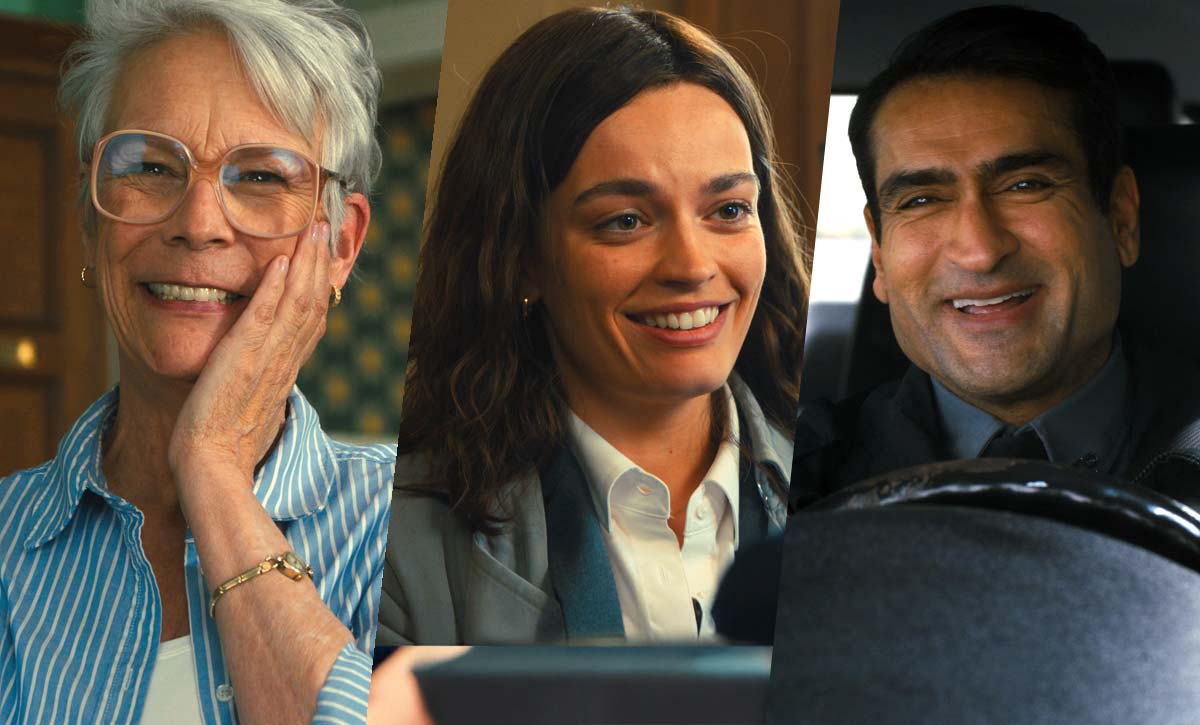
It sure would be nice if there were someone like Emma Mackey’s Ella McCay. Someone who upholds rigorous ethical standards. Someone who disdains the performance of politics at the expense of its substance. Someone so devoted to delivering on promises for constituents.
But the problem with “Ella McCay,” the first movie in 15 years from legendary filmmaker James L. Brooks, is that its protagonist is not real. That’s not just to say she does not exist, either as an actual historical figure or a fictionalization of one. Ella is not honest because her construction as a character is so nonsensical that she hardly even feels like a human at all. She’s an empty vessel for Brooks’ misplaced idealism, which he proffers as a salvo for our contemporary political malaise.
The year is 2008, a time when – according to Julie Kavner’s narrator, Estelle – “we all still liked each other.” (Fake news.) An unnamed president taps the governor (Albert Brooks) of an unidentified state and unspecified political party to join his cabinet. This appointment results in an unexpected promotion for Ella, who then serves as the lieutenant governor at the remarkably green age of 34.
READ MORE: 16 December Films To Watch: ‘Marty Supreme,’ ‘Anne Lee,’ ‘Is This Thing On?’ & More
As rickety as such a transition might be, “Ella McCay” would have benefited from the much-memed “you’re probably wondering I got here” explanation following a record scratch and freeze frame. Brooks never justifies Ella’s meteoric rise, save one scene of a familial argument that ends with her stalwart aunt Helen (Jamie Lee Curtis) picking up her niece’s A+ sociology paper. “YOU CAN BE A FORCE FOR GOOD,” reads the instructor’s comments to the precocious high schooler.
Brooks treats this evaluation as enough information to substitute for character development. Ella is just inherently good. Ella has no great want driving her forward. She has no motivation to serve as a guiding light for her actions. The closest thing the young pol faces to a real conflict stems from the potential for the most innocuous sex scandal of all time to break. With no great malice in her heart, Ella has used state property for consensual relations with her husband, Ryan (Jack Lowden), during lunch breaks.
The film does not lack the time to provide the much-needed definition and clarity around the character. “Ella McCay” is overstuffed with side characters and B-plots that Brooks could easily have streamlined. Be it an undercooked arc around a jealous mother-in-law (Becky Ann Baker) or a bizarre tangential journey of Ella’s brother (Spike Fearn) to try and win back a former flame (Ayo Edebiri), these superfluous storylines only serve to pull focus from an already unfocused main narrative. And that’s to say nothing of an out-of-nowhere emotional monologue given to a young trooper in Ella’s security detail, played by none other than the filmmaker’s son, Joey Brooks.
Brooks is a towering titan of the “dramedy” genre fusion, a feat only possible through masterful control of story and tone. Every once in a while, a solid one-liner like “what’s more beautiful than two people who each other everything?” lands a punch. But the screenplay is an otherwise calamitous creation that demonstrates more than just a lack of Brooks’ previous genius. It stands in complete disregard for the most basic principles of screenwriting.
Brooks is not a bad filmmaker. He knows how to direct performances and dialogue. Every once in a while, he sticks around a scene of “Ella McCay” long enough to allow for immersion. But there is not enough soft Hans Zimmer score in the world to paper over the bizarre lack of consistency between the components of the script. It becomes downright disorienting to watch “Ella McCay” continue to stumble forward, accumulating no momentum as it keeps stepping on metaphorical rakes.
The film’s stumbles stem from a cardinal sin in Brooks’ concept, which is defining Ella primarily by her lack of cynicism or craven ambition. This negative space then becomes a black hole of charisma by occupying the center of the universe in “Ella McCay.” Nothing in the film makes sense because the wishy-washy protagonist lacks any internal logic apart from serving to peddle Brooks’ “no labels” political pablum.
Mackey works in overdrive to try to sell a post-partisan fantasy of a character who amounts to little more than an incomplete sketch. But her performance, which draws heavily on brassy leading ladies of the classical studio era, somehow takes the “person” out of “impersonation.” This only increases the sensation that Ella is more of an idea than an individual. Rather than functioning as a reminder of a bygone time, she highlights Brooks’ detachment from any time whatsoever.
In a dark time for the world, it’s not surprising a movie like “Ella McCay” would exist to channel old-school (Frank) Capra-corn sentimentality and schmaltz. But by leaning so hard into nicecore storytelling, Brooks inadvertently tips over into something worse. Call it “naïve-core,” perhaps, as the film so thoroughly loses touch with reality by avoiding conflict of any kind. His empty platitudes like “humans help humans” are rendered useless and risible inside a work that seems to lack even a basic understanding of humanity in 2008, 2025, or any time at all. [D]
“Ella McCay” opens in theaters on Friday, December 12.


 Capra-corn sentimentality and schmaltz.)