


Once upon a time, Garth Ennis exerted a net positive influence upon the comic book industry, in the happier days long before AMC adapted his masterpiece, “Preacher,” into a cartoony bouncy house full of low-hanging fruit and skewed casting choices. In between the comics’ conclusion in 2000 and the series’ premiere in 2016, Ennis published “The Boys,” a title ahead of its time by several years. Marvel had yet to change the moviegoing industry for the worse; superheroes had yet to dominate popular culture on big and small screens; not every universe demanded sharing.
READ MORE: 15 Must-See April TV Shows: ‘Beef,’ ’Euphoria,’ ‘Margo’s Got Money Troubles’ & More
The gap between “The Boys,” the comic, and “The Boys,” the series adaptation devised by Eric Kripke–with co-signing from executive producers Evan Goldberg and Seth Rogen, who show-ran “Preacher” into a shape unrecognizable from its source material–perhaps is crucial to what makes the latter superior to the former. Sometime after wrapping up the “Preacher” comic, Ennis got it in his head that the property’s success had more to do with its lurid content than its substance, and so bent “The Boys” around edgelord provocation, as if rolling infanticide and cannibalism into a single act has inherent meaning if Superman’s evil narcissistic cousin does it. (Worse to come is Rob Jabbaz’s upcoming movie adaptation of “Crossed,” a comic that dares to ask: “What if a zombie apocalypse, but with 100% more gang rape?”)
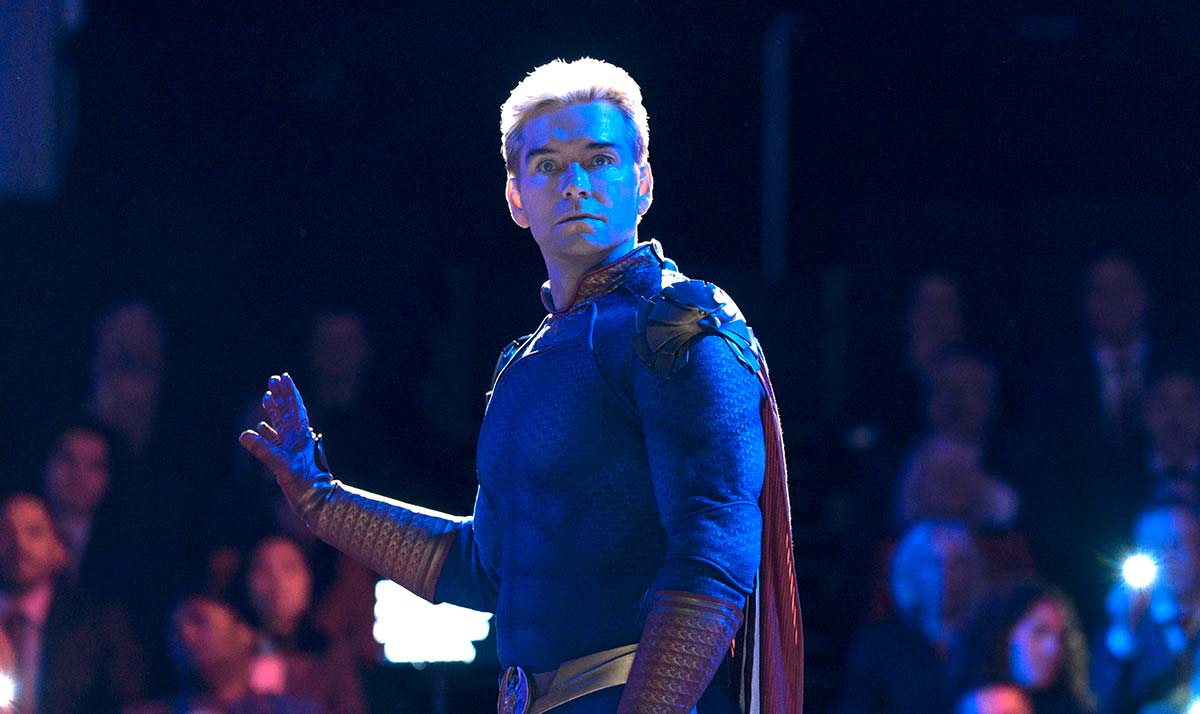
All of this is to say that Kripke’s work on “The Boys” for Amazon is a terrific example of comic book adaptation done right. He’s put his stamp on the material, changed it enough to maintain familiarity with it while giving it distinction from its source, and, above all else, cast the production with actors game to fill in the blanks in their character profiles where necessary. Antony Starr’s performance as Homelander, the evil Superman, ties the series together; he lands squarely in the space between contempt and empathy, carving out a figure at once despicable and pitiable. Starr’s Homelander is terrifying, outrageous, and deeply tragic, which is to say that he’s exactly the product of capitalist interests taking precedence over humanity.
We recognize Homelander’s egotism and aggrieved white male rancor as a reflection of the same barnyard braying issued by the head of America’s bureaucratic hierarchy, too–a cacophony echoing through “The Boys’” overarching plot, and in season 5’s details more so than ever. There are “freedom camps” for Homelander’s political enemies, where we find Hughie (Jack Quaid), Frenchie (Tomer Capone), and M.M. (Laz Alonso) captive after the season 4 finale; Christian nationalism provides a means to an end for attaining power as well as silencing opposition; women collaborating with patriarchy, like Ashley (Colby Minifie) and Sage (Susan Heyward) live in constant “red alert” mode, knowing well that failure to placate the boss means ascending to the chopping block, whether the failure is theirs or someone else’s.
Kripke’s commentary is too obvious not to land. This is fine; he and his writers don’t care for subtlety. (Not for nothing, but subtlety seems out of place in a show about people who can fly, shoot laser beams out of their eyes, or unfurl tentacles out of their palms.) Where they struggle is closing the seams across various plot arcs, as Billy Butcher (Karl Urban), now empowered by an unstable version of the serum that made Homelander who he is, first springs his crew from prison with the help of Starlight (Erin Moriarty), Kumiko (Karen Fukuhara), and A-Train (Jessie T. Usher), then field tests a virus capable of killing supes–all of them, up to and including Homelander. It’s scorched earth. “The Boys’” moral conundrum is irreconcilable, and the futility of the debate–do genocide, else Homelander attains pseudo-godhood–gives juice to its character beats, where nigh-invulnerable people aren’t beating each other to various degrees of pulped.
But from episode to episode, the problem hounding the show in the final lap toward its finale is inconsistent grace in scene transitions. Considering that each episode clocks in at around an hour apiece, the sense that the writers feel pressure to soldier through the plot every step of the way is more than a tad baffling. Grant that what has grown into a robust ensemble requires a laundry list of resolutions, and that in many cases, “resolution” infers “violent death”; also grant that structuring a handful of these episodes around a build-up to violent death grows repetitive and feels clunky, even if in some cases, the choice of who bites the dust not only comes as a shock on surface levels, but unexpected emotional ones, too.
“The Boys’” capacity to encourage us to feel for characters inspired by Marvel and DC comic book icons, even as they are stained by the taint of capitalism, is one of its greatest strengths. The Deep (Chace Crawford), who has graduated to “Manosphere podcast bro” in the gap between season 4 and season 5 after introducing himself by sexually assaulting Annie in season 1, is punctuated as insecure, helpless, and desperate for acceptance; season 5 bluntly implies that he was happier when he could be Aquaman, and that the reason he can’t be is his association with Vought. Capitalism ruins everything, even superheroes. If Homelander, as we’ve seen over the series’ course, is a megalomaniac recklessly seeking love, it’s because Vought raised him that way. Butcher has no such excuse. He’s out for vengeance, and in fairness, he’s not wrong to crave it. But “The Boys” argues that his anger doesn’t justify his methods, an arc brought to a head this season as he continues to browbeat his friends while orchestrating mass murder.
For as serious as these matters are, “The Boys” refuses to take itself seriously, which is a blessing. Kripke keeps his tongue embedded in his cheek. Remarkably, he avoids treading on sentimental moments at the same time; the show is silly, and more than a little bit gory, but it is never less than sincere. Hughie’s musings on the importance of preserving hope when hopelessness is instinctive hit home particularly for those keeping up with current events. The United States’ breakneck slide into dimwitted authoritarian oblivion is a drag to live through. Maybe it’s crass to turn that kind of thing into entertainment. On the other hand, “The Boys” makes god complexes and garden variety fascism entertaining–a distinction with merit that, in the end, sufficiently earns its laurels. [B]


