


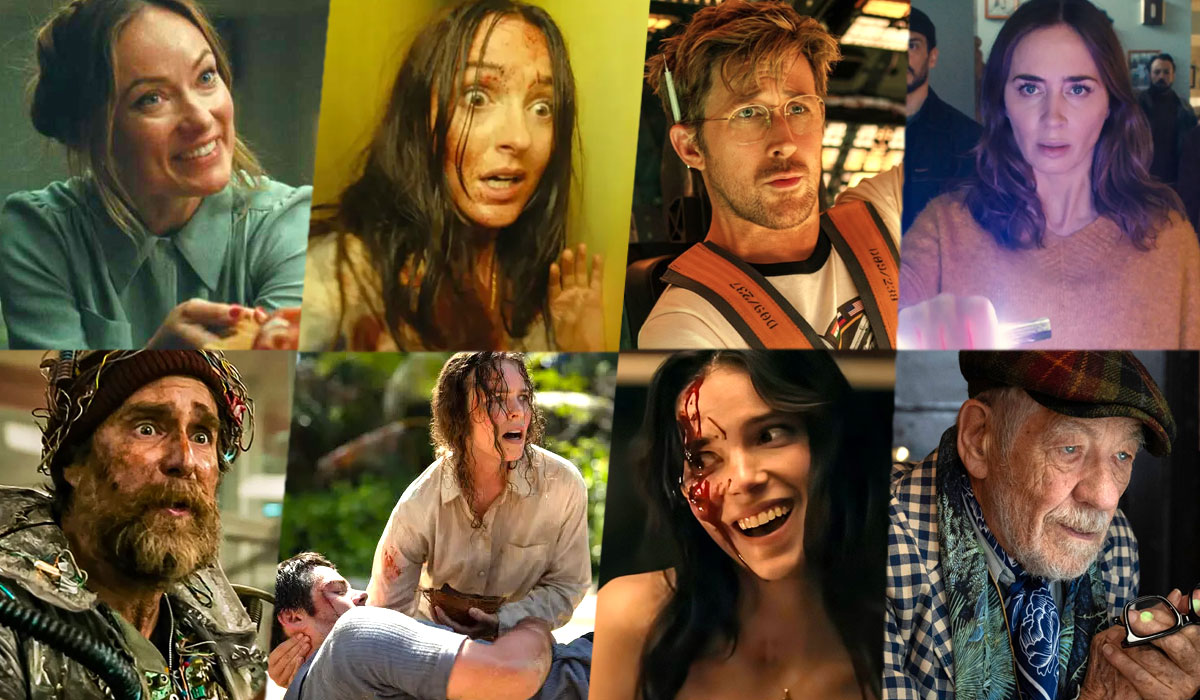
Well, here we are again. 2026 is only halfway over, and yet the year in movies has already been busy enough to make any tidy narrative feel a little suspect. Depending on where you looked, the past six months offered studio spectacle, nervy horror, festival discoveries, auteurist curios, animated crowd-pleasers, formally adventurous indies, and at least a few movies that seemed to arrive from nowhere before immediately lodging themselves in the collective cinephile brain.
READ MORE: The 150 Most Anticipated Films Of 2026
If there’s been a recurring theme so far, it may be a sense of filmmakers trying to push through the noise. Some of the year’s best films have been about people trapped inside systems, histories, fantasies, families, workplaces, delusions, or literally impossible spaces; others have found grace in connection, curiosity, silliness, or the old-fashioned pleasure of watching movie stars do what movie stars are meant to do. In a landscape still defined by franchise fatigue, streaming churn, and the great algorithmic flattening of taste, it’s been heartening to see so many films feel handmade, strange, personal, or stubbornly alive.
As always, this is not meant to be definitive, and no “best of the year so far” list could pretend to account for everything still waiting in the wings. Some of these films have already opened, some have been seen on the festival circuit, and some will continue to gather steam as the year goes on. But taken together, the movies below offer a strong snapshot of 2026 at its midpoint: unruly, unpredictable, sometimes bleak, often funny, and, at its best, full of the kind of risk that makes the medium feel thrilling again.
Here’s our list in no particular order.
“Good Luck, Have Fun, Don’t Die”
Gore Verbinski is himself a throwback to an era when big Hollywood movies and the visionaries who directed them weren’t afraid to be in-your-face bizarre. This alone makes him a novelty in our current, depressingly personality-free blockbuster climate. Verbinski’s “Pirates of the Caribbean” movies may have been derided as expensive, entertaining populist trash in their time, but make no mistake: these movies are deeply weird, and that’s not even getting into his acid-fried reptile Western “Rango” or “A Cure For Wellness,” one of the most alienating mainstream releases that its studio, 20th Century Fox, ever unleashed into the world. All of this is another way of saying that “Good Luck, Have Fun, Don’t Die” has been a long time coming. The Gore heads have been waiting for this one, and there are parts of this gonzo sci-fi chase epic that Verbinski directs as if he may never get to make another movie again. The story of a motley collection of strangers led by a stark-raving mad Sam Rockwell embarking on an apocalyptic mission through late-night Los Angeles (shout out to the Norm’s on La Cienega representation), Verbinski’s return to filmmaking has scorn to spare: for AI especially (this movie despises AI), but also for smartphone addiction and our culture of ignorant, homegrown All-American violence. The miracle of “Good Luck, Have Fun, Don’t Die” is that, while the movie may be overflowing with ideas to the point of pure chaos, it never becomes a screed: Verbinski remains a showman to the core, fusing elements from “Repo Man,” “Akira,” “12 Monkeys,” and his own wackadoodle oeuvre into an unreasonably entertaining middle-finger statement directed at all the right targets. – NL
“A Poet”
It was announced earlier this year that Nathan Silver (“Between The Temples”) was interested in directing an English-language remake of Simon Mesa Soto’s “A Poet,” one of the most discomfortingly funny films of 2026 thus far. It’s not hard to see what drew Silver, himself a poet of the emotionally maladjusted, to this material. The “Poet” of this film’s title is a failed scribe named Oscar, embodied without an ounce of shame or vanity by actor Ubeimar Rios in a performance that recalls nothing less than Ronald Bronstein’s “Frownland” in its evocation of flop sweat in human form. Oscar is a bitter, misanthropic, judgmental, most likely alcoholic, middle-aged teacher whom some might describe as a loser. How he manages to get through life day by day is mystifying. One of the joys of “A Poet” is that Soto sees the humanity buried beneath Oscar’s frumpy, disagreeable surface: you may have to look hard to see it, but it’s there (if you squint). “A Poet” is mostly about what happens when Oscar takes a pupil named Yurlady (terrific newcomer Rebeca Andrade) under his wing. More to the point, it’s about the many things that go wrong, and the question of whether or not Oscar can save himself from himself. Suffice to say, “A Poet” isn’t “Good Will Hunting,” and Oscar’s pathetic attempts at mentorship inevitably fail spectacularly; that Soto can mine both tragedy and pitiable comedy from his hero’s plight is the kind of transcendent arc that movies were invented to capture. – Nicholas Laskin
“Blue Heron”
The deceptive modesty of Sophy Romvari’s “Blue Heron” is part of what makes it so devastating. This is, on its surface, an autobiographical family drama about an eight-year-old girl named Sasha, played with watchful sensitivity by Eylul Guven, whose family relocates to Vancouver Island in the 1990s as her older half-brother Jeremy begins to spiral. But Romvari’s debut is not built like a tidy trauma memoir, nor does it behave like a conventional indie drama in which every wound is explained, diagnosed, and arranged for maximum catharsis. Instead, “Blue Heron” understands something far knottier about childhood memory: that the things we experience most intensely as children often come back to us in fragments, impressions, strange silences, half-understood adult decisions, and images that refuse to resolve. Jeremy, played by remarkable newcomer Erik Beddoes, is tender, frightening, unknowable, and often studied by the film from a distance that feels painfully true to Sasha’s perspective. His behavior is never reduced to a case file, even when Romvari later folds in real social workers, family materials, childhood photos, videos, and audio to deepen the film’s memoiristic texture. The result is a film whose power comes from restraint rather than melodrama. Maya Bankovic’s naturalistic cinematography gives the world a tactile, lived-in clarity, while Romvari’s structure allows the past to remain unresolved without feeling vague. “Blue Heron” is the rare family drama that understands how siblings can be both intimate and alien, beloved and unreachable, present in every room and still somehow impossible to know. – Rodrigo Perez
“Tuner”
Documentarian Daniel Roher’s first foray into fiction after his Oscar-nominated “Navalny” and this year’s “The AI Doc: Or How I Became An Apocaloptimist” is the jazzy, laid-back buddy/romance/gangster movie hybrid “Tuner,” one of the year’s most unexpected surprises. “Tuner,” at the risk of trotting out an oft-used critical maxim, is one of those they don’t make ’em as they used to pictures: a charming, distinctly mellow throwback and actor’s showcase that hums to life in its many quiet moments. The film also boasts some of the sharpest sound design of the year, all the better to capture the condition of its central character: that would be Leo Woodall’s soft-spoken Niki, who spends most of his days puttering around greater New York with his aging chatterbox pal Harry (a warmer-than-usual Dustin Hoffman), fixing rich people’s pianos. “Tuner” lets us see – and more importantly, hear – the world through Niki’s P.O.V., rendering Roher’s film an unusually subjective experience, even if “Tuner” itself never loses a grip on its cool-headed, unhurried tone. Carried by Woodall’s earthy rapport with Hoffman, which is to say nothing of a genuinely smoldering on-screen dynamic with co-star Havana Rose Liu, playing an ambitious music student, “Tuner” orients ordinary characters in proximity to crime, which is a great deal more interesting than simply delivering a predictable, seen-it-before crime movie. This nimble little number offers proof that Woodall – one of the breakout stars of “The White Lotus,” and a scene-stealer in everything from last year’s “Nuremberg” to “Bridget Jones: Mad About The Boy” – possesses the stuff that true-blue movie stars are made of. – NL
“Mother Mary”
It can be tricky to trace a through-line through the films of David Lowery, varied and eclectic as they are. Once liberated from the Malick homage of “Ain’t Them Bodies Saints” and the demands of mounting Disney IP (though his terrific “Pete’s Dragon” remains a slept-on treasure), Lowery’s world revealed itself as one of fantasy and magic, where the line between our world and the world of spirits (“A Ghost Story”) and the otherworldly (“The Green Knight”) is gossamer-thin. Nothing about the premise of Lowery’s latest, the spellbinding “Mother Mary,” would suggest anything supernatural. “Mother Mary” is a spooky mood piece centered on the eponymous pop diva (Anne Hathaway, leaving it all on the floor) and the woman who may be her closest confidante, worst enemy, or both: Sam Anselm (Michaela Coel, giving two of the strongest performances of 2026 thus far in this and “The Christophers”), the woman behind Mary’s most iconic looks. Mother Mary shows up at Sam’s door looking like a dog that’s been dragged through weeks of rain, eyes wet and heart shattered. She needs Sam to make her a dress. But is a dress all she needs? Watching these characters chip away at the emotional armor they’ve constructed to keep the world at arm’s length is captivating, and the original songs – our favorite is “Burial,” but they’re all great, which makes sense when you can afford to hire Charli XCX, Jack Antonoff, and FKA Twigs (who appears here in a spine-tingling séance sequence) to compose original arrangements for you – are some of the biggest bangers of the year in film to date. – NL
“The Invite”
The ghost of Esther Perel hovers over Olivia Wilde’s “The Invite,” and that is very much a compliment. Wilde’s third feature is a marital dramedy about desire, recognition, stagnation, resentment, and the slow corrosion that sets in when two people who once chose each other stop feeling chosen. Exquisitely shot in a single New York apartment, the film stars Wilde and Seth Rogen as a married couple whose relationship has gone flat in ways that feel both familiar and faintly humiliating. Their upstairs neighbors, played by Penélope Cruz and Edward Norton, are everything they are not: cooler, calmer, sexually liberated, emotionally fluent, and seemingly unburdened by the tiny daily grievances that have turned Wilde and Rogen’s marriage into a low-grade war of attrition. What begins as an awkward dinner with a pair of intimidatingly evolved swingers slowly becomes something richer, funnier, and more painful: a full-blown reckoning with all the needs left unspoken and all the disappointments that have curdled into contempt. Cruz, naturally, plays a therapist, the film’s most explicit Perel analogue, while Norton is her boyfriend, a former firefighter whose life was transformed by tragedy and who now carries himself with the serene ease of someone who has already been broken open and rebuilt. “The Invite” is often hilarious and shouty, and yes, the possibility of a “fourgy” gives the movie some of its wicked comic charge. But Wilde is after something more emotionally searching than a sex-farce setup. The movie is most compelling in the way its twists keep deepening rather than merely escalating, pushing its central couple toward the kind of brutal honesty that might either save their marriage or finally expose why it cannot be saved. Like Perel’s best writing and conversations, “The Invite” understands that relationships can survive, evolve, and even flourish, but only through truth, intention, humility, and the willingness to endure the pain that comes with being fully seen. What a sharp, funny, and unexpectedly moving triumph of emotional acuity. – RP


