


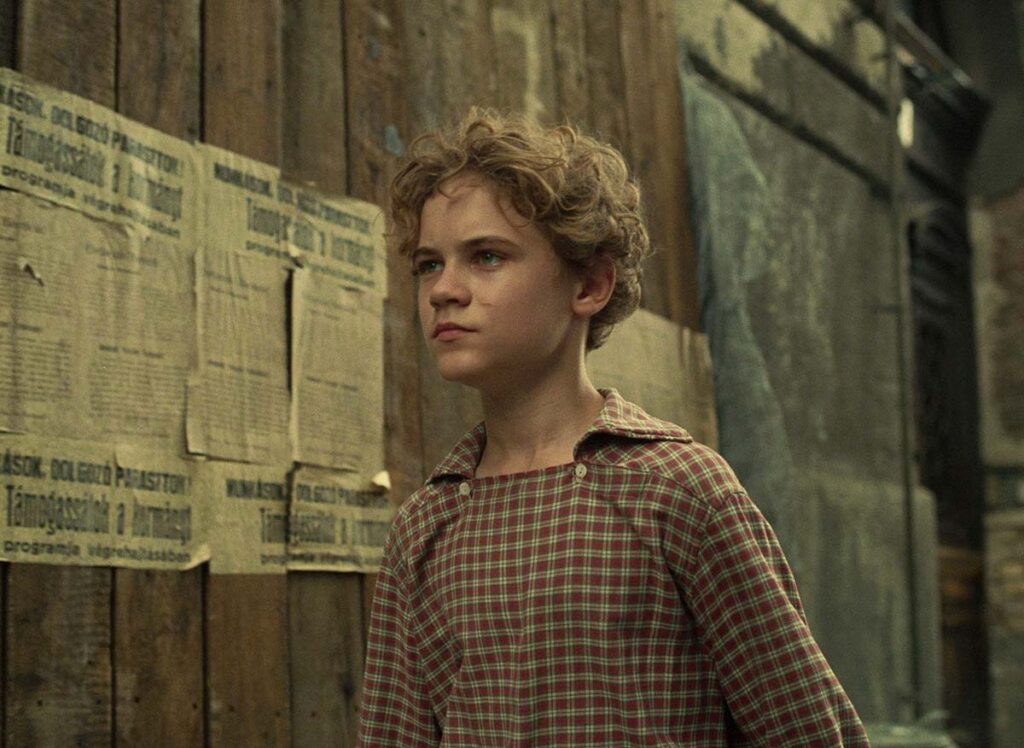
![‘Orphan’ Review: László Nemes’s Historical Drama Is Technically Accomplished But Emotionally Sparse [Venice]](https://cdn.theplaylist.net/wp-content/uploads/2025/08/28104202/102878-ORPHAN_-_Actor_Bojtorj__n_Bar__bas.jpg "‘Orphan’ Review: László Nemes’s Historical Drama Is Technically Accomplished But Emotionally Sparse [Venice]")
In a pivotal scene of László Nemes’s “Orphan,” a man pierces a heavy blanket of tension by looking into a child’s eyes and making a quiet promise: “We will never talk about this again.” But the thing about history is that it begs to be told, for stories not shared become mythical treasures, waiting for the hungry hands of the curious to come digging.
The Oscar-winning “Son of Saul” director returns seven years after the lukewarm “Sunset” precisely to prod at this primitive need for answers made ever-consuming at times when secrecy stands between life and death. We first meet Andor (Bojtorján Barabás) four years after the end of World War II and right as he steps away from orphanhood and back into the loving arms of his young mother, Klára (Andrea Waskovics). Almost a decade later, Hungary is recovering from the Revolution of 1956 — which saw a nationwide revolt against the reigning Communist regime — and 12-year-old Andor is struggling with a battle of his own.
READ MORE: 2025 Venice Film Festival Preview: 23 Must-See Films To Watch
One late night, the loud revving of an old motorcycle breaks the quiet of curfew in Budapest. Landing at Klára’s doorstep is a man she long thought to be a ghost, bringing with him not only a storm of wants and needs but also piercing the bubble Andor had carefully nested himself in. The boy knows little about his progeny, and even less about why he spent the first four years of his life in an orphanage, but what he does know is that his father, Hirsch, was a good man. Or is, for his death is neither confirmed nor denied, a tragic denial disguised as hope, given that Hirsch was a Jewish man taken to the concentration camps during the war.
“Orphan” is a personal film to Nemes, who took inspiration from his father’s real-life story to co-write the script with longtime contributor Clara Royer. This closeness clouds the film’s first half, the director sluggishly establishing the littlest intricacies of Andor and Klára’s routine, sparsely capturing time without much urgency to arrive at the story’s dramatic core. With the return of the brute who carries with him Klára’s gravest secrets, “Orphan” changes gears, finally zooming into the boy’s pained coming-of-age, directly tied to that pivotal moment in one’s youth when the idolized image of their parents irrevocably shatters, a rite of passage made even sterner against the backdrop of war.
Alas, for all the intricate detailing Nemes so laggardly spends time relaying over the film’s first two acts, very little constitutes matters of substance. “Orphan” stems from the closeness of the personal but is delivered with the distance of the archetypal, with no character, except Andor, given enough attention or care to be elevated from the one-dimensional. The most tragic example of this is Klára, concocted as if an empty vessel of suffering, a poor mother designed only to provide her beloved son with a taste of life’s great cruelties. She moves as if only allowed to walk through the fringes, where all other women in this story also bide, relegated to an existence bitterly tied to traumas denied the mercy of pity in favor of the vileness of shame.
The care blatantly denied to the characters is given instead to the film’s craft, the Hungarian director imbuing this world so familiar to him with great tangibility, the dilapidated buildings of a once thriving capital crackling with the weight of corrosion as the people that occupy them are made weightless by despair. Colors are stripped out of skies and trees and fruits, reserved mostly for the expansive world of the city’s theatre, once home to ticket-seller Hirsch and now a sacred place to a young boy who can feel his dad’s presence in the grandeur of the entry hall but also in the delicately ribbed edges of brightly-coloured paper tickets.
Working once again with Mátyás Erdély, the cinematographer who lensed his two previous features, Nemes shoots in 35mm film in a tight 3:4 aspect ratio, a choice that at once reinforces the claustrophobia and the depth of this world seen by a child. It is a point of view echoed by a camera often held at hip height, capturing adults and dark nooks and crannies from below. This proximity to Andor’s viewpoint lends itself to the film’s desire to grasp at a child’s ability to shape and bend their reality through meagre crumbs of truth, a survival mechanism made magical realism at times.
Still, “Orphan” feels like an exercise more concerned with the precision of its technical execution than the more ungovernable reins of its emotional axis. It is a frustrating companion to Nemes’s much more accomplished “Son of Saul,” also a father-son story set against the horrors of the Holocaust, but with a much firmer grasp on not only the tragedy of its central character but the complexities of film as a formal tool of historical catharsis – a curiosity the director seems to have lost entirely with his latest. [C]
Follow along with all our coverage of the 2025 Venice Film Festival.

Rafa Sales Ross is a Brazilian film journalist, critic and programmer currently living in Scotland. She contributes to Variety, BBC Culture, Sight & Sound among others, and can often be seen writing about Latin American Cinema and explorations of death and desire.


