


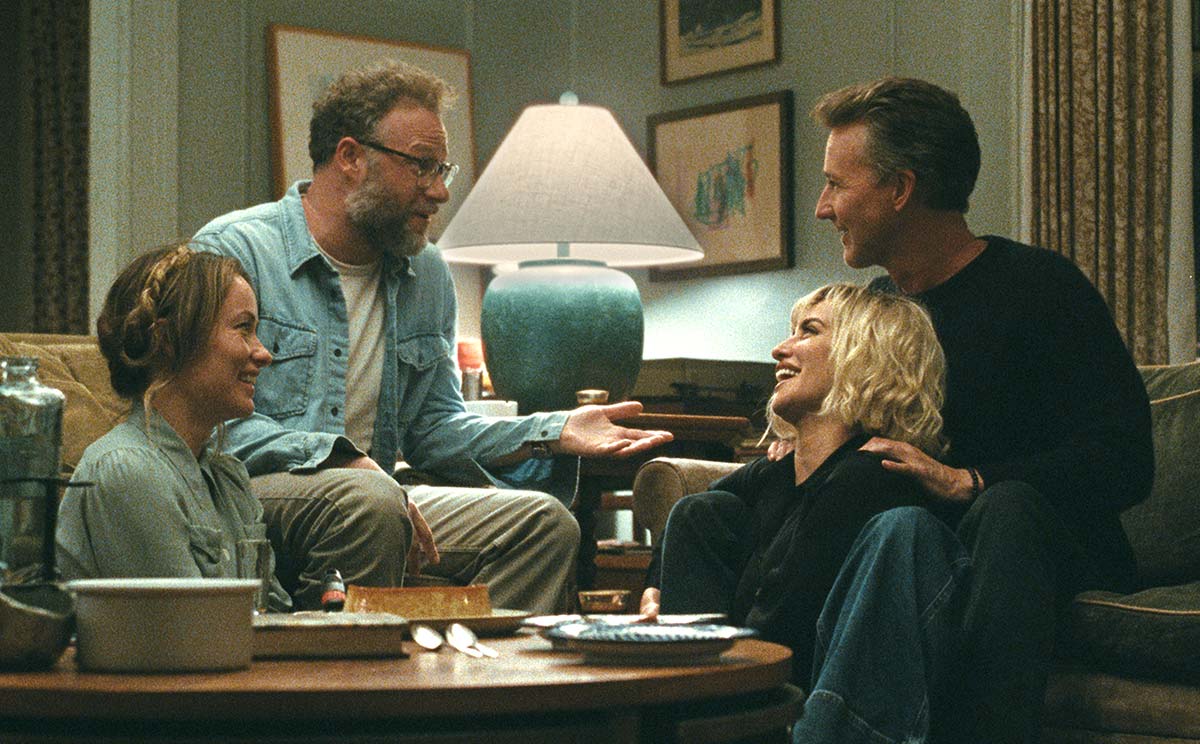
The pendulum scarcely swings so far in the opposite direction for a filmmaker looking for a reset as it does for Olivia Wilde with “The Invite.” Following a press debacle that overshadowed her scale-up to major studio filmmaking with “Don’t Worry Darling,” she pivots away from the grandiose imagination of that film’s incel metaverse trappings. Here, she presents an inverse through an intimate, single-location chamber piece about an unpredictable dinner party.
Wilde uses the constricted storytelling environment to direct the film within an inch of its life. Her hand in shaping each moment feels so present that she’s basically appearing twice in the movie alongside her character, Angela. The overbearing calculation of the project undermines the type of dramaturgical naturalism for which she aims with the stripped-down, actor-driven production.
“The Invite” exists somewhere at the intersection of marital drama, “Who’s Afraid of Virginia Woolf?” and sex comedy “Bob & Carol & Ted & Alice.” The film charts a rapidly disintegrating dinner party where Angela and her unwitting husband, Seth Rogen’s Joe, invite their upstairs neighbors down for the evening. But the dynamics shift when Edward Norton’s Hawk and Penélope Cruz’s Pina invite the bickering couple into their world of sexual libertinism.
READ MORE: Sundance 2026 Preview: 30 Films We Can’t Wait To See
The chatty screenplay, penned by Rashida Jones and Will McCormack, puts language into overdrive for these extremely expressive couples. But the rapid-fire dialogue, edited into cacophonous staccato rhythm by editors Yorgos Mavospridis (a two-time Oscar nominee for his collaboration with Yorgos Lanthimos) and Anthony Boys, devolves into a self-satisfied exercise of verbal ping-pong. “The Invite” loses sight of what it means for the characters to say these things in the first place because Wilde gets so obsessed with treating verbosity like a competitive sport.
Each of the film’s three acts arrives with a distinct genre spin. The first plays like an anxious thriller as Angela and Joe’s marital anxieties spill out into polite company. The middle passage settles into the rhythms of a raunchy comedy as the plans for an orgy begin to organically arise. Finally, it settles into a raw domestic drama as each of the foursome lays bare their struggles.
But no matter the tone, Wilde pieces together the action similarly. She hacks up her scenes to death, cutting relentlessly at the end of a line delivery to make each remark land with greater force. And if that’s enough, she juices the film’s stakes through a blaring Devonté Hynes score with the volume jacked up. It’s as if the actors know they’re fighting to be heard not only over their scene partners but also over the cello, guitar, and soft piano instrumentation that define the soundscape of each respective act.
Wilde is so obsessed with arranging all the technical elements to reinforce a scene’s feeling. Yet it’s hard to underscore a sensation that is not organically arising from the action on-screen itself. “The Invite” bears a strong resemblance to the formal presentation of prestige filmmaking without possessing any of its substance in theme or character. She mistakes loudness and lengthiness for liveliness.
Lost in the sprawling brawling of “The Invite” is a beating human heart and organic character development. The heartfelt final act monologues by each dinner party attendee arrive too late to shape any sense of who these characters are beyond what they say. A trauma dump is no substitute for consistent, explicit characterization that can be revealed through dialogue. (Or, heaven forbid, a quiet reflective moment if Wilde ever wanted to give her audience a moment to breathe.)
There’s a high floor in quality for any film that can assemble such a talented cast and crew. Wilde and Rogan are game for the comedic beats and bickering, while Norton and Cruz can shade their underwritten characters with some mystery and gravitas. Behind the camera, cinematographer Adam Newport-Berra’s celluloid photography lends “The Invite” some grit and grounding it otherwise lacks. But he’s frustratingly locked into portrait mode, rarely getting to move around the apartment or block the actors in striking compositions.
All these components should add up to more than they do. Wilde toils feverishly to create the illusion of momentum and communicates to the audience that they must be feeling such a sensation. But for all the belabored artistry of this choppily cut enterprise, little in “The Invite” actually moves. It’s potential energy, unconvincingly trying to pass itself off as kinetic. [C]
Follow along for all of our coverage from the 2026 Sundance Film Festival here.


