

It might be tempting to compare Olivier Assayas’ “The Wizard of the Kremlin” to a piece of Russian literature, but the points of similarity mostly end with it being long and dense. There’s not much in the way of philosophical heft or psychological insight as the plot follows many decades in the life of Paul Dano’s Vadim Baranov, the fictionalization of a real apparatchik spearheading Putin’s communication strategy. While a comprehensive look at how the playbook for the paradoxical “sovereign democracy” came to be, the film proves clunky to watch.
READ MORE: 2025 Venice Film Festival Preview: 23 Must-See Films To Watch
For a film about a subject who prefers terse explanations that paradoxically demonstrate the depths of his power and intelligence, Assayas and Emmanuel Carrère’s adaptation of the Giuliano da Empoli novel of the same name is given to verbosity and over-explanation. “The Wizard of the Kremlin” finds its narrative spine in a conversation Baranov initiates with a journalist (Jeffrey Wright) who profiled him in a write-around. It’s not entirely clear why someone who built his reputation operating in the shadows suddenly opens up in such illustrative detail … beyond, of course, as an excuse to let the audience in on the secret.
Baranov’s kaleidoscopic ascent through the ranks of power mirrors the post-Cold War Russian national journey from hope to resignation. He starts as an avant-garde playwright, where he first meets the beguiling and boundary-pushing Ksenia (Alicia Vikander). That artistry transfers nicely into a brief stint producing reality television, where he first crosses paths with oligarch Boris Berezovsky (Will Keen), a man who’s made a pretty penny off the privatization of Russia’s television networks. It’s Boris who blurs the lines between news and propaganda, first establishing a direct connection between Baranov and then-FSB chief Vladimir Putin (Jude Law).
From there, “The Wizard of the Kremlin” bops around major historical events under Putin’s regime in a largely episodic fashion. Tying them all together is Baranov’s participation, spinning them all into furthering the narrative framework that has ultimately come to define 21st-century geopolitics. Russia stands for order always, which can look appealing to a world that constantly feels in chaos. Baranov maintains a tight grip over the party, with an influence that is so far-reaching it includes managing office wait times for his boss.

The accumulation of Baranov’s accomplishments, if one wants to call them that, furthers the film’s assertion that these maneuvers to consolidate power are worth understanding. Yet, “The Wizard of the Kremlin” strikes an odd balance with its inch-deep, mile-wide purview of the history it covers. Blowing out one section of the film with Baranov at the height of his power and influence might make a good movie. All of these instances, given room to breathe, could provide enough material for a miniseries. This 156-minute feature-length iteration is just a slog that dulls its point through repetition.
Assayas’ emphasis on a single man to understand the trajectory of a nation’s slide toward consolidated autocracy belies Baranov’s own stated view on the nature of power. It does not rest in a person themselves, he postulates, but derives from their proximity to people in positions of authority. Even if he lets his boss take more of the credit for his strategic prowess, Baranov, the interjections of the narrator do little to dispel his “great man”-inspired theory of Russian history.
READ MORE: ‘The Wizard of the Kremlin’ Clip: Paul Dano Determines The Limit Of Satire
Dano delivers a steely, subtle performance that feels entirely in line with Baranov’s vision of his own position, yet he’s undercut by the film around him at every step of the way. The script forces him to spoon-feed the exact tactics of his work during key flashpoints in Russian politics, which undermines his shadowy Rasputin-esque figure. His on-again, off-again romance with Ksenia throughout the years only feels like it pulls focus from the main storyline.
To understand what might compel Baranov to Ksenia is to grasp something of his character beyond the ruthless logic powering his political ascent. But “The Wizard of the Kremlin” does not show much interest in exploring the figures on screen as anything more than archetypes or ideas. The film becomes something like a contemporary Russian riff on “Forrest Gump,” where a character serves as a spirit guide through major events. (Though Baranov, at least, is aware of the agency he exerts.)
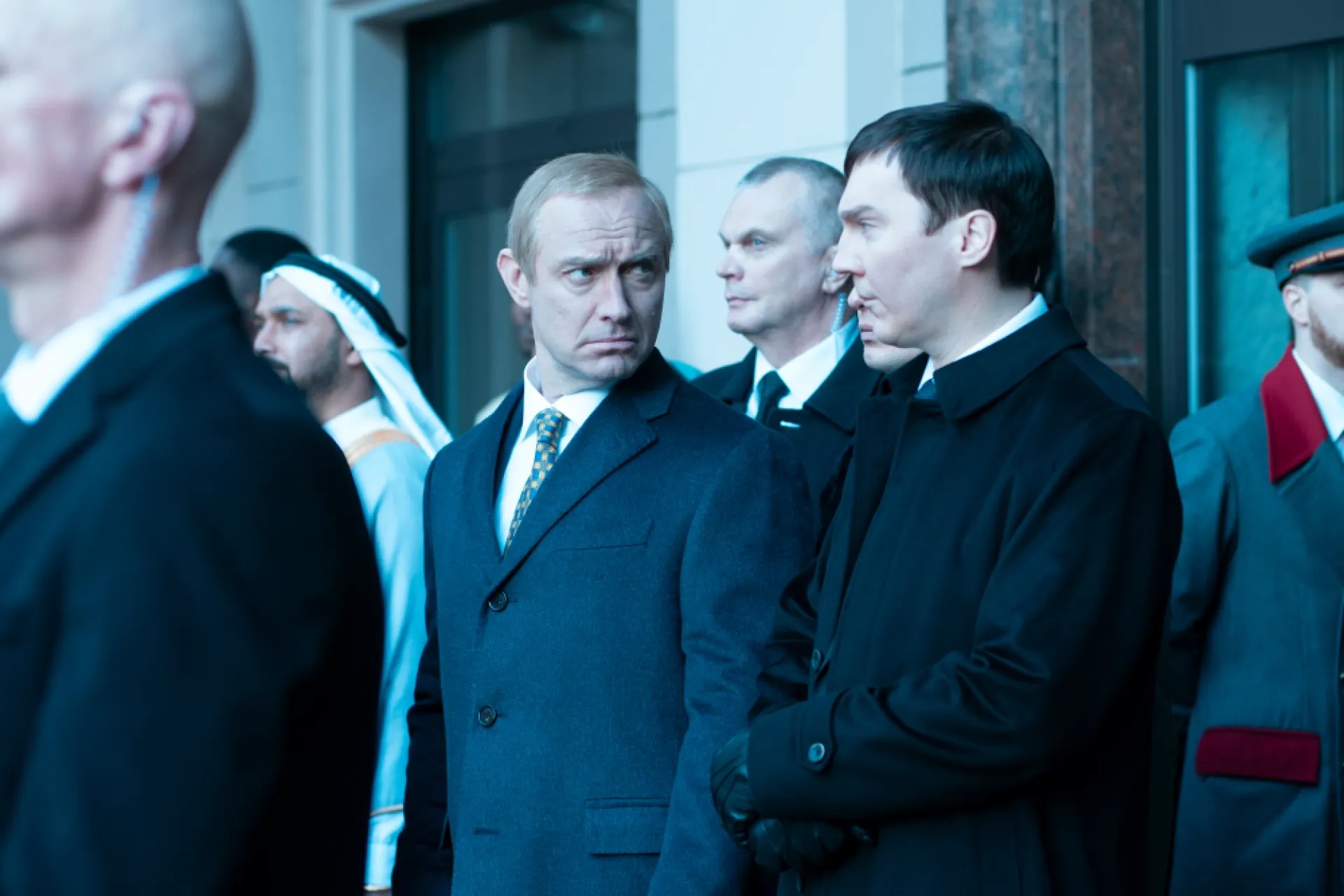
It’s no surprise, then, that the most compelling figure in “The Wizard of the Kremlin” is Jude Law’s incarnation of Putin himself. It’s a performance that recalls Sebastian Stan’s take on Donald Trump in “The Apprentice,” focusing on the precision of movements rather than the trap of psychology. Law nails his subject down to twitches like Putin’s shifty eyes, which makes him feel both immediate and inscrutable. Law’s take on the Russian leader feels both real and mysterious — two features that the film otherwise struggles to corral across its unwieldy runtime. [C]
Follow along with all our coverage of the 2025 Venice Film Festival.


