


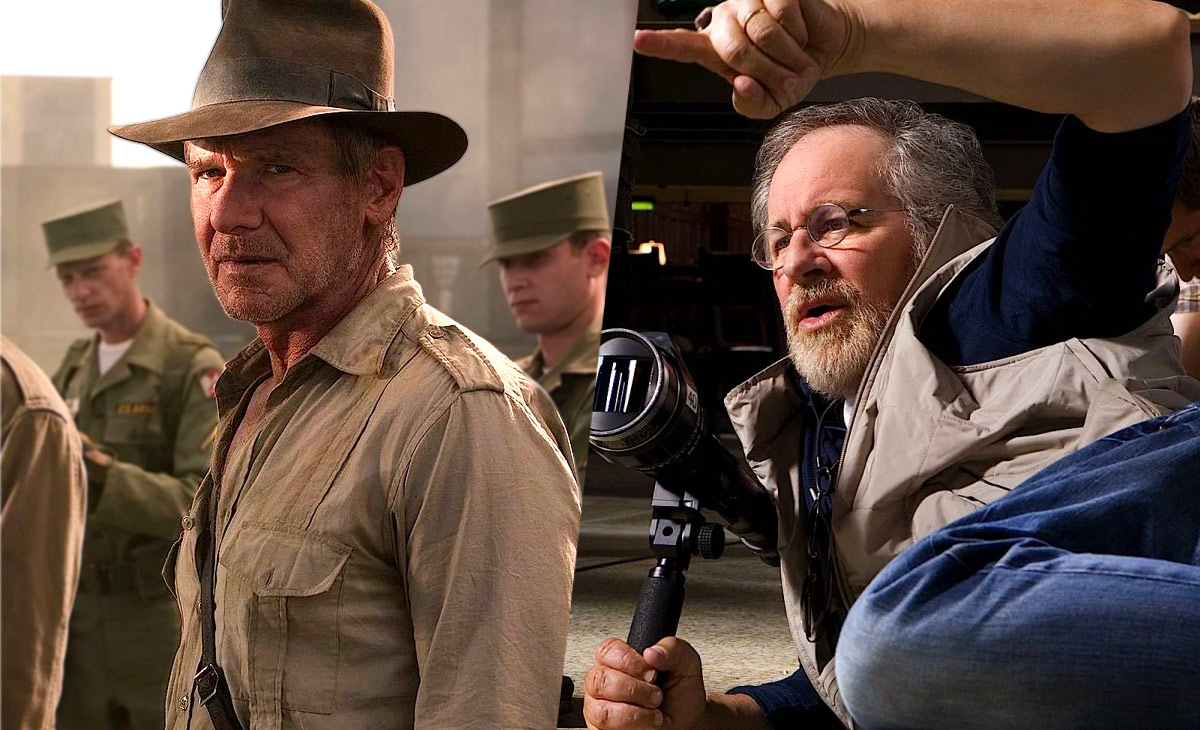
For years, “Indiana Jones and the Kingdom of the Crystal Skull” has endured as the franchise’s punching bag, a sequel remembered less as a grand return than as the moment Indy nuked the fridge, chased aliens, and tested the outer limits of fan goodwill. The 2008 film marked the long-awaited reunion of Steven Spielberg, George Lucas, and Harrison Ford, bringing Indy back nearly two decades after “The Last Crusade,” and while it was a commercial hit, grossing nearly $791 million worldwide, its reputation has only soured over time. Between the alien-adjacent mythology, glossy digital sheen, CG-heavy action, infamous “nuking the fridge” sequence, and a finale that pushed the franchise into full-on flying-saucer territory, “Crystal Skull” is widely regarded as the low point of the series.
Steven Spielberg Says He Was ‘Crushed’ When Harrison Ford Turned Down Alan Grant In ‘Jurassic Park’
Now, Kathleen Kennedy is offering a pretty blunt explanation for why the movie never entirely worked: the core creative team was not fully united behind the idea.
In a sprawling new Vulture oral history of Spielberg’s career tied to the existential threat UFO thriller, “Disclosure Day” (read our review), Kennedy, the co-founder of Amblin Entertainment and former president of Lucasfilm, says “Crystal Skull” was a difficult experience in part because Spielberg and Ford were uneasy about building an “Indiana Jones” movie around aliens.
“Crystal Skull was a tough production for Janusz,” Kennedy said, referring to longtime Spielberg cinematographer Janusz Kamiński, who also admits in the piece that the movie was “by far” the hardest of his career because he was trying to recreate the look of the earlier Indy films shot by Douglas Slocombe. “Steven was struggling with that movie. Harrison was struggling with the movie. They didn’t want to do a ‘Raiders’ movie that involved aliens, and they kind of got into a fight with George [Lucas] about it.”
Lucas, for his part, says his original instinct was to make the film more overtly in the vein of “War of the Worlds,” rooted in 1950s flying-saucer paranoia. But Ford and Spielberg pushed back.
“I wanted it to be kind of a ‘War of the Worlds’ sort of thing,” Lucas said. “Harrison said, ‘I’m not going to do another science-fiction movie.’ And Steven said, ‘I’m not going to do another science-fiction movie.’” Lucas argued that the 1950s setting made UFOs a natural fit, but says the group ultimately went through “about five scripts” before arriving at a compromise: the beings would not be aliens, exactly, but entities from another dimension.
That compromise, of course, did not necessarily solve the problem. “Crystal Skull” still ends with what looks very much like a flying saucer taking off, a point Lucas himself acknowledges in the oral history. Spielberg apparently tried to rationalize it as interdimensional travel, but Lucas says his response was simple: “It looks like a flying saucer.”
Kennedy’s assessment is even more direct. She says the filmmakers ultimately followed Lucas’ lead, but that the lack of full buy-in from Spielberg and Ford damaged the movie.
“They ended up all of them doing what George wanted to do, which was probably the right thing,” Kennedy said. “But Harrison and Steven were not 100 percent on board. That’s why the movie, out of the four that Steven made, is the weakest.”
Kennedy worked with Spielberg after “1941,” was part of the “Raiders of the Lost Ark” production, and helped shepherd the Amblin machine through the era that made Spielberg the defining popular filmmaker of his generation.
The Vulture piece also frames “Raiders” as a kind of course correction for Spielberg after his reputation for difficult, over-budget productions. Lucas says studios were wary of hiring Spielberg for “Raiders” because they feared he would go over budget, and he had to promise Paramount that the film would be made for $20 million, with Lucas covering anything above that. Kennedy recalls that the mantra on those early Indy films was, “Don’t forget, we’re making a B-movie.”
That spirit, evidently, was harder to recapture decades later on “Crystal Skull.” Kamiński says he struggled to imitate Slocombe’s classic Indy look, admitting, “I don’t think I succeeded, because Douglas Slocombe, who did the other Indiana Jones movies, was just brilliant, and I’m not Douglas.” Screenwriter David Koepp also says he took the job with “some trepidation,” trying to model a form of storytelling that had worked brilliantly in the past.
Ford’s later return also takes on a different shape in Kennedy’s telling. Spielberg ultimately stepped away from 2023’s “Indiana Jones and the Dial of Destiny,” with James Mangold taking over directing duties, but Ford apparently saw one more film as a chance to move Indy past “Crystal Skull.”
“That’s why Harrison was so deeply committed to ‘Destiny,’” Kennedy said. “He didn’t want that to be the end.”
“Dial of Destiny” was hardly embraced as a triumphant franchise finale, but Ford’s emotional commitment to giving Indy a more grounded ending now makes a little more sense. “Crystal Skull” may have reunited the original brain trust, but Kennedy’s comments suggest that Ford and Spielberg should have listened to their instincts and just left it all on the table with ‘The Last Crusade.’
So, in Kennedy’s telling, “Crystal Skull” was not undone by one bad idea so much as by a core team that never fully agreed on the movie they were making. For a franchise built on timing, chemistry, and instinct, that was enough.


