




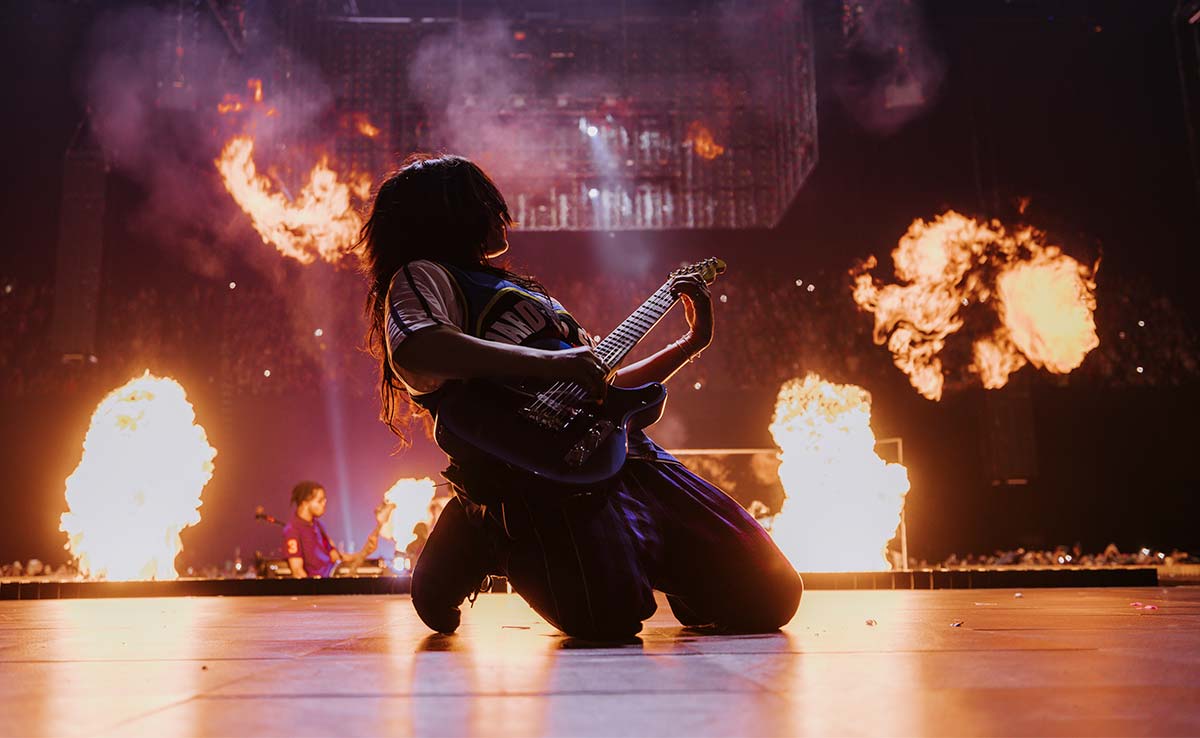
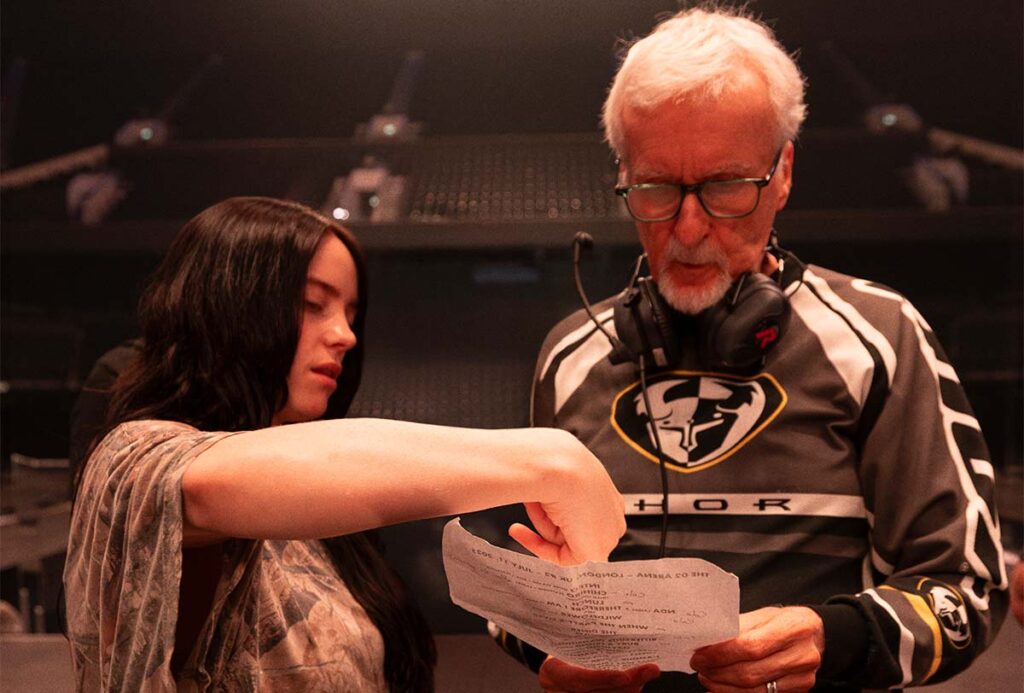
In the grand tradition of James Cameron’s largest-scale work, “Billie Eilish — Hit Me Hard and Soft: The Tour” is immense and intimate at once—a 3D concert film built for scale, speed, light, and thunderous sound, yet shaped around the feeling of standing close enough to Billie Eilish to catch the breath between notes. Co-directed by Cameron and Eilish, though Cameron openly credits Eilish with much of the vision, the film is dynamic, enveloping, and frequently overwhelming in the best possible sense: a sensory flood that captures the enormity of her live show while keeping its focus on the artist moving through the machine.
READ MORE: 53 Must-See Films To Watch Summer 2026
The obvious selling point is access, and the film has it everywhere. Dozens of cameras seem to cover every inch of the arena, from the vast sweep of a massive, emotionally charged crowd to the tiny backstage corridors and under-stage hiding places where Eilish waits before reappearing. But the real achievement is perspective. Cameron does not simply photograph the concert from a privileged vantage; he places the viewer beside Eilish, tracking with her as she runs across the stage, sings through some of her most exposed emotional passages, and throws herself into the next physical and vocal challenge with astonishing ease.
The result may be one of the most complete concert-film experiences imaginable. In 3D, on a large screen, the proximity becomes almost surreal. You are not watching Eilish from the bleachers, or even from the front row. You are next to her, inside the choreography of the show, moving through exertion, adrenaline, precision, and release. For many fans, it may be the closest thing to the ideal Billie Eilish concert—perhaps even a version no actual ticket could provide. The film makes the arena feel huge, but it also makes the performance feel personal, almost private, as if the camera has been granted emotional adjacency rather than merely physical proximity.
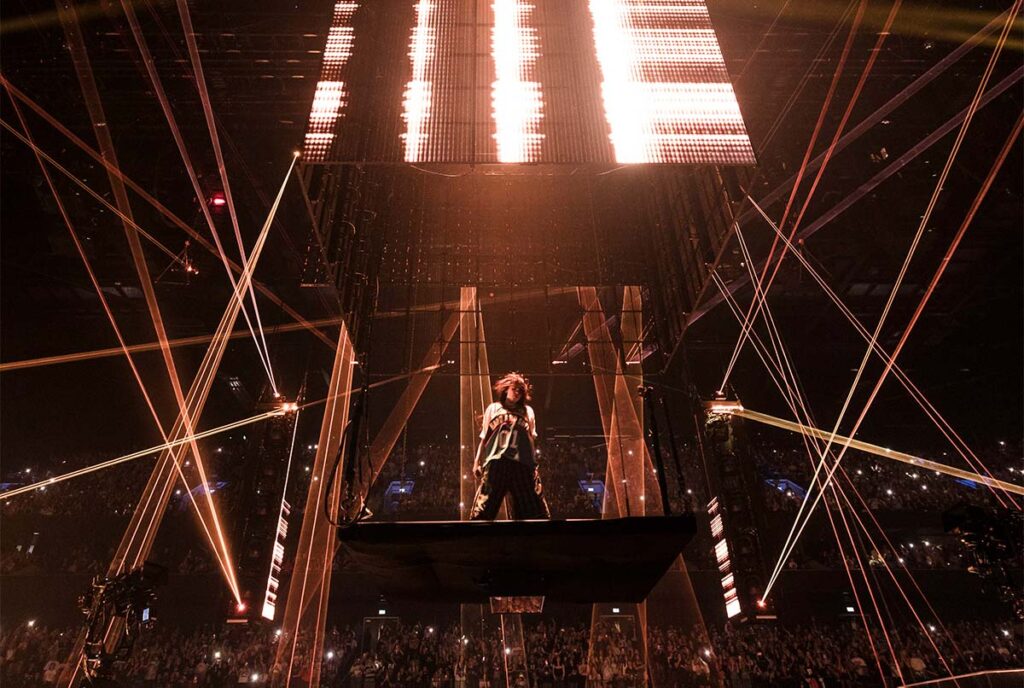
One of the film’s sharpest ideas comes early in a sequence built around a suspended box of color, light, and flashing effects that hovers above the stage before revealing Eilish inside. The moment is already dazzling from the crowd’s perspective, building anticipation for the singer to reveal herself to the crowd. Still, the film then rewinds and shows what happened 11 minutes earlier from Eilish’s point of view. Suddenly, the grand visual flourish becomes something more revealing: an artist tucked inside a glowing machine, giddy, focused, waiting for the reveal. That double perspective—mythic from the outside, human and unassuming from the inside—is the movie’s clearest expression of what Cameron and Eilish are after.
The same balance runs through the fan material. The film understands the intensity of Eilish’s audience without condescending to it. Faces in the crowd are tearful, overwhelmed, ecstatic, devoted. There is an almost worshipful emotional connection in the room, but Eilish gives that energy back with genuine warmth. Her interactions with fans feel intentional and generous, especially when the film underlines how much her work has meant to young people who want to feel seen, accepted, and held. Eilish has become a voice for a generation that understands isolation, identity, and emotional volatility as daily conditions, and the movie captures that relationship without ever exploiting it.
That sense of care also informs the backstage conversations, where Eilish speaks candidly about womanhood, performance, sexuality, and the pressure of being looked at. She discusses the complications of presenting herself onstage without being reduced to an object, and the film is strongest when it lets that tension sit beside the overwhelming force of the live show. Eilish is commanding, funny, vulnerable, charming, and completely watchable, but she clearly thinks through the ethics of how she appears, what she offers, and what she withholds. The show is maximal, but her self-presentation is controlled and deeply considered.
When Finneas appears for a couple of songs, the movie gains an additional layer of warmth. His presence is not overplayed, but it registers immediately: a familiar musical partnership, a sibling bond, and a shared emotional language that feels lived-in rather than performed. After his relative absence from the first half, his arrival gives the film a lovely sense of reunion. You feel the ease between them, the support, the private shorthand, and the mutual respect that have long been central to her music without needing the film to underline it.
“Billie Eilish: Hit Me Hard & Soft” is thrilling as a concert film, but its force comes from how carefully it maps the machinery behind the magic—the lighting choices, stage movements, emotional calibration, hidden pathways, and private moments of anticipation. It is vivid, immersive, and unusually personal, a portrait of a performer who understands the scale of her platform and still wants every person in the room to feel seen. For a film this massive, its most impressive trick is how close it comes to witnessing everyone. [B+]

