


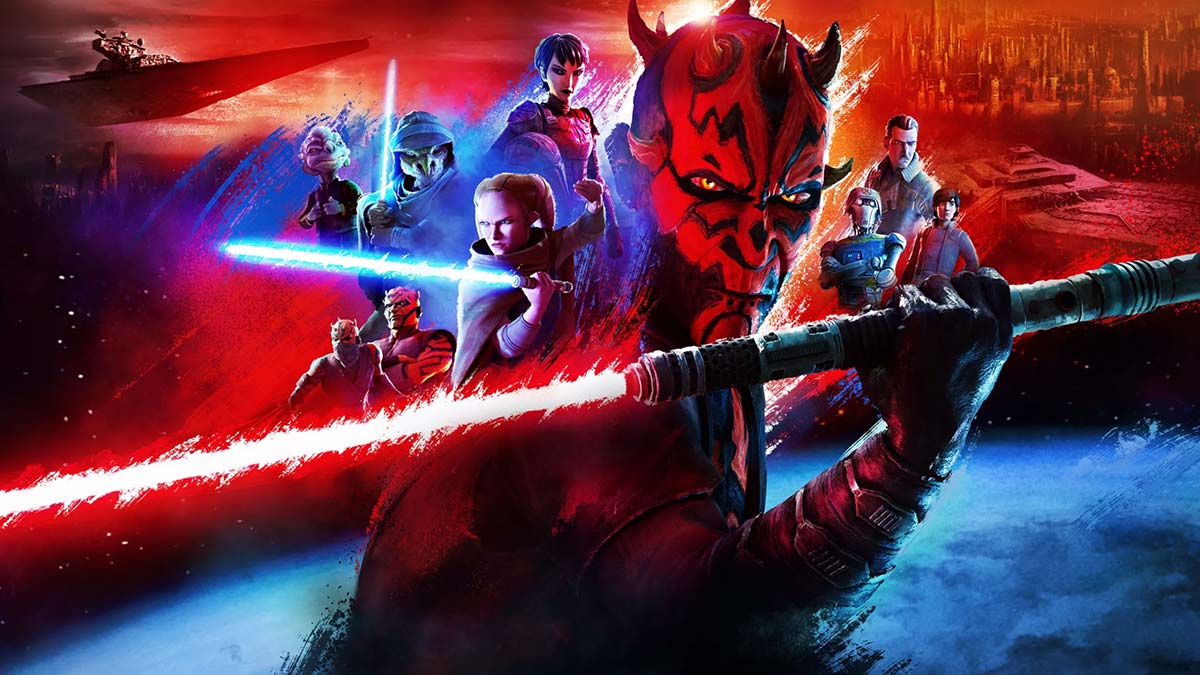
For a long time now, “Star Wars” has too often confused its mythology with meaning, mistaking callback lore and endless brand management for the darker, knottier moral drama that once gave the saga its force. Too much of the franchise in recent years has run on fan-abaiting recognition alone, content to recycle emblems of conflict without the emotional, political, or spiritual pressure that made those symbols resonate in the first place. And this is what makes Lucasfilm’s “Star Wars: Maul – Shadow Lord” feel like such a jolt. It’s not just another return to familiar iconography or another exercise in fan-service necromancy. It is a sharp, thrilling, unexpectedly rich series that restores menace, temptation, and genuine moral conflict to a galaxy that has too often felt trapped in its own deadened legend.
READ MORE: 15 Must-See April TV Shows: ‘Beef,’ ’Euphoria,’ ‘Margo’s Got Money Troubles’ & More
Set roughly a year after “The Clone Wars,” during the tightening reign of the Empire, the new animated series follows Maul as he rebuilds his criminal syndicate on the planet Janix and begins hunting for a new apprentice. Developed by Dave Filoni and Matt Michnovetz, the show immediately understands that Maul is compelling not because he is secretly good, or because he can be softened into some fashionable antihero, but because he lives in a morally unstable space that “Star Wars” rarely explores with enough patience. He is still vain, duplicitous, manipulative, and steeped in vengeance. But he is also wounded, humiliated, half-broken by abandonment, and driven by a pain that never curdles into innocence. That contradiction gives the show its voltage and a tension that makes it feel urgent.
It helps, of course, that Maul was already one of the franchise’s richest reclaimed characters. He may have begun as a striking visual in “The Phantom Menace,” but “The Clone Wars” turned him into something far more potent: a villain sharpened by grievance, shame, and thwarted ambition. “Shadow Lord” pushes that even further. Voiced again by Sam Witwer, Maul here is all crippling fury and Machiavellian intelligence, a creature fueled equally by revenge and insecurity. He remains obsessed with Darth Sidious, still stung by being discarded and thrown away, still unable to stop picking at the old wounding scab that defines him. At one point, Maul experiences nightmares about being ripped away from his brother and family to become Sidious’ apprentice, and that psychic damage hangs over everything. He is not softened by trauma, but distorted by it, and that distinction is what makes him so interesting.
The series’ central dramatic engine is Devon Izara, a Twi’lek Jedi voiced by Gideon Adlon, who is on the run after Order 66 with her Master, Eeko-Dio-Daki, voiced by Dennis Haysbert. Maul identifies Devon as a potential new apprentice, but what follows is not some blunt, rushed seduction to the dark side like Anakin’s clunky, inelegant turn in “Revenge Of The Sith.” It is something slower, eerier, and more psychologically precise. He gets in her head by planting doubt and isolates her from the certainty that once gave her life structure. He understands that the Jedi Order has been obliterated, that she is no longer a guardian of peace in any meaningful sense, and that survival itself can become its own destructive philosophy. “Shadow Lord” handles this with real elegance. Devon’s disillusionment isn’t turned on like the flash of a lightsaber; it accumulates until it starts to feel overwhelming.
That gradual corrosion is also where the series’ animation proves itself exceptional. This may be some of the best animation “Star Wars” has ever had, not just because it is sleek or visually polished, but because it communicates inner conflict with such precision. The show is terrific at inflecting emotion through physical movement alone — posture, hesitation, recoil, silence, small fractures in confidence that never need to be over-explained. Devon’s growing self-doubt becomes visible before it is ever verbalized, and that gives the series a quiet, dramatic sophistication that a lot of much pricier, broader live-action franchise TV simply seems to miss. The characters don’t just speak conflict; they carry it like a burden.
And when the action hits, it is superb. The lightsaber battles are among the best in recent “Star Wars,” dazzling in choreography and genuinely hypnotic in motion. Still, the crucial thing is that the show never treats action as its own justification. It understands a truth that too much franchise storytelling ignores: spectacle is just noise if it is not tied to character, stakes, and emotional consequence. “Shadow Lord” understands that and builds its action sequence around those ideas. Its fights are thrilling because the series has already built the drama underneath them. Its car chases and pursuit sequences feel urgent and nerve-racking because there is a real sense that disaster might befall them. The fear is never synthetic, and the danger pulses throughout.
Refreshingly, the supporting cast deepens the world rather than cluttering it. Wagner Moura brings a bruised, grounded presence to Brandon Lawson, a detective on Janix whose local law-enforcement role places him in uneasy proximity to the Empire. Richard Ayoade voices Lawson’s droid, TBOT — better known as 2 Boots — with a dry comic energy that stands out without puncturing the tone, and Pamela Adlon’s Rena Sewell adds a hustler’s edge as a gambler-gangster who serves, in part, as Brandon’s informant, though the show also teases a romantic charge between them. One of the more intriguing undercurrents in the series is Brandon’s fractured home life. He is separated from his wife, who works for the Empire, while he remains deeply hostile to it even as his own job forces him to answer to its machinery. That detail — along with his relationship with his son, who seems perceptive enough to clock the emotional crosscurrents around him — gives the series an unusually adult texture. Yet, it’s never trying to be “mature” in some self-advertising way. It just trusts lived-in complications.
The Inquisitors, meanwhile, are as fearsome here as they have been anywhere in the franchise, bringing with them the creeping fear of being hunted, erased, and cornered by a system that turns survival into existential siege. All of that feeds back into the show’s larger themes: pride, vengeance, corruption, the ache of lost purpose, and the sinister intimacy of manipulation. This is a story about an eternal villain trying to find his place in a world that has chewed him up and left him monstrous, and about how easily confusion, despair, and loneliness can become a gateway to evil. Already greenlit for a second season, if Devon is indeed destined to become Maul’s apprentice, “Shadow Lord” makes that journey feel tragic, as it should, rather than merely inevitable.
Outside of “Andor” and, yes, “Star Wars Rebels,” this is easily some of the best work “Star Wars” has done in ages. More than that, it raises an uncomfortable question for the live-action side of Lucasfilm: why does the animated arm so often grasp what the flagship projects miss? “Shadow Lord” understands that mythology only works when it is attached to real moral pressure. It knows that revenge can feel like purpose, that power can be mistaken for salvation to the lost, and that the most gripping “Star Wars” stories are not the ones most obsessed with canon, but the ones most alert to fear, temptation, and the wounds people mistake for destiny. [A-]

Rodrigo Perez is the founder and editor-in-chief of The Playlist, which he launched in 2008. He has worked in entertainment journalism since 2000, including at MTV, and has written for SPIN, IndieWire, Pitchfork, Complex, Magnet, and various music, film, and entertainment publications over the past two decades.

