


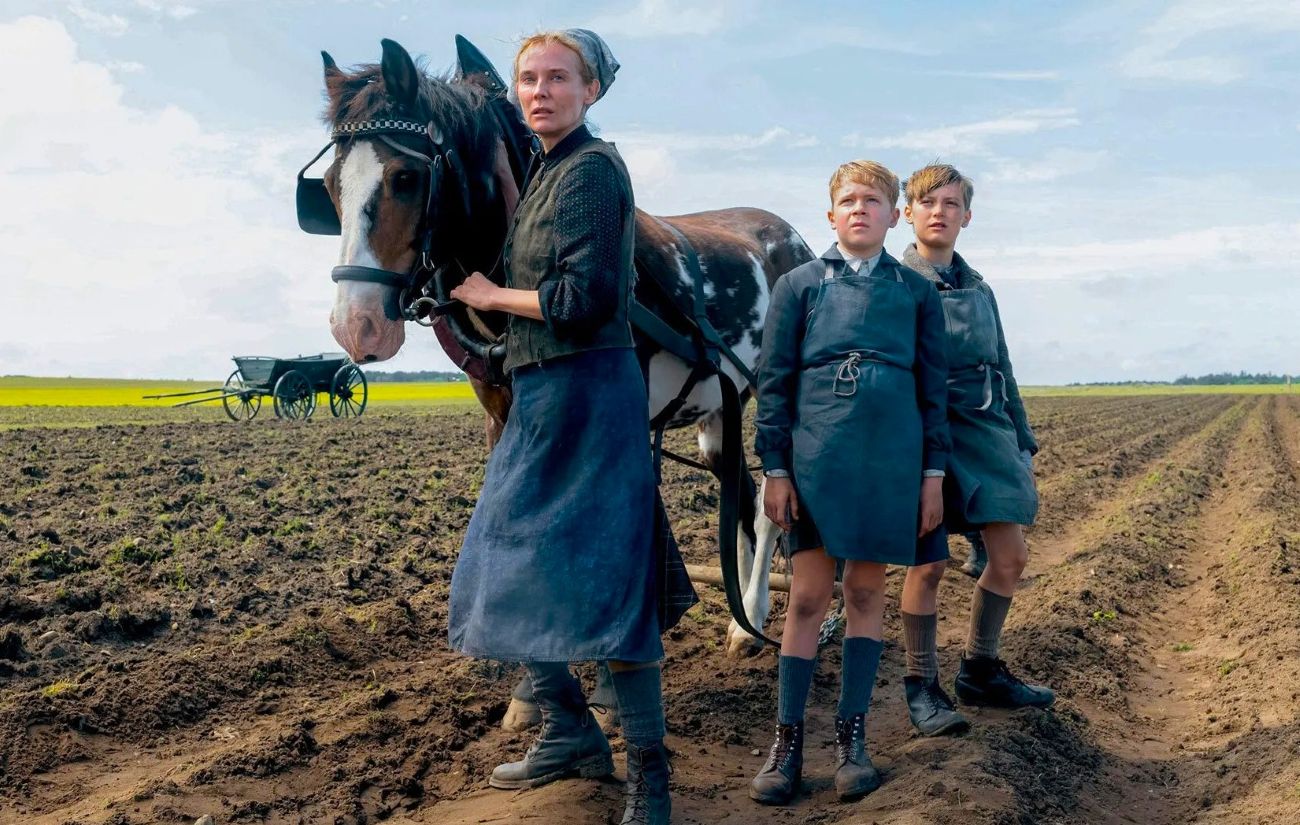
A child’s-eye view of war often depends on distance — on what can be half-seen, half-misunderstood, and only slowly absorbed as history hardens into personal loss. German-Turkish film director and screenwriter Fatih Akin’s “Amrum” understands that dynamic with quiet precision. Set in the spring of 1945 on the German island of Amrum, as World War II is sputtering toward its end, the film follows 12-year-old Nanning (a tremendous and revelatory Jasper Billerbeck) through the last days of a world he is too young to fully grasp and just old enough to be scarred by forever—at least eventually. The result is a tender but often harsh coming-of-age drama about the loss of innocence, one that never romanticizes childhood and never lets the island’s windswept beauty soften the moral desolation taking root underneath it.
Nanning spends his days fishing and working on a farm, laboring his way through the routines of island life while the larger machinery of collapse closes in around him. Known for engrossing dramas like “The Edge of Heaven” and “In The Fade,” Akin stages those early nuanced passages with a striking, almost deceptive calm. Amrum looks spare and beautiful, the sort of place where open air and sea light might suggest freedom, but the film keeps letting unease creep into that landscape. Hardship is everywhere. Community is thinner than it appears. And when the farmer Tessa, played by Diane Kruger, tells Nanning the war may soon be over, the boy’s first instinct is not political comprehension but childish hope: maybe his Nazi officer father will finally come home.
That small, devastating misunderstanding sets the film’s entire moral framework. Nanning is not responsible for the ideology that shaped his household, but he has been born inside it, and “Amrum” refuses to pretend that fact is incidental. His mother’s collapse at the prospect of Germany’s defeat tells him more than any speech could. Tessa is scolded for hurting morale and warned by the police, then turns and kicks Nanning off her farm. The boy begins reaching outward for care, protection, and solidarity, only to discover how quickly fear, cowardice, and social rot hollow those things out. The true enemy, the film suggests, is not only the distant war but the poisoned moral order that has already made itself at home in the island’s daily life.
That makes “Amrum” a tricky and often impressive film. It is, in some sense, asking the audience to sit with the pain of Nazi progeny without confusing that pain for absolution. That is an impossible moral line in theory and a delicate one in practice, yet Akin keeps the film from tipping into sentimentality or self-excusing historical softness. Nanning’s innocence matters because it is real, but it is also compromised by the world that formed him, the family he comes from, and the poisonous mythology still hanging in the air around him. “Amrum” does not resolve that tension so much as embrace it. That discomfort is part of what gives the film its force.
The cinematography by Carl Walter Lindenlaub is a huge part of that achievement. Working in steely blues and muted earth tones, Lindenlaub gives the island a severe, minimalist beauty that never turns postcard-pretty. The imagery is sparse, even slightly punishing, and it mirrors Nanning’s own isolation with remarkable clarity. The land feels open, yet emotionally airless. The shorelines and fields suggest escape, but the frame keeps finding loneliness, exposure, and a kind of spiritual chill. It is beautiful work, not because it flatters the setting, but because it lets the setting register as both refuge and trap.
That restraint carries through the film as a whole. “Amrum” is moving, but it never grows syrupy. It is sad, sometimes deeply so, yet it resists the easy cues of prestige melancholy. Akin seems far more interested in the soft abrasions that shape a child’s understanding of the world — the moment when adult hypocrisy becomes visible, when safety reveals itself as conditional, when belonging starts to feel like a lie. The film’s sense of loss does not arrive in a single grand shattering. It accumulates. That slow bruising is what makes it so resonant.
If “Amrum” has a limitation, it may be that its emotional austerity can occasionally keep the film at a slight remove, as though its discipline sometimes withholds just a little too much emotional fondness. But even that reserve feels tied to the material rather than imposed on it. This is a story about a child learning that the people, institutions, and inherited values around him are weaker, uglier, and more compromised than he had imagined. A warmer, more obviously manipulative version of the film would likely have betrayed that realization.
What lingers is the ache of that recognition. “Amrum” is a subtly touching film that never begs to be called tender. It looks at the waning days of the war not through battlefield spectacle or historical summation, but through a boy’s collapsing faith in the adults who built his world. By the end, innocence has not been dramatically ripped away so much as gently starved out. Akin understands how devastating that can be, and “Amrum” leaves behind a wistful, yet not entirely hopeless, chill that feels earned. [B+]

Rodrigo Perez is the founder and editor-in-chief of The Playlist, which he launched in 2008. He has worked in entertainment journalism since 2000, including at MTV, and has written for SPIN, IndieWire, Pitchfork, Complex, Magnet, and various music, film, and entertainment publications over the past two decades.

