


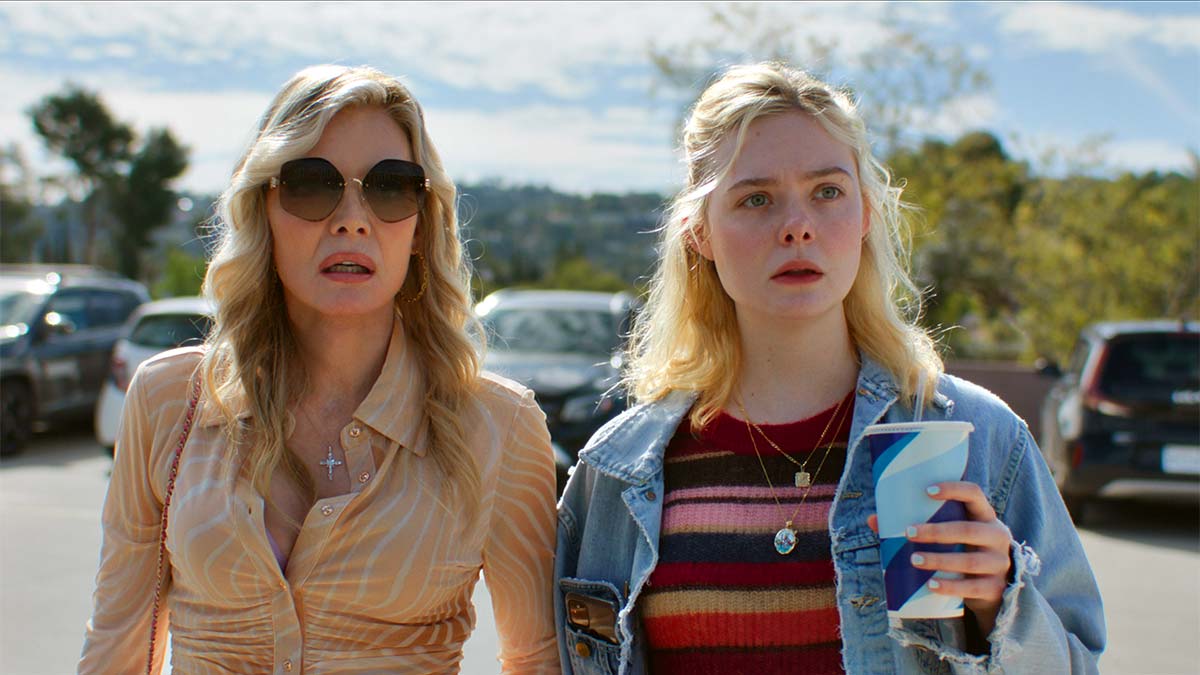
“Margo’s Got Money Troubles” has the kind of premise that, on paper, reads like Reddit mad libs gone rogue. A broke college dropout gets pregnant by her writing professor, has the baby, starts an OnlyFans account to stay afloat, and winds up using the showmanship lessons of her estranged ex-pro wrestler father to build an online persona. Add an ex-Hooters waitress mother, a custody fight tinged with class contempt, and the glossy, high-wire sensibility of David E. Kelley, the man who has spent years proving he can turn tricky, heightened material into sleek, compulsively watchable television, and the whole thing sounds like it should collapse under the weight of its own competing instincts. Instead, this Apple TV+ series, based on the 2024 novel by Rufi Thorpe, pulls off something trickier than provocation or satire. It finds a humane, lightly bruised rhythm inside material that could easily have hardened into gimmick, condescension, or knowing camp.
READ MORE: 15 Must-See April TV Shows: ‘Beef,’ ‘Euphoria,’ ‘Margo’s Got Money Troubles’ and More
That balance is not immediate. The early episodes are a little jumpy as the show tries to hold all of its moving parts in the same frame: internet-age sexual entrepreneurship, single motherhood, family dysfunction, economic panic, and the strange theater of wrestling as both damage and accidental life coaching. The OnlyFans material, the wrestling angle, the family drama, and the class commentary do not click into place right away. At first, the series can feel like it is trying out a few different versions of itself at once. But once it stops leaning so hard on the novelty of its setup, it settles into something much more confident and affecting.

A lot of that comes down to Elle Fanning, who gives the series its center as Margo Millet. Fanning never plays her as a symbol of modern struggle or a tidy piece of internet-age commentary. She portrays her as bright, embarrassed, funny, stressed, adaptable, and often exhausted. Margo is buried under bills, bad choices, and the kind of financial panic that leaves very little room for dignity, but Fanning never lets her become just a victim. She gives her wit, pride, stubbornness, and a believable instinct for survival.
Initially, Fanning does not seem like the most obvious fit for an OnlyFans success story. She has such a wholesome, openhearted screen presence that the idea carries a faint mismatch at first. But she is so endearingly charming and emotionally transparent, without pushing too hard, that she quickly makes the premise work. What seems unlikely at first starts to make sense because she makes Margo’s appeal feel grounded in personality as much as performance. It is one of Fanning’s most mature performances because it feels so natural. She does not oversell the pain or underline the character’s significance. She just makes Margo feel real.
That grounded performance matters because the show is really about performance in more ways than one. Margo turns to OnlyFans because she needs money, but the series is less interested in shock than in the mechanics of self-presentation. How do you sell a version of yourself? How do you turn vulnerability, sex appeal, stress, and personality into something that might pay the rent? “Margo’s Got Money Troubles” is sex-positive without becoming smug about it. It does not flatten Margo’s choices into a neat empowerment story, but it also refuses the usual moral panic. It treats what she is doing as labor, performance, compromise, and survival. That gives the show more honesty than a cheaper version of this material would have had.
The father-daughter dynamic is where the series really shines. Nick Offerman plays Jinx Millet, Margo’s estranged father, a washed-up wrestler with no real stability of his own. Offerman gives him a battered warmth that keeps him from turning into a stock lovable screwup. Jinx is unreliable, broke, and carrying around a lot of failure, but he also has a weirdly useful wisdom. The show uses his wrestling background in a smart way, not just as colorful character detail, but as a way into its larger ideas about persona, audience, and spectacle. Jinx understands how performance works, how identity can be shaped for public consumption, and how you sell a character without disappearing inside it. That knowledge proves unexpectedly useful to Margo, and the connection turns out to be funnier and more emotionally persuasive than it sounds.

Michelle Pfeiffer is also excellent as Shyanne Millet, Margo’s mother, who reacts to her daughter’s OnlyFans turn with some combination of judgment, shame, and denial. Pfeiffer plays her with exactly the right sharpness. Shyanne is hypocritical, but not in a simple way. Her reaction is tangled up with her own past and her own need to draw a moral line that flatters her. The show is good at exposing that contradiction without reducing her to it. The same goes for Margo’s broader family and social world. Michael Angarano plays Mark, the writing professor who gets her pregnant and then mostly leaves her to deal with the fallout, with exactly the weak, slippery energy the role needs. Marcia Gay Harden brings cold entitlement to Elizabeth, Mark’s wealthy mother, while Greg Kinnear’s Kenny adds another layer of respectable judgment. Nicole Kidman’s Lace, a former wrestling buddy turned lawyer, fits neatly into the show’s offbeat emotional world.
That question of who gets to seem respectable is one of the show’s strongest ideas. “Margo’s Got Money Troubles” is not just about sex, money, or family chaos. It is also about class and who gets protected by the language of propriety. Margo and her family are messy, broke, impulsive, and a little tacky by the standards of the more polished people around them, and the series understands how quickly aesthetic judgment can turn into moral judgment. Wealthier people get to hide behind concern, order, and fitness while looking down on a family that wears its instability in public. The custody fight is where that tension lands hardest, and it gives the show some real bite beneath all its warmth.
If the series has a weakness, it is that the tonal mix takes time to settle. Some of the brighter early material can feel a little too eager to show you how unusual the whole thing is. But once the show relaxes, that oddness starts working in its favor. It is unconventional, sometimes messy, and occasionally clumsy in its shifts, but it is also funny, watchable, and much more emotionally sincere than its premise suggests.
That sincerity is what finally makes it work. Underneath the OnlyFans account, the wrestling gimmicks, the family chaos, and the class warfare, “Margo’s Got Money Troubles” is a story about a young woman trying to build a life in circumstances designed to grind her down. The pitch may sound like a dare, but the series keeps finding its way back to something real. That bruised warmth, more than any of its quirks, is what gives this oddball dramedy its pulse. [B+]

