


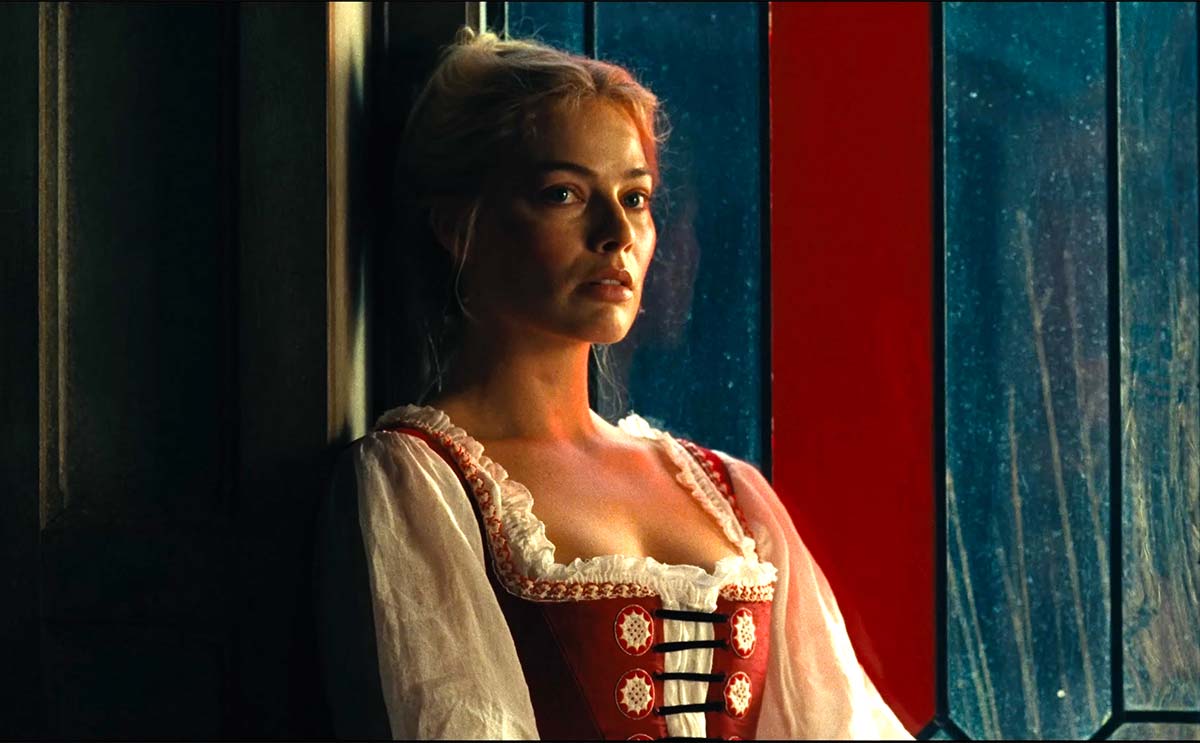
The recurring knock on filmmaker Emerald Fennell (“Saltburn,” “Promising Young Woman”), in some circles at least, is that she is all vibes: a stylist with a mean streak and no substance, an empty shit-poster guilty of confrontational rage bait. Naturally, reactions to her jagged work can bristle, but the critique’s subtext often reads like skepticism toward her cinematic sincerity, a distaste that sits in the back of the throat for anything that feels like superficial incitement. And if that’s the case, well, her latest effort—the bold, audacious, purposefully full-throated “Wuthering Heights”—plays overwhelmingly sincere, all vibes in the best way possible, and when provocative, earnest in its intent to conjure a deep sense of longing, erotic desire, and desperate aching of the heart. If it’s pornographically opulent, bricked up, and erogenous, chalk that up in the win column.
READ MORE: The 150 Most Anticipated Films Of 2026
“Wuthering Heights” doesn’t play like an exercise in empty antagonism. Beyond betting loudly on sincerity, it goes whole hog on need as a physical condition, on appetite as something that can feel holy and ugly at the same time. Fennell doesn’t sand off the story’s harshness or its sweat. She stages it as an overheated romantic epic where emotional harm becomes its own language; the damage keeps resurfacing because these people don’t know how to live without it. And yes, the steamy affair is unabashedly horny.
Moreover, in the tradition of recent efforts by Ryan Coogler, Paul Thomas Anderson, and Josh Safdie, Fennell’s wind-lashed grandeur feels like an ambitious, grand event worthy of IMAX and big-screen presentation: lush scale, often over-the-top sensation, and radiant passion with no expense spared. Even when it’s deliberately excnessive, it feels purposeful—romance at maximum volume, melodrama turned operatic, the kind of sweeping adult spectacle studios keep insisting they want to make while rarely committing the resources to do it properly. In that regard, it also feels like a product of Warner Bros. executives Mike DeLuca and Pam Abdy’s agenda: continuing to bankroll filmmaker-driven swings willing to alienate as many people as they seduce.
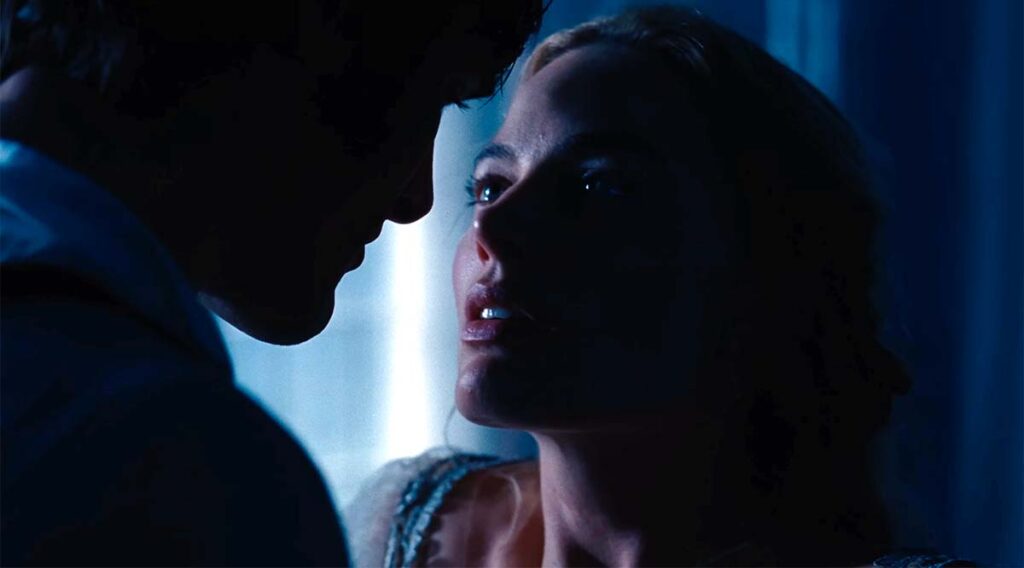
Results will vary re: the casting controversy—the characters are teens in the book, Heathcliff is described as “dark-skinned,” and the film is already being charged with whitewashing. But on its own terms, Fennell’s film still lands its central scar: Heathcliff is treated as disposable, and he grows into a man who refuses to be ignored again, weaponizing power because it’s the only thing that ever made anyone look twice.
Fennell keeps the narrative’s spine, but she doesn’t linger on plot mechanics. A ruined household, a feral bond, a “sensible” match that reads like survival, then a return that re-ignites everything in the most toxic way imaginable. Essentially, if you’ve come to experience an intense Gothic tale of destructive love, revenge, and fixation on the Yorkshire moors—with raw emotional intensity and desolate atmosphere following the lives of two turbulent families—you’ve come to the right place. If you’re looking for that racial texture, you might want to revisit Andrea Arnold’s 2011 version, which is arguably more faithful, but honestly nowhere near as sharp, arousing, or compellingly watchable.
For the uninitiated, “Wuthering Heights” is a bleak romance rooted in class and obsession, set on the wind-scoured Yorkshire moors. At its center is the Earnshaw household, already sliding toward ruin under a volatile patriarch (Martin Clunes), when a young orphan named Heathcliff is taken in and quickly relegated to the margins. The only kindness he receives comes from the family’s daughter, Cathy, and the bond that forms between them—intense, insular, emotionally feral—becomes the story’s gravitational force. As they grow up inside the same collapsing world, affection hardens into something more dangerous, shaped as much by deprivation and resentment as by love.
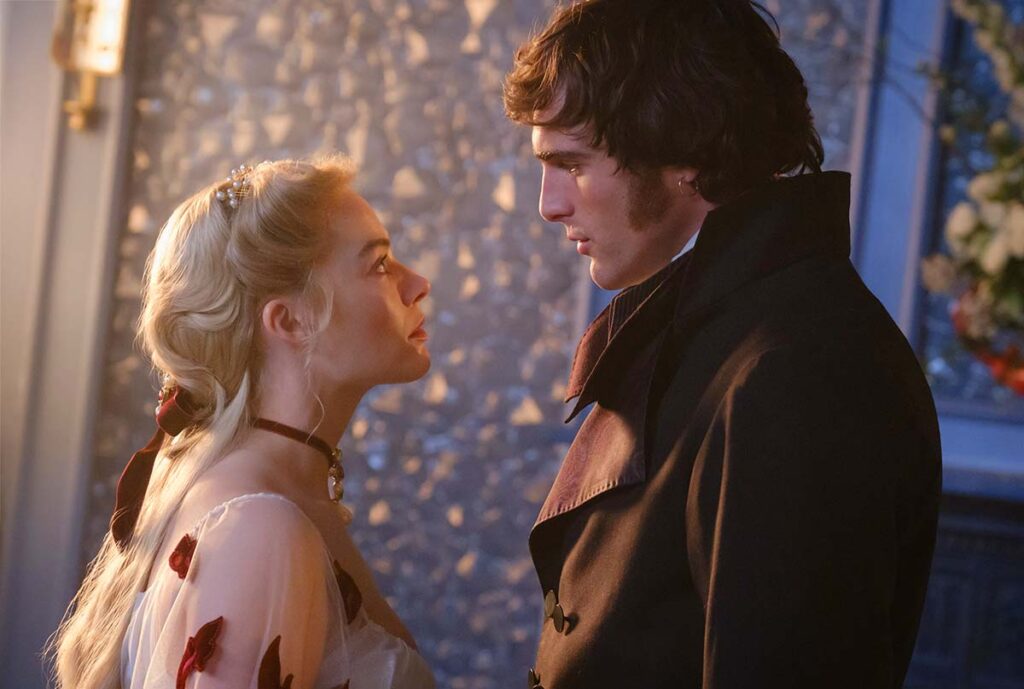
Years later, that bond curdles under social pressure. Cathy (Margot Robbie), pushed toward security and status, chooses a wealthy suitor and the life that comes with him, while Heathcliff (Jacob Elordi), feeling scorned and betrayed, disappears—only to return transformed, newly powerful, and determined to settle scores. What follows isn’t a clean romantic triangle but a sustained cycle of vengeance and reprisal, as love becomes inseparable from punishment and desire is expressed through control and domination. The story moves inexorably toward tragedy, not because the characters don’t understand what they want, but because they do—and can’t stop themselves from destroying everything around them in pursuit of it.
This is where the central performances do the heavy lifting. Robbie plays Cathy as someone split down the middle: hungry for safety, addicted to heat, furious at herself for needing what she needs. There’s a physicality to her choices—flush, breath, posture, the way she seems to vibrate when she’s cornered by her own hunger—that makes the character’s contradictions feel embodied rather than merely “dramatic.” Across from her, Elordi gives Heathcliff a blunt, intimidating gravity: a man whose tenderness has been trained to hide behind control, and whose control is always one breath away from violence. Their chemistry isn’t romantic fantasy; it’s fixation—two people who recognize each other as both salvation and ruin.
The film’s most audacious formal move is its embrace of anachronism, especially in the music. Fennell doesn’t treat period trappings as a museum exhibit; she uses them as a frame for something that’s meant to throb. Alongside Anthony Willis’ score, Charli XCX songs crash into the film like an exposed nerve, giving the ache a modern pulse and the melodrama a heavenly bite. Forget cute needle-drop gimmickry. These swells—‘80s-coded, Kate Bush-adjacent, and charged with supersonic thirst—work as an accelerant, insisting these feelings aren’t quaint, that this isn’t “classic literature” preserved in amber, that the craving is still messy and immediate.
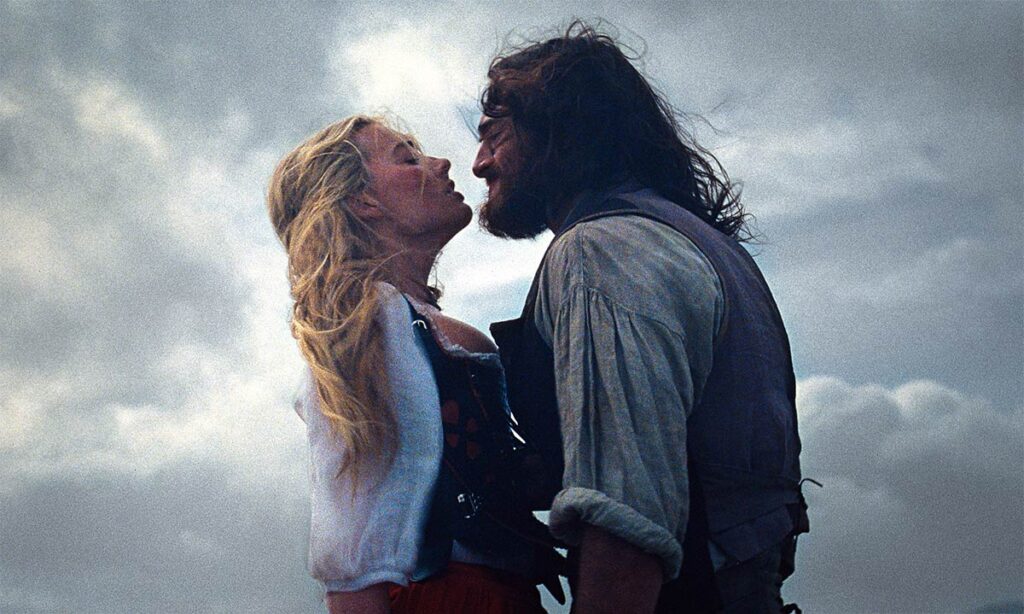
And yes, there are a few outrageous moments—Elordi licking the walls, the overtly sensual egg-squeezing—that push into the absurd and will elicit laughs of wicked delight. They’re brazen little flourishes, but they’re also pure Fennell: tactile, confrontational, and unafraid to let the body do the talking.
The craftsmanship matches the ambition. The cinematography—shot by the film’s director of photography (Oscar winner Linus Sandgren)—is gorgeous, and the production design and costuming lean into a porcelain elegance that looks one bad decision away from shattering. The movie’s erotic charge isn’t just bodies in proximity; it’s the atmosphere of a world where want is treated as a threat and therefore becomes irresistible. Fennell’s direction keeps pushing toward extremity—not because she’s pursuing scandal, but because she’s chasing the point where passion stops being poetic and starts being frightening.
The drawbacks sit mostly in the margins. Shazad Latif’s Edgar is written and played as such an ineffectual wet sop that he can begin to feel like a narrative function rather than a person, and Alison Oliver sometimes tips into a slightly cartoonish register that doesn’t always harmonize with the film’s otherwise committed emotional brutality (and or she’s the comedy relief that’s a little too caricature). Those choices don’t sink the movie, but they do flatten some of the surrounding human landscape when the central relationship is already so consuming.
Even so, “Wuthering Heights” remains an elegant, brutal, lustful gothic romance that refuses tasteful distance. It’s maximal and deliberately anachronistic, a big-screen fever dream of ache and viciousness that treats desire like an injury you keep reopening with your own hands. Fennell leans into excess not as provocation, but as emotional truth, letting obsession swell until it becomes the only language the film speaks. The feeling cuts here not as poetry, but as pressure—barbed wire wrapped tight around a heartbeat. In all its wildness, Fennell seals the film with an embrace and a bruise, then lands the kiss like a sudden dagger to the ribs. [B+]

Rodrigo Perez is the founder and editor-in-chief of The Playlist, which he launched in 2008. He has worked in entertainment journalism since 2000, including at MTV, and has written for SPIN, IndieWire, Pitchfork, Complex, Magnet, and various music, film, and entertainment publications over the past two decades.

